
$10K Strix
Buy Options. Long calls & puts.
$179one-time
- Profit target
- $1,200
- Trailing drawdown
- $600 EOD
- Consistency rule
- None
- Overnight holding
- Allowed
- Strategies
- Long calls & puts
- Funded activation
- $69
Pay one small fee. Pass the evaluation, and you can earn with our money.
Example: Pay $119. Trade a $10,000 account.

Pay once, from $119. One activation fee when you pass. Nothing is taken from your payouts.
No clock, no minimum days. Pass when you are ready.
Long calls and puts on every plan. Spreads, iron condors, 0-DTE and other selling strategies on Strix Pro.
Pass your evaluation, trade with funded capital, and keep 80% of your profits.
Reach $800 profit while staying above the $400 floor. No deadline.
Start trading a funded $10K account on our platform. A $69 activation fee applies.
Keep 80% of the profit. Request a payout after 8 qualifying winning days.
Next: Top traders may be invited to Live, with real firm capital and no payout caps.
Example based on the $10K Express plan.
One evaluation, one fee. Pass it and you trade our capital. Strix Pro adds option selling.
All prices are one-time. Full rules for every phase are on the Rules page.
Paid in the last 7 days · live from the payout wall, surnames covered, tap a certificate
Strix is amazing. They have fast payouts and easy to meet goals. I couldn’t ask for a better options trading prop firm. Keep up the great work!
Finally, a prop firm that allows overnight holding. Perfect for Options swing traders.
Easy to follow rules with a clear target. No hidden rules. The brokerage is user friendly and can be piloted easily. Highly recommended!

Every Strix account runs on RixTrade, our trading platform. Options chains, multi-leg tickets and fills under 10 ms. Your rules, balance and drawdown floor sit on one dashboard, with the same numbers the rules page shows.
Learn the rules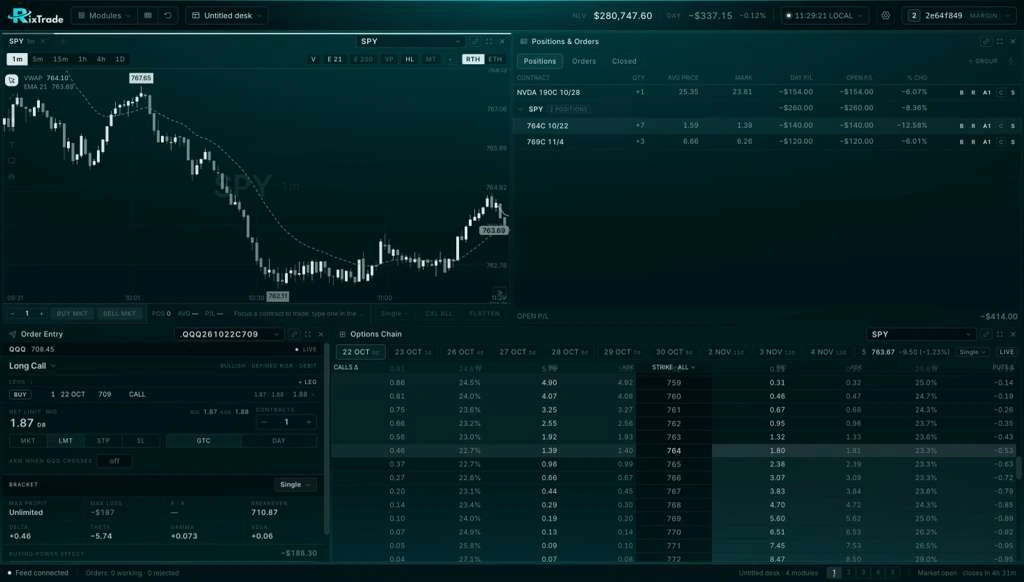
Strix gives options traders more flexibility, fewer restrictions, and faster access to payouts.
| Common concerns | Most prop firms | Strix |
|---|---|---|
| Is there a deadline to pass? | Often a 30-day deadline | No deadline, no minimum days. Never expires! |
| Can a lucky day pass me? | No: a day may not be more than 30% of your profit | Yes. No cap on your best day, in any phase (no consistency rule). |
| What do I pay? | A fee, then monthly bills until you pass | One-time fee. Nothing monthly or recurring. |
| Can I hold overnight? | Mostly not, you must be flat by the close | Yes, every plan, every phase, weekends too! |
| What if I breach? | Buy a new evaluation | Get reset at 10% lower than you paid |
| How do payouts work? | Monthly, capped, often one payout a month | After 8 winning days, caps that grow, no cap at Live |
| Can I trust the rules? | Often change, may be surprised after you buy! | Published before you buy. Same numbers as your dashboard |
| Can I sell options as well? | Mostly buy only | Yes, buy and sell on Strix Pro! |
You pay one fee to pass an evaluation on a simulated account. Once you pass, you trade our capital in a funded account and keep 80% of the profit. We are not a brokerage and do not hold customer funds.
The accounts are simulated; the payouts are real money, posted on our wall with the certificate.
One evaluation fee, from $119. Strix and Express add one activation fee when you pass ($69 to $149); Strix Pro has none. No monthly billing, nothing taken from payouts.
In the evaluation: one reset at 10% less than you paid, from your dashboard. No deadline on the evaluation itself.
Keep 80%. Request a payout after 8 qualifying winning days; caps grow with every payout, no cap at Live.
The top of the program: real firm capital at a real brokerage, by invitation only, on $25K accounts and above, with no payout caps.
Got more questions? Read the full FAQ

Pass one evaluation, trade our capital, keep 80%. Full rules for every phase are published before you buy.
Every rule and exactly what it takes to get paid. Same numbers as your dashboard.
The short version is below; the rulebook and the definitions follow further down.
These are the rules for new purchases. Existing accounts keep their purchased rules, shown in your dashboard.
One target. Zero deadlines.
Trade well and hit the profit target, and your account moves up to Funded. There is no deadline or countdown. The drawdown floor trails upward behind your equity peak. If you fail and touch the floor, the account closes. Strix and Strix Pro floorsStrix floors recalculate once a day at the close. Express floors follow your peak in real time.
Fail once? You can buy one reset of the same evaluation for 10% less than you paid and start over with the full balance.
| Plan | $10K | $25K | $50K | $100K |
|---|---|---|---|---|
| Strix profit target (12%) | $1,200 | $3,000 | $6,000 | $12,000 |
| Strix trailing drawdown (6%, end of day) | $600 | $1,500 | $3,000 | $6,000 |
| Express profit target (8%) | $800 | $2,000 | $4,000 | $8,000 |
| Express trailing drawdown (4%, intraday) | $400 | $1,000 | $2,000 | $4,000 |
| Strix Pro profit target (12%) | $1,200 | $3,000 | $6,000 | $12,000 |
| Strix Pro trailing drawdown (6%, end of day) | $600 | $1,500 | $3,000 | $6,000 |
| Deadline | None | None | None | None |
| Consistency rule | None | None | None | None |
| Reset | One per evaluation, at 10% less than you paid, back to the starting balance | |||
Follow the rules. Bank payouts.
Activating the funded account resets the trailing drawdown. The floor keeps trailing your peak until it reaches your starting balance, then it locks there for good. You keep 80% of the profit. Each payout cycle needs 8 qualifying winning days (days that close with realized profit at or above your plan's floor; they need not be in a row), and one payout can take up to 50% of your profit, limited by the cap for that payout number.
| Plan | $10K | $25K | $50K | $100K |
|---|---|---|---|---|
| Profit share | 80 / 20 | 80 / 20 | 80 / 20 | 80 / 20 |
| Trailing drawdown (6%, end of day) | $600 | $1,500 | $3,000 | $6,000 |
| Funded activation fee | $69 | $89 | $119 | $149 |
| Payout minimum | $250 | $500 | $1,000 | $2,000 |
| Winning days per payout | 8 | 8 | 8 | 8 |
| Qualifying day (realized) | $100+ | $100+ | $150+ | $200+ |
| Payout #1 cap | $1,000 | $1,000 | $1,000 | $2,000 |
| Payout #2 cap | $1,500 | $1,500 | $1,500 | $3,000 |
| Payout #3 cap | $2,000 | $2,000 | $2,000 | $4,000 |
| Payout #4 cap | $2,500 | $3,000 | $3,000 | $6,000 |
| Max per payout | 50% of profits | 50% of profits | 50% of profits | 50% of profits |
| Drawdown locks at | $10,000 | $25,000 | $50,000 | $100,000 |
| Plan | $10K | $25K | $50K | $100K |
|---|---|---|---|---|
| Profit share | 80 / 20 | 80 / 20 | 80 / 20 | 80 / 20 |
| Trailing drawdown (4%, intraday) | $400 | $1,000 | $2,000 | $4,000 |
| Funded activation fee | $69 | $89 | $119 | $149 |
| Payout minimum | $250 | $500 | $1,000 | $2,000 |
| Winning days per payout | 8 | 8 | 8 | 8 |
| Qualifying day (realized) | $100+ | $100+ | $150+ | $200+ |
| Payout #1 cap | $1,000 | $1,000 | $1,000 | $2,000 |
| Payout #2 cap | $1,000 | $1,000 | $1,500 | $3,000 |
| Payout #3 cap | $1,500 | $1,500 | $2,000 | $4,000 |
| Payout #4 cap | $2,000 | $2,500 | $5,000 | $10,000 |
| Max per payout | 50% of profits | 50% of profits | 50% of profits | 50% of profits |
| Drawdown locks at | $10,000 | $25,000 | $50,000 | $100,000 |
| Plan | $10K | $25K | $50K | $100K |
|---|---|---|---|---|
| Profit share | 80 / 20 | 80 / 20 | 80 / 20 | 80 / 20 |
| Trailing drawdown (6%, end of day) | $600 | $1,500 | $3,000 | $6,000 |
| Funded activation fee | $0 | $0 | $0 | $0 |
| Payout minimum | $200 | $500 | $1,000 | $2,000 |
| Winning days per payout | 8 | 8 | 8 | 8 |
| Qualifying day (realized) | $100+ | $100+ | $150+ | $200+ |
| Payout #1 cap | $200 | $500 | $1,000 | $2,000 |
| Payout #2 cap | $300 | $750 | $1,500 | $3,000 |
| Payout #3 cap | $400 | $1,000 | $2,000 | $4,000 |
| Payout #4 cap | $600 | $1,500 | $3,000 | $6,000 |
| Max per payout | 50% of profits | 50% of profits | 50% of profits | 50% of profits |
| Drawdown locks at | $10,000 | $25,000 | $50,000 | $100,000 |
A breach in Funded closes the account for good; only evaluations can be reset. Strix Pro only: before each funded payout, new net profit must reach 15% of your largest assessed risk in that cycle (see the full rules).
Existing accounts keep their purchased rules, shown in your dashboard.
Firm capital. Withdraw it all.
Real firm buying power sits behind your trades. The 80/20 split continues; withdrawals have no caps and a $100 minimum; there is no winning-day requirement and no recurring fee. At Live, asking for a payout raises your floor to your allocated capital. Before that, the floor trails your peak. Either way it locks for good at the figure below once a trading day closes with your total profit at or above the lock threshold, your plan's maximum drawdown, and your equity at least $200 above your allocated capital.
| Plan | $25K | $50K | $100K |
|---|---|---|---|
| Live capital | $12,500 | $25,000 | $50,000 |
| Trailing drawdown (end of day) | $2,000 | $2,500 | $5,000 |
| Floor locks at | $12,600 | $25,100 | $50,100 |
| Withdrawals | 100% of profits, no cap | 100% of profits, no cap | 100% of profits, no cap |
| Payout minimum | $100 | $100 | $100 |
Live is not offered on $10K accounts. Live is by invitation only, and traders cannot apply; the complete rulebook is the Live Program Rules and the Live Trader Agreement.
These hold across every account size and phase.
Every account in every phase can hold positions overnight and over the weekend. On Evaluation and Funded accounts, the only forced close is a position expiring that day. A Live account has its own closing rules: if what you carry overnight could lose more than 70% of the drawdown you have left, it is closed in full before its market closes, as the Live Program Rules set out.
Strix $179 / $299 / $419 / $569. Express $119 / $179 / $229 / $339. Strix Pro $198 / $398 / $798 / $1,598. One payment, no renewal, and the evaluation never expires. Discount codes apply to every plan.
Strix and Express: one fee when you activate after passing, $69 (10K), $89 (25K), $119 (50K), $149 (100K). Charged upfront, never taken from a payout. Strix Pro: none, and no funded subscription on any plan.No plan has a funded subscription.
Strix and Express: single-leg long calls and puts; you may sell to close what you own. Strix Pro: buying plus supported finite-loss selling, spreads included; a short call with unlimited loss needs a hedge.The Strix Plan carries Level 5 options approval: undefined risk is allowed, and you can build spreads and multi leg structures, from verticals and butterflies to iron condors, calendars, diagonals, and beyond. The Express Plan trades long premium only: single leg calls and puts, bought to open.
Options trade only on approved symbols; any other order is blocked. See the approved ticker whitelist ( symbols) or e-mail support to request one.
One paid reset per evaluation, at 10% less than you paid, back to the full starting balance. Funded accounts cannot be reset. Giveaway, prize and demo accounts cannot be reset.
After your first payout, your balance at request time must be at least $1 above the balance of your last request, less anything the cap held back. The same profit never funds two payouts.
A position expiring that day is closed automatically on its expiry day. On Strix Pro, standard instrument hours, 0-DTE cut-offs and settlement rules also apply.
Nothing caps how much of your profit comes from one day, in the evaluation or when funded. One strong day can take you to the target.
Every rule and every number, for all twelveeight plans, in one place. Each block opens on click. Where this page and the Terms of Service differ, the Terms apply.
You pass when your balance reaches the profit target. There is no deadline and no minimum number of trading days.
The drawdown floor sits a fixed amount below your highest account value and moves up as it rises; it never moves down. If your account value touches the floor, the account closes. On Strix and Strix ProStrix the floor moves up once a day, at the close; on Express it moves up in real time. On every plan a breach counts the moment it happens, at any time of day.
No consistency rule: nothing caps how much of your profit comes from a single day.
| Metric | Strix 100K | Strix 50K | Strix 25K | Strix 10K | Express 100K | Express 50K | Express 25K | Express 10K | Strix Pro 100K | Strix Pro 50K | Strix Pro 25K | Strix Pro 10K |
|---|---|---|---|---|---|---|---|---|---|---|---|---|
| Profit target | 12% ($12,000) | 12% ($6,000) | 12% ($3,000) | 12% ($1,200) | 8% ($8,000) | 8% ($4,000) | 8% ($2,000) | 8% ($800) | 12% ($12,000) | 12% ($6,000) | 12% ($3,000) | 12% ($1,200) |
| Deadline | None | None | None | None | None | None | None | None | None | None | None | None |
The drawdown floor trails upward behind your equity peak. Touch the floor and the account is closed.
Strix and Strix Pro floorsStrix Plan floors recalculate once per day at the close (End of Day). Express Plan floors follow your peak in real time (Intraday).
End of Day versus Intraday only controls how often the floor moves UP behind a new peak. On every plan the floor itself is watched in real time through the session, so a breach is recorded the moment your equity crosses it, intraday, not only at the close.
| Metric | Strix 100K | Strix 50K | Strix 25K | Strix 10K | Express 100K | Express 50K | Express 25K | Express 10K | Strix Pro 100K | Strix Pro 50K | Strix Pro 25K | Strix Pro 10K |
|---|---|---|---|---|---|---|---|---|---|---|---|---|
| Trailing drawdown | 6% ($6,000) | 6% ($3,000) | 6% ($1,500) | 6% ($600) | 4% ($4,000) | 4% ($2,000) | 4% ($1,000) | 4% ($400) | 6% ($6,000) | 6% ($3,000) | 6% ($1,500) | 6% ($600) |
| Floor update | End of Day | End of Day | End of Day | End of Day | Intraday | Intraday | Intraday | Intraday | End of Day | End of Day | End of Day | End of Day |
If you breach during the evaluation, you can buy one reset from your dashboard: the same evaluation starts again with the full starting balance, the floor back on day one, and every other rule unchanged. A reset is a separate one-time charge, has no deadline, and starts no recurring billing.
Price: 10% less than you paid for that evaluation. An older evaluation that is still charged a current price is priced at 10% less than that current price. If a code made the evaluation free, the reset is priced from today's list price with a discount 10 points deeper than any sale running that day.
One paid reset per evaluation; once used, no second one. Giveaway, prize and demo accounts (including evaluations won with a reward code) cannot be reset. A free reset, where your account shows one, is separate from the paid reset.
One reset can be bought for each evaluation while the purchase behind it stays active. Unless a free reset is available on that account, a new evaluation is the way to keep trading.
| Metric | Strix 100K | Strix 50K | Strix 25K | Strix 10K | Express 100K | Express 50K | Express 25K | Express 10K | Strix Pro 100K | Strix Pro 50K | Strix Pro 25K | Strix Pro 10K |
|---|---|---|---|---|---|---|---|---|---|---|---|---|
| Available | Yes | Yes | Yes | Yes | Yes | Yes | Yes | Yes | Yes | Yes | Yes | Yes |
| Cost | 10% off what you paid | 10% off what you paid | 10% off what you paid | 10% off what you paid | 10% off what you paid | 10% off what you paid | 10% off what you paid | 10% off what you paid | 10% off what you paid | 10% off what you paid | 10% off what you paid | 10% off what you paid |
| Resets to | $100,000 | $50,000 | $25,000 | $10,000 | $100,000 | $50,000 | $25,000 | $10,000 | $100,000 | $50,000 | $25,000 | $10,000 |
| Limit | One paid reset per evaluation | One paid reset per evaluation | One paid reset per evaluation | One paid reset per evaluation | One paid reset per evaluation | One paid reset per evaluation | One paid reset per evaluation | One paid reset per evaluation | One paid reset per evaluation | One paid reset per evaluation | One paid reset per evaluation | One paid reset per evaluation |
Activation resets the trailing drawdown. The floor then trails your highest account value, as in the evaluation, until it reaches your starting balance; from then on it stays there for good (the lock).
Touching the floor in Funded closes the account permanently. Funded accounts cannot be reset; a new evaluation is the way back.
No lock applies during Evaluation.
| Metric | Strix 100K | Strix 50K | Strix 25K | Strix 10K | Express 100K | Express 50K | Express 25K | Express 10K | Strix Pro 100K | Strix Pro 50K | Strix Pro 25K | Strix Pro 10K |
|---|---|---|---|---|---|---|---|---|---|---|---|---|
| Trailing drawdown | 6% ($6,000) | 6% ($3,000) | 6% ($1,500) | 6% ($600) | 4% ($4,000) | 4% ($2,000) | 4% ($1,000) | 4% ($400) | 6% ($6,000) | 6% ($3,000) | 6% ($1,500) | 6% ($600) |
| Floor update | End of Day | End of Day | End of Day | End of Day | Intraday | Intraday | Intraday | Intraday | End of Day | End of Day | End of Day | End of Day |
| Locks at | $100,000 | $50,000 | $25,000 | $10,000 | $100,000 | $50,000 | $25,000 | $10,000 | $100,000 | $50,000 | $25,000 | $10,000 |
Split. 80% of the profit is yours, 20% stays with the firm. Nothing is deducted from a payout: the activation fee on Strix and Express is paid upfront, once.
Size. One payout can take up to 50% of your profit, and no more than the cap for that payout number (first, second, third, fourth and later), listed below. The payout minimum is the smallest amount you can request.
Winning days. Before each request, the current cycle must contain 8 qualifying winning days: days that close with realized profit at or above your plan's floor ($100 on a $10K or $25K account, $150 on a $50K, $200 on a $100K). Open positions do not count. The days need not be consecutive; a losing day, a flat day, a green day under the floor or a day off never takes a day back.
When a new cycle starts. Strix and Express: when a payout is paid or rejected; the next cycle starts at zero from the moment of that request. Strix Pro: only when a payout is paid; a pending, rejected or cancelled Pro request keeps your progress. On every plan, withdrawing a request yourself changes nothing.
Consistency. No Funded Consistency rule. Nothing caps a single day's share of a payout cycle, and you are never asked to spread a cycle's gains a particular way. What a cycle has to contain instead is 8 qualifying winning days, set out above. Once your account is funded, your Payouts page lists the requirement your own account is measured against, and that is the one we hold you to.
Balance rule. After your first payout, your balance at the next request must be at least $1 above the balance of your last request, less any amount the cap held back then (up to the size of that payout). The same profit never funds two payouts.
Example: you request payout one at a balance of $52,000 and the cap does not limit it, so your next request needs a balance of $52,001 or above. Where the cap did hold money back, that amount comes off the bar, up to the size of the payout itself. You are never asked to re-earn what the cap refused to pay you, and the same profit never funds two payouts.
| Metric | Strix 100K | Strix 50K | Strix 25K | Strix 10K | Express 100K | Express 50K | Express 25K | Express 10K | Strix Pro 100K | Strix Pro 50K | Strix Pro 25K | Strix Pro 10K |
|---|---|---|---|---|---|---|---|---|---|---|---|---|
| Profit share | 80 / 20 | 80 / 20 | 80 / 20 | 80 / 20 | 80 / 20 | 80 / 20 | 80 / 20 | 80 / 20 | 80 / 20 | 80 / 20 | 80 / 20 | 80 / 20 |
| Max per payout | 50% of profits | 50% of profits | 50% of profits | 50% of profits | 50% of profits | 50% of profits | 50% of profits | 50% of profits | 50% of profits | 50% of profits | 50% of profits | 50% of profits |
| Payout minimum | $2,000 | $1,000 | $500 | $250 | $2,000 | $1,000 | $500 | $250 | $2,000 | $1,000 | $500 | $200 |
| Winning days per payout | 8 required | 8 required | 8 required | 8 required | 8 required | 8 required | 8 required | 8 required | 8 required | 8 required | 8 required | 8 required |
| Qualifying day | $200+ | $150+ | $100+ | $100+ | $200+ | $150+ | $100+ | $100+ | $200+ | $150+ | $100+ | $100+ |
| Payout #1 cap | $2,000 | $1,000 | $1,000 | $1,000 | $2,000 | $1,000 | $1,000 | $1,000 | $2,000 | $1,000 | $500 | $200 |
| Payout #2 cap | $3,000 | $1,500 | $1,500 | $1,500 | $3,000 | $1,500 | $1,000 | $1,000 | $3,000 | $1,500 | $750 | $300 |
| Payout #3 cap | $4,000 | $2,000 | $2,000 | $2,000 | $4,000 | $2,000 | $1,500 | $1,500 | $4,000 | $2,000 | $1,000 | $400 |
| Payout #4 cap | $6,000 | $3,000 | $3,000 | $2,500 | $10,000 | $5,000 | $2,500 | $2,000 | $6,000 | $3,000 | $1,500 | $600 |
| Funded activation fee | $149 | $119 | $89 | $69 | $149 | $119 | $89 | $69 | $0 | $0 | $0 | $0 |
Before each Pro payout, the new net trading profit of the cycle must be at least 15% of the cycle's peak assessed risk. It qualifies the request; it deducts nothing and does not change the 80% share. It does not apply to passing the evaluation.
Peak assessed risk is the largest maximum loss your open positions could have had at one time in the cycle, valued at the prices you paid and received, entry fees included. Supported hedges are recognised. Repeating a trade of the same size does not add its risk twice, and closing a position does not erase the peak already recorded.
Net profit is trading profit after fees and losses. Deposits and payout debits are not profit or loss. Example: $20,000 of peak risk needs $3,000 of new net profit.
Cycles. The first cycle starts at activation. A paid payout starts the next cycle at the moment of its request, carried positions included; a pending, rejected or cancelled request does not. All other payout rules (minimum, caps, 8 winning days, balance rule, drawdown) still apply; meeting this check makes a request eligible, it does not fix the amount or promise Live.
There is no additional fixed fresh-profit minimum each cycle. The ordinary 50% cash-above-original-starting-balance withdrawal pool still includes retained profit.
| Metric | Strix 100K | Strix 50K | Strix 25K | Strix 10K | Express 100K | Express 50K | Express 25K | Express 10K | Strix Pro 100K | Strix Pro 50K | Strix Pro 25K | Strix Pro 10K |
|---|---|---|---|---|---|---|---|---|---|---|---|---|
| Required net return | Not applied | Not applied | Not applied | Not applied | Not applied | Not applied | Not applied | Not applied | 15% of peak assessed risk | 15% of peak assessed risk | 15% of peak assessed risk | 15% of peak assessed risk |
| Cycle reset | Not applied | Not applied | Not applied | Not applied | Not applied | Not applied | Not applied | Not applied | Paid payouts only | Paid payouts only | Paid payouts only | Paid payouts only |
Live is the top of the program, by invitation only, on $25K accounts and above. Real firm buying power sits behind your trades. The 80/20 split continues; withdrawals have no cap, a $100 minimum and no winning-day requirement; there are no recurring fees.
At Live, asking for a payout raises your floor to your allocated capital. Before that, the floor trails your peak. Either way it locks for good at the figure below once a trading day closes with your total profit at or above the lock threshold, your plan's maximum drawdown, and your equity at least $200 above your allocated capital. Each payout must leave at least $100 of account value (equity) above the floor.
| Metric | Strix 100K | Strix 50K | Strix 25K | Strix 10K | Express 100K | Express 50K | Express 25K | Express 10K | Strix Pro 100K | Strix Pro 50K | Strix Pro 25K | Strix Pro 10K |
|---|---|---|---|---|---|---|---|---|---|---|---|---|
| Capital | $50,000 | $25,000 | $12,500 | Not offered | $50,000 | $25,000 | $12,500 | Not offered | $50,000 | $25,000 | $12,500 | Not offered |
| Trailing drawdown | $5,000 | $2,500 | $2,000 | Not offered | $5,000 | $2,500 | $2,000 | Not offered | $5,000 | $2,500 | $2,000 | Not offered |
| Floor update | End of Day | End of Day | End of Day | End of Day | End of Day | End of Day | End of Day | End of Day | End of Day | End of Day | End of Day | End of Day |
| Floor locks at | $50,100 | $25,100 | $12,600 | Not offered | $50,100 | $25,100 | $12,600 | Not offered | $50,100 | $25,100 | $12,600 | Not offered |
| Profit share | 80 / 20 | 80 / 20 | 80 / 20 | 80 / 20 | 80 / 20 | 80 / 20 | 80 / 20 | 80 / 20 | 80 / 20 | 80 / 20 | 80 / 20 | 80 / 20 |
| Withdrawal scope | 100% of profits | 100% of profits | 100% of profits | 100% of profits | 100% of profits | 100% of profits | 100% of profits | 100% of profits | 100% of profits | 100% of profits | 100% of profits | 100% of profits |
| Payout minimum | $100 | $100 | $100 | $100 | $100 | $100 | $100 | $100 | $100 | $100 | $100 | $100 |
| Recurring fees | None | None | None | None | None | None | None | None | None | None | None | None |
The complete Live rulebook: Live Program Rules and Live Trader Agreement.
Evaluation fee. One payment per evaluation, no renewal; the evaluation never expires. Eligible discount codes apply to every plan. (If your Billing page shows a monthly amount, you are on an older monthly plan: it renews until you cancel it, which you can do there at any time.)
Activation fee. Strix and Express: one payment when you activate a passed account, charged upfront, non-refundable, and the only charge between passing and trading funded. Strix Pro: none. No plan has a funded subscription.
| Metric | Strix 100K | Strix 50K | Strix 25K | Strix 10K | Express 100K | Express 50K | Express 25K | Express 10K | Strix Pro 100K | Strix Pro 50K | Strix Pro 25K | Strix Pro 10K |
|---|---|---|---|---|---|---|---|---|---|---|---|---|
| Evaluation fee (list) | $569 | $419 | $299 | $179 | $339 | $229 | $179 | $119 | $1,598 | $798 | $398 | $198 |
| Funded activation fee | $149 | $119 | $89 | $69 | $149 | $119 | $89 | $69 | $0 | $0 | $0 | $0 |
| Monthly fees | None | None | None | None | None | None | None | None | None | None | None | None |
Strategies. Strix and Express: single-leg long calls and long puts; you may sell to close what you own. Any opening short leg, including one inside a debit spread, needs Strix Pro. Strix Pro: buying plus supported finite-loss selling, credit and debit spreads included, within buying power and the drawdown rules. A short call with unlimited loss needs a hedge on the same option root and expiry; different roots and expiries are assessed separately. A stop order does not reduce the assessed maximum loss. Accounts bought earlier keep the strategy permissions they were sold.The Strix Plan carries Level 5 options approval: undefined risk is allowed, and you can build spreads and multi leg structures, from verticals and butterflies to iron condors, calendars, diagonals, and beyond. The Express Plan trades long premium only: single leg calls and puts, bought to open.
| Metric | Strix 100K | Strix 50K | Strix 25K | Strix 10K | Express 100K | Express 50K | Express 25K | Express 10K | Strix Pro 100K | Strix Pro 50K | Strix Pro 25K | Strix Pro 10K |
|---|---|---|---|---|---|---|---|---|---|---|---|---|
| Permitted strategies | Long only | Long only | Long only | Long only | Long only | Long only | Long only | Long only | Buy & sell | Buy & sell | Buy & sell | Buy & sell |
Approved tickers. Only symbols on the whitelist can be traded; any other order is blocked. E-mail support@strixoptionsfunding.com to request a symbol.
Overnight holding. Every account in every phase may hold positions overnight and over the weekend.
Expiring positions. A position expiring that day is closed automatically on its expiry day. On Strix Pro, standard instrument hours, 0-DTE cut-offs and settlement rules also apply. Pro adds no earlier expiry cutoff. Use each instrument’s actual trading and settlement schedule, including early closes. Existing accounts retain their purchased terms. Missing executable quotes follow the standard settlement rules; the platform does not invent an execution price.Any position still open at 4pm on its expiration day is closed automatically at that time. The auto close keeps surprise assignment off your account and keeps every account inside the rules.
Accounts bought earlier keep the rules they were sold; your dashboard shows which rules apply to you.
The words the rules use, in plain language. Each one links to the rule it belongs to in your head: read these first if you are new to prop firms.
The test you buy. You trade a simulated account and try to reach the profit target without touching the drawdown floor. It has no deadline and no minimum number of days.
The stage after you pass. Still a simulated account, but your profit is real: you keep 80% of it through payouts. Strix and Express charge one activation fee to open it; Strix Pro does not.
The top stage, by invitation only, on $25K accounts and above. Real firm capital at a real brokerage, no payout caps, a $100 minimum per withdrawal.
The profit you must reach to pass the evaluation: 12% of the account size on Strix and Strix Pro, 8% on Express. $1,200 on a $10K Strix, for example.
The most you may lose, measured from your highest account value so far (cash plus open trades). That high minus the drawdown amount is your floor. It rises with your account value and never goes down. Touch the floor and the account closes.
How often the floor moves up. Strix and Strix Pro: once a day, at the close. Express: in real time, every time your account value makes a new high. On every plan a breach counts the moment it happens, at any time of day.
In Funded, the floor stops trailing once it reaches your starting balance ($50,000 on a $50K account) and stays there for good. From then on you can never lose more than your profit above that line.
Your account value touches the floor, even for a moment. In the evaluation you can buy one reset; in Funded the account closes for good and a new evaluation is the way back.
A paid second chance in the evaluation: the same account starts again with the full starting balance and the floor back on day one. It costs 10% less than you paid for that evaluation, and you get one per evaluation. Giveaway, prize and demo accounts cannot be reset.
A limit some firms put on how much of your profit may come from one day. Strix has none, in any phase: one big day counts in full.
A trading day that closes with realized profit at or above your plan's floor: $100 on a $10K or $25K account, $150 on a $50K, $200 on a $100K. Open positions do not count until you close them.
The period between two payout requests. A cycle needs 8 qualifying winning days, in any order, before you can request. On Strix and Express a paid or rejected payout starts the next cycle; on Strix Pro only a paid one does. A pending request, or one you withdraw, never ends a cycle.
The most one payout can be, by payout number: your first payout has one cap, your second a higher one, and so on. On top of the cap, one payout can take at most 50% of your profit. Live has no caps.
The smallest payout you can request: $250 on a $10K ($200 on a $10K Strix Pro), $500 on a $25K, $1,000 on a $50K, $2,000 on a $100K. At Live, $100.
After your first payout, your balance at the next request must be at least $1 above the balance you last requested at, less anything the cap held back. It stops the same profit being paid twice.
Profit from positions you have closed. Unrealized profit, on positions still open, does not count toward a qualifying day or a payout.
The single payment for an evaluation. It never renews and the evaluation never expires. Discount codes apply.
One payment, charged upfront when you switch a passed Strix or Express account on ($69 to $149 by account size), never taken from a payout. Strix Pro has none.
Of every payout, 80% is yours and 20% stays with the firm.
Buying an option to open, single leg. Allowed on every plan. You may sell to close what you own.
Opening short legs too: credit and debit spreads, condors, covered selling. Only strategies with a limited maximum loss; a short call with unlimited loss needs a hedge on the same root and expiry.
The largest maximum loss your open positions could have had at one time in a payout cycle, at the prices you paid and received; only supported hedges reduce it. Before each Pro payout, new net profit in the cycle must be at least 15% of this figure.
Options that expire today. A position expiring that day is closed automatically on its expiry day under the instrument's standard rules; everything else can be held overnight and over the weekend.
The symbols you may trade. An order on any other symbol is blocked before it reaches the market.
Every Strix evaluation and funded account trades a simulated market with live prices; no real securities are bought. Payouts are real money. Live is the only stage with real firm capital.
Every payout that is approved and paid is posted here with the trader certificate. Surnames are covered for privacy, nothing else. This wall shows the last 7 days.
The payout wall could not be loaded, so no payouts are shown. Nothing here is out of date: there is simply nothing to show until it loads.
Shows payouts that have been approved and paid over the past 7 days. A payout appears here the moment it is paid, not when it was requested.
| Date / time | Trader | Amount | Country | Account |
|---|
No payouts match that search.
Figures show the net amount actually paid to the trader, after the 80/20 split. Past payouts do not predict future results.
Loading the full history…
Every payout we approve is posted automatically with the certificate attached. Nothing to show just yet, check back shortly.
These are the certificates we issue, exactly as issued. Surnames are covered, nothing else is.
Pass the evaluation, get funded, get paid.
Verified reviews from funded Strix traders on Trustpilot.
No reviews to show just yet. Read Strix reviews on Trustpilot.
The reviews could not be loaded just now. Read them on Trustpilot.
The firm keeps 20%. The activation fee is paid once upfront, so nothing is ever taken from a payout.
A cycle needs 8 days that close with realized profit at or above your plan's floor. Any order; losing or flat days never reset it.
Each payout can draw up to 50% of profits, limited by a cap that rises with every payout. Live accounts have no caps.
| Strix Plan | $10K | $25K | $50K | $100K |
|---|---|---|---|---|
| Payout minimum | $250 | $500 | $1,000 | $2,000 |
| Qualifying day (realized) | $100+ | $100+ | $150+ | $200+ |
| Payout #1 cap | $1,000 | $1,000 | $1,000 | $2,000 |
| Payout #2 cap | $1,500 | $1,500 | $1,500 | $3,000 |
| Payout #3 cap | $2,000 | $2,000 | $2,000 | $4,000 |
| Payout #4 cap (Strix) | $2,500 | $3,000 | $3,000 | $6,000 |
Express and Strix Pro figures are on the Rules page. Figures are gross amounts, before the 80/20 split. Past payouts are not a prediction of future results.
When someone buys an evaluation through your link, that is a paid referral. You earn 25% of what they pay, rising to 45% as your paid referrals grow each month. Free to join, no minimum audience. Reach 15 paid referrals in a month and we add a free Strix $25K evaluation.
The live program figures could not be loaded, so the figures on this page (marked with a dotted line) are the ones last published with it and have not been checked against the live program just now.
Just fill in your name, email and phone. No fee. Most people are approved at once and land in their dashboard with a live link and code.
Your link gives your audience 10 points more off than the site sale: at least 10% off, at most 65%. When Strix runs 45% off, your link is worth 55% off.
You earn 25% (up to 45%) of what each referral pays for their evaluation account. The money is available 14 days after they pay. Payouts start at $100 available, after at least 5 paid referrals.
Free forever. No minimum audience.
Six levels, set by your paid referrals this month. The more you refer, the higher your level and your commission.
| Level | Paid referrals this month | Commission |
|---|---|---|
| Bronze | 1 to 2 | 25% |
| Silver | 3 to 7 | 30% |
| Gold | 8 to 14 | 35% |
| Platinum + free Strix $25K | 15 to 74 | 38% |
| Diamond | 75 to 149 | 40% |
| Obsidian | 150+ | 45% |
Your average commission this month: 32.2% · Level: Platinum · 60 more paid referrals to reach Diamond (40%)
This example assumes every referral buys a Strix $50K at today’s price on your link (10% off, as no site sale is running). Your real earnings depend on what your referrals buy. Nothing is guaranteed.
Your link always gives 10 points more off than the site sale. The table shows prices with no sale running. During a sale your audience saves more.
| Plan | List | On your link (10% off) | They save |
|---|---|---|---|
| Strix $10K | $179.00 | $161.10 | $17.90 |
| Strix $25K | $299.00 | $269.10 | $29.90 |
| Strix $50K | $419.00 | $377.10 | $41.90 |
| Strix $100K | $569.00 | $512.10 | $56.90 |
| Express $10K | $119.00 | $107.10 | $11.90 |
| Express $25K | $179.00 | $161.10 | $17.90 |
| Express $50K | $229.00 | $206.10 | $22.90 |
| Express $100K | $339.00 | $305.10 | $33.90 |
| Strix Pro $10K | $198.00 | $178.20 | $19.80 |
| Strix Pro $25K | $398.00 | $358.20 | $39.80 |
| Strix Pro $50K | $798.00 | $718.20 | $79.80 |
| Strix Pro $100K | $1,598.00 | $1,438.20 | $159.80 |
When no site sale is running, your link takes the 10% off standard prices. Every figure is the one-time evaluation fee, nothing billed after it.
Nothing, and there is no minimum audience. Just fill in your full legal name, email and phone. Most people are approved at once and get a live link and code in their dashboard.
When someone you referred, through your link or code, buys an account, that is a paid referral. Your dashboard shows the count. It sets your level and your bonus (a free Strix $25K account).
Once you have at least 5 paid referrals and $100 in total available, you can request a payout. Each commission becomes available 14 days after that referral pays. You can request again every 14 days. Every payout is reviewed and sent by our team; once sent, it reaches you in 1 to 3 business days.
By referring more. Your level is set by your paid referrals in each month: you start at 25% and reach 30% at 3 and so on (see the table). Every month starts fresh, so a new partner can reach the same levels as anyone. Nobody is sitting on a legacy rate above you.
Yes. From day one your link or code gives 10 points more off than the site sale (a 45% sale becomes 55% on your link), up to 65% off. Nothing to configure, claim or ask for: the discount is worked out fresh at every checkout from the live site sale. When the site sale changes, your discount changes with it, in both directions.
Your link still gives 10% off. That is a floor rather than a promotion, so your audience always saves something, and whenever a site sale is running your link stacks 10% on top of it, up to 65% off.
Yes, whenever they buy another account. An evaluation is a one-time charge, not a subscription, so there are no renewals to earn on, but every new account your referral buys earns your commission; resets and activation fees do not. That is what funds a 25% to 45% rate card instead of the thin slice a lifetime revenue share pays.
A commission already booked is never re-rated, up or down. A refund reverses that one sale and lowers your count for the month it was booked in. Everything else you have earned stays exactly as booked.
No. Your code and link are for referring other people. They cannot be used on your own purchases, and your own purchases do not count toward your paid referrals or payouts.
No company. If you will earn $600 or more in a year, we need a W-9 (the US tax form for individuals) before your first payout. That is why we ask for your legal name at sign-up.
No, purchase or payment are not limited to US residents. Instead of a W-9, non-US partners or affiliates have to fill in a W-8BEN (the form for non-US persons) before their first payout. Payouts are sent in US dollars and follow US sanctions regulations.
What you earn, what changes it, what cancels it, and what ends an account. Click a block to open it.
Your commission is your % of what the customer actually paid, after their discount; your % is set by your level (see below). You earn it on every new account the customer buys. Resets, activation fees and $0 orders earn nothing. Each commission keeps the % it was booked at. Your own link and code do not work on your own purchases, and your own purchases do not count as paid referrals.
Levels count your paid referrals in each calendar month (US Eastern time), starting fresh on the 1st of the month. The new referral that brings you to the next level will be paid at the new %: e.g. your 3rd referral is the first paid at 30%. Earlier referrals keep the % they were booked at, and a commission is never recalculated afterwards.
Once you have at least 5 paid referrals and $100 in total available, you can request a payout. Each commission becomes available 14 days after that referral pays. You can request a payout again every 14 days. Every payout is checked and sent by our team, and the money reaches you 1 to 3 business days after it is sent. If you will earn $600 or more in a year, we need a W-9 (US partners) before your first payout. Non-US partners or affiliates have to fill in a W-8BEN (the form for non-US persons) before their first payout. Payouts are sent in US dollars and follow US sanctions regulations.
The first partner link a visitor clicks is remembered for 30 days and locked to you when they sign up. From then on they stay yours, and you earn when they pay. The exception: if they buy with another partner’s link or code, that partner gets the commission. At checkout, a typed code beats a link.
If a purchase is refunded, or the customer’s bank reverses it (a chargeback), that one commission is cancelled and the amount comes off your next payout. If it is more than your balance, the rest carries over. The cancelled line stays in your dashboard with the reason, and it also lowers your count for that month. No other commission changes.
15 paid referrals in a calendar month earns you one free Strix $25K evaluation, set up in the first days of the next month. Nothing to claim. It trades on the standard rules, and if you pass it, it activates into a real funded account that is yours. Two differences from a paid account: a trader payout from it needs 15 paid referrals in the month you request it, and if you breach it, it resets to a fresh evaluation the next month you reach 15 again.
One account, not one per month: if the one you hold is still alive, re-qualifying changes nothing and you keep it running. If you breached it, re-qualifying resets it to a clean evaluation. If it reached funded, it is yours and we never touch it again. A refund that lands after the month closed does not take back an account already granted. Your affiliate commission payouts are never gated by any of this.
Breaching these rules will terminate your account and unpaid commission is lost:
Strix traders earn spin credits for referrals. Partners earn cash instead. If you are a trader, once you open an affiliate partner account, your spin credits stop and commission starts. Daily login, trading and review missions carry on as normal.
Nine purchases in one September, during a 45% site sale. The commission goes up at referral #3 and #8, and earlier lines keep their %. The chargeback is taken out of the count, so the month ends on Silver.
An illustration, not a real account.
| Date | Plan | Referral # | They paid | Commission | You earned | Status |
|---|---|---|---|---|---|---|
| Sep 2 | Strix $50K | #1 | $188.55 | 25% | $47.14 | Available |
| Sep 4 | Express $25K | #2 | $80.55 | 25% | $20.14 | Available |
| Sep 9 | Strix $100K | #3 | $256.05 | 30% | $76.82 | Available |
| Sep 11 | Strix $25K | #4 | $134.55 | 30% | $40.37 | Available |
| Sep 15 | Express $10K | #5 | $53.55 | 30% | −$16.07 | Cancelled (chargeback) |
| Sep 18 | Strix $50K | None | $230.45 | None | $0.00 | Your own purchase: no commission |
| Sep 21 | Express $50K | #6 | $103.05 | 30% | $30.92 | Available |
| Sep 24 | Strix $50K | #7 | $188.55 | 30% | $56.57 | Available |
| Sep 27 | Strix $25K | #8 | $134.55 | 35% | $47.09 | Available Oct 11 |
Available $271.96 · Pending $47.09 · Cancelled −$16.07 · Month ends on Silver
| Feature | Strix | Common range |
|---|---|---|
| Starting commission | 25% | 15% to 25% |
| Top commission | 45% | 30% to 40% |
| What sets your level | Paid referrals this month | Sales or revenue, often lifetime |
| Second level reached at | 3 paid referrals | 5 to 20 sales, or a revenue figure |
| Warm-up rate | None | Sometimes, on early sales each period |
| The referral that moves you up | Paid at the new level | Usually paid at the old level |
| Commission on later purchases | Every new account earns; resets and activation fees do not | Often none, rarely said out loud |
| Discount on your link | 10% more than the site sale; at least 10%, at most 65% | 5 to 15% more, rarely a minimum |
| Cap on that discount | 65% off, published | Set internally, rarely stated |
| Payout minimum | $100 | $50 to $250 |
| Paid referrals before your first payout | 5 | None to a handful |
| Commission available after | 14 days | 14 to 60 days |
| Request a payout every | 14 days | 14 to 30 days |
| Free evaluation account | 15 paid referrals in a month, reset when re-earned | Rare, usually a one-off at the top level |
Levels count each month on its own, so you are paid for the month you are in. That is why the second level starts at 3 paid referrals instead of a revenue target.
Get your free link in a minute. Share it on your social accounts and with your network, and earn up to 45% on every account bought through it.
Commission levels, their thresholds, the free account benefit and payout terms are the current published terms of the Strix Options affiliate program and may be revised on notice. Commission already booked is unaffected by a revision. Levels are earned per calendar month and do not carry forward. Earnings depend entirely on referral volume, and no level of earnings is guaranteed or implied. Trading evaluations carry substantial risk and nothing on this page is investment advice. Strix Options LLC, Miami, Florida.
Wondering about a plan, a rule, or your account? Ask away. A real person typically answers inside 8 hours.
Live chat, fellow traders, and announcements the second they drop.
Join Discord
Strix Options LLC
1945 Brickell Ave, Suite 800
Miami, FL 33129
Search the approved symbols available for trading on STRIX accounts.
The live sync with the trading platform could not be read, so the symbols below are the app's built-in fallback list. It may be out of date and does not confirm that a symbol is approved right now.
The live approved list could not be loaded. The symbols below are the list last published with this page. It may be out of date and does not confirm that a symbol is approved right now.
Try another ticker symbol.
The live list could not be checked just now, so this does not confirm that the symbol is unapproved.
The approved list is currently empty. Check back later, or e-mail support@strixoptionsfunding.com about a symbol.
Try again below, refresh the page, or e-mail support@strixoptionsfunding.com to check a symbol.
The short version of everything traders ask before they start.
Try a shorter or different word, or browse the categories. If it is still not covered, our team answers fast.
New here? Start with what Strix Options is, how the program flows, and where the official rules live.
A funding program for options traders. Pass a simulated evaluation to qualify for payouts and potentially a live account.
You do not deposit trading capital. Evaluation and Funded are simulated; Live is a separate discretionary brokerage stage. Evaluations are one-time purchases. Strix Pro has no activation fee and no funded subscription. Strix and Express retain their one-time funded activation fee, charged upfront at activation: $69 to $149 depending on account size for Strix and Express; Strix Pro has no activation fee. The evaluation fee is a separate one-time payment.
A brokerage account uses your own capital. Strix gives you a simulated evaluation account first, then a funded account carried by the firm. You do not put up trading capital. The evaluation is a single one-time fee, not a subscription, and the funded account has its own one-time activation fee when you switch it on.
Options traders who want clear account rules. Evaluations have no deadline or minimum trading-day count. New Strix and Express purchases allow single-leg long calls and long puts. Selling an option you already own to close it is allowed. Opening any short leg, including a short leg in a debit spread, requires Strix Pro. Previous purchases keep their original permissions in Evaluation and Funded.
Active options traders who want capital and rule clarity. Evaluations never expire and there is no minimum number of trading days. The Strix Plan allows full multi-leg structures including writing; Express is limited to buying.
The Rules page is the source of truth. Every dollar amount, percentage, and threshold lives there.
Log in, look at the dashboard, read the Rules page, and start trading. Your evaluation account is issued on the spot, there is no warm-up period, and your first trade counts straight away.
There is no free trial. You buy the evaluation once and it is yours: a single one-time fee with no monthly billing, nothing to renew and nothing to cancel. Evaluations never expire, so the account keeps running until you pass it, breach it, or close it.
No. Traders outside the US can trade with Strix. KYC and tax forms differ for non-US traders.
Pick an account size on the homepage, complete checkout, and trading access opens. The account is issued on the spot.
Strix is built for options traders. Strix Pro supports buying and supported finite-loss selling strategies; new Strix and Express accounts support single-leg long calls and puts. Buying and supported finite-loss option selling are allowed. Unlimited-loss short calls require a hedge. Call hedges must match the short call’s option root and expiration; different roots and expirations are assessed separately. A stop order does not limit theoretical maximum loss. Standard instrument trading and expiration rules apply; there is no additional Pro early-close rule.
Options trading allows defined-risk multi-leg strategies, premium selling, and overnight holds without futures-style settlement. Strix is built for options-first traders, with full multi-leg and undefined-risk access on the Strix Plan and a buy-only single-leg path on Express.
A simulated environment lets you prove an edge without your own capital at risk. The firm carries the risk on accounts that pass into Funded and Live. The simulation runs on real market data, so results map cleanly onto live conditions.
How accounts work, what they cost, and what you can run in parallel.
Your evaluation account is issued on the spot, and you can place your first trade as soon as you log in.
No. Evaluations never expire, so you have as long as you need.
Up to 10 open accounts at once. Evaluations and funded accounts both count toward that one limit, so it could be 10 evaluations, 10 funded accounts, or any mix. Passing an evaluation does not free the slot; the funded account it becomes keeps it. Breached, closed and passed-but-not-yet-activated accounts do not count.
Four sizes: $10K, $25K, $50K, and $100K. Each is available on Strix, Express and Strix Pro.
Four sizes: $10K, $25K, $50K, and $100K. Every size is available on both the Strix Plan and the Express Plan.
Strix and Strix Pro use end-of-day drawdown; Express uses intraday drawdown. Strix: 12 percent of account size. Express: 8 percent of account size. Strix Pro: 12 percent of account size. Strix: 6 percent of account size. Express: 4 percent of account size. Strix Pro: 6 percent of account size. Strix and Express are buying-only. Pro allows buying and supported finite-loss selling. No evaluation has a consistency rule, minimum trading days or deadline.
Strix use end-of-day drawdown; Express uses intraday drawdown. Strix: 12 percent of account size. Express: 8 percent of account size. Strix: 6 percent of account size. Express: 4 percent of account size. No evaluation has a consistency rule, minimum trading days or deadline.
Strix: $179 for $10K, $299 for $25K, $419 for $50K, $569 for $100K. Express: $119 for $10K, $179 for $25K, $229 for $50K, $339 for $100K. Strix Pro: $198 for $10K, $398 for $25K, $798 for $50K, $1598 for $100K. Regular one-time prices before eligible discounts; no activation fee or funded subscription. These are one-time evaluation fees. Strix Pro has no activation fee and no funded subscription. Strix and Express retain their one-time funded activation fee, charged upfront at activation: $69 to $149 depending on account size for Strix and Express; Strix Pro has no activation fee. The evaluation fee is a separate one-time payment.
Strix: $179 for $10K, $299 for $25K, $419 for $50K, $569 for $100K. Express: $119 for $10K, $179 for $25K, $229 for $50K, $339 for $100K. Each of those is a single one-time evaluation fee: it is charged once at checkout, nothing renews, and there is nothing to cancel. The funded activation fee is separate and is only charged if and when you activate a funded account.
After passing, activate Funded from your dashboard. Strix Pro has no additional activation charge. Strix Pro has no activation fee and no funded subscription. Strix and Express retain their one-time funded activation fee, charged upfront at activation: $69 to $149 depending on account size for Strix and Express; Strix Pro has no activation fee. The evaluation fee is a separate one-time payment. Funding activation and payout processing are separate steps.
Once your evaluation passes, activate it from your dashboard and the funded account is issued to you, ready to trade. Activation is the step that charges the funded activation fee. This is separate from payout speed, which is how quickly a funded payout is sent.
Strix: $179 for $10K, $299 for $25K, $419 for $50K, $569 for $100K. Express: $119 for $10K, $179 for $25K, $229 for $50K, $339 for $100K. Strix Pro: $198 for $10K, $398 for $25K, $798 for $50K, $1598 for $100K. Regular one-time prices before eligible discounts; no activation fee or funded subscription. Strix Pro has one evaluation: a 12% profit target and 6% end-of-day trailing drawdown, monitored in real time. It has no consistency rule, evaluation deadline or minimum evaluation days. The 15% profit-to-risk check applies only to funded payouts, not passing Evaluation. For Strix Pro, 8 qualifying winning days need not be consecutive; the floors are $200 on a $100K, $150 on a $50K, $100 on a $25K or $10K, measured on realized profit before trading fees. Only a paid payout starts the next cycle, anchored at that request's snapshot. Pending, rejected and cancelled requests reset neither the days nor peak assessed risk. If paid, trading after that snapshot belongs to the next cycle. Before each funded payout, earn new net trading profit of at least 15% of your largest simultaneous assessed portfolio maximum loss in that payout cycle. This is a qualification requirement, not a deduction from profit. Only a paid payout starts a new cycle; rejected or cancelled requests do not reset your progress. Funded keeps the 80% split and 50% cash-above-original-starting-balance gross withdrawal pool, including retained profit. Pro minimums and proportional gross caps are published on /rules; the fourth cap repeats. Retained profits increase buying power. Buying and supported finite-loss option selling are allowed. Unlimited-loss short calls require a hedge. Call hedges must match the short call’s option root and expiration; different roots and expirations are assessed separately. A stop order does not limit theoretical maximum loss. Standard instrument trading and expiration rules apply; there is no additional Pro early-close rule. One-time evaluation fee. No activation fee or funded subscription. Eligible discount codes apply.
There is nothing to cancel. Evaluations bought today are a single one-time fee with no monthly billing and no renewal. If you hold an older recurring plan from before that change, email support from your account address and we will sort it out.
The evaluation is charged once at checkout, with no renewal. Strix Pro has no activation fee and no funded subscription. Strix and Express retain their one-time funded activation fee, charged upfront at activation: $69 to $149 depending on account size for Strix and Express; Strix Pro has no activation fee. The evaluation fee is a separate one-time payment.
Once, at checkout, for the evaluation. Nothing bills after that. The only other charge in the program is the funded activation fee, and that is charged once, at the moment you choose to activate a funded account.
Eligible discount codes apply to the one-time evaluation purchase, including Strix Pro when available. They do not create recurring billing or reduce a separate activation fee.
The purchase does not complete and no account is issued. Update your card in dashboard billing and try again. If the charge shows on your statement but no account appeared, send support the receipt and the email you purchased with.
Yes. Card payments are processed by a PCI-compliant payment gateway that tokenizes your card, and we do not store full card numbers on our servers. See the Privacy Policy for vendor details.
Refund eligibility, what to do when something looks wrong on your card, and how chargebacks are handled.
Evaluation fees and funded activation fees are one-time and final, and neither is refundable. Exceptions exist for billing mistakes, double charges, and payments that failed to process, as spelled out on the Terms page.
Evaluations bought today are one-time, so there is nothing to cancel and nothing should bill again. If you hold an older recurring plan and a charge landed after you cancelled it, email support from your account address with the date and amount and we will track down what happened.
Send support both timestamps along with your account email so we can reconcile the charges.
Sign out and back in first; that refreshes most accounts. If it is still missing, send support your receipt and the email you purchased with.
One message through the Contact page does it. Include the email on your account and either a receipt or the time the charge posted.
A bank dispute can get the account suspended and access removed. Billing problems get fixed far faster by our support team, so talk to us first.
Yes. A pending or resolved chargeback can block payouts while our risk team reviews. The cleanest path is to contact support directly for billing issues.
New purchases may be blocked while a chargeback is unresolved. Once the chargeback is closed, contact support to review access.
No. Funded and Live accounts run on rule compliance, not on billing: the evaluation was paid for once and there is no ongoing charge behind the account. An unresolved chargeback is the exception, because that is a risk review rather than a billing lapse.
Drawdown is the maximum loss an account can take before it closes, and it trails your highest equity. Evaluations sold today carry no consistency rule.
Drawdown is your max allowed loss. We use trailing drawdown, which follows your highest account equity. If you touch the drawdown floor, the account is closed.
Strix: 6 percent of account size. Express: 4 percent of account size. Strix Pro: 6 percent of account size. In dollars: Strix gives $600 (10K), $1,500 (25K), $3,000 (50K), $6,000 (100K). Express gives $400 (10K), $1,000 (25K), $2,000 (50K), $4,000 (100K). Strix Pro gives $600 (10K), $1,500 (25K), $3,000 (50K), $6,000 (100K).
Strix: 6 percent of account size. Express: 4 percent of account size. In dollars: Strix gives $600 (10K), $1,500 (25K), $3,000 (50K), $6,000 (100K). Express gives $400 (10K), $1,000 (25K), $2,000 (50K), $4,000 (100K).
Strix Plan $50K example: starting balance $50,000, trailing drawdown $3,000, drawdown floor starts at $47,000. You finish day one up $2,000 (balance $52,000). End-of-day floor moves to $49,000. You finish day two up another $1,000 (balance $53,000). Floor moves to $50,000. If you give back $3,000 and touch $50,000, the account is closed.
The drawdown floor moves UP once per session, at the market close. That is the only thing the mode controls. The floor itself is watched in real time all session, so touching it intraday still closes the account.
The drawdown floor tracks your equity high-water mark in real time, and the account ends the moment you touch it. This is the Express mode.
Yes. In Funded the floor locks when it climbs to your starting balance; your balance getting there is not what does it. In Live it locks at your allocated capital plus $100 after the close of the first trading day your total profit reaches your plan's maximum drawdown. Details are on the Rules page.
The floor trails one full drawdown below your peak, and once the floor itself climbs to the lock balance it stays put from then on. Your lock balance equals your starting capital ($10K, $25K, $50K, or $100K, depending on plan), so locking takes a peak one full drawdown above that figure. This lock applies in Funded, not in Evaluation; in Live the floor locks at your allocated capital plus $100 after the close of the first trading day your total profit reaches your plan's maximum drawdown.
Activating a Funded account resets the trailing drawdown. The floor then follows your peak until the floor itself reaches your starting balance, the level it locks at, and it holds there from that point on. You can keep trading and keep requesting, but if the balance comes back down to the floor, the account closes under the standard drawdown rule.
New accounts have no consistency rule in Evaluation or Funded. Funded payouts require 8 qualifying winning days. Pro also has the 15% profit-to-risk check, shown as a dollar goal in your dashboard. Existing accounts follow their purchased rules, shown in the dashboard.
New accounts have no consistency rule in Evaluation or Funded. Funded payouts require 8 qualifying winning days. Existing accounts follow their purchased rules, shown in the dashboard.
Every plan, Express included. A drawdown breach during the Evaluation does not have to end your run: you can buy an Account Reset from your dashboard and keep trading the same evaluation. Each reset is priced at 10% less than you paid for that evaluation. An older evaluation that is still charged a current price is priced at 10% less than that current price. The reset of an evaluation a discount code made free at checkout is priced from today's list price instead, with a discount 10 percentage points deeper than any sale running that day. Giveaway, prize and demo accounts cannot be reset, and that includes any evaluation won with a reward code. After a reset the account holds its full starting balance again, its drawdown floor sits where it did on day one, and trading is switched back on. Every other rule carries on unchanged. Resets have no deadline, and one reset can be bought for each evaluation while the purchase behind it stays active. Once the paid reset on an evaluation is used, another cannot be bought for it. Unless a free reset is available on that account, a new evaluation is the way to keep trading. Each reset is billed as a separate one-time charge. It does not start any recurring billing and changes nothing else you have bought. Only evaluations can be reset. A breach closes a funded account for good, and no price buys a reset for it. A new evaluation is the way back to trading.
No. Only evaluations can be reset. A breach closes a funded account for good, and no price buys a reset for it. A new evaluation is the way back to trading. Nor does a breached Funded account go back to being an Evaluation.
Not with a paid reset. Resets have no deadline, and one reset can be bought for each evaluation while the purchase behind it stays active. Once the paid reset on an evaluation is used, another cannot be bought for it. Unless a free reset is available on that account, a new evaluation is the way to keep trading. Your dashboard shows whether a reset is available for your account.
No. After a reset the account holds its full starting balance again, its drawdown floor sits where it did on day one, and trading is switched back on. Progress toward the profit target starts again from zero.
Strix: 12 percent of account size. Express: 8 percent of account size. Strix Pro: 12 percent of account size. In dollars: Strix gives $1,200 (10K), $3,000 (25K), $6,000 (50K), $12,000 (100K). Express gives $800 (10K), $2,000 (25K), $4,000 (50K), $8,000 (100K). Strix Pro gives $1,200 (10K), $3,000 (25K), $6,000 (50K), $12,000 (100K).
Strix: 12 percent of account size. Express: 8 percent of account size. In dollars: Strix gives $1,200 (10K), $3,000 (25K), $6,000 (50K), $12,000 (100K). Express gives $800 (10K), $2,000 (25K), $4,000 (50K), $8,000 (100K).
No. Evaluation has no minimum trading days, no consistency rule and no deadline. The winning-day requirement applies to funded payouts.
There is nothing to pause. Evaluations never expire and there is no recurring charge running in the background, so not trading costs you nothing and no clock is running against you.
Plans are separate accounts, not toggles. Buy an account in the family you want; the original keeps running until you pass it, breach it, or close it. If you think an upgrade path applies to your account, ask support before you buy, because eligibility depends on the account’s own history.
Yes. The two families are independent, each tracked on its own rules and its own drawdown. Both count toward the 10-account limit.
Approved instruments, trading hours, news events, expiring positions, overnight rules, and access while traveling.
Options only, and only on tickers from the approved list.
/ticker-whitelist has the searchable list. Requests for new tickers go to support@strixoptionsfunding.com.
If the ticker is on the whitelist, yes. Check /ticker-whitelist, which is the live list rather than a summary of it.
For Strix Pro: Standard instrument-specific trading hours, 0DTE cutoffs, auto-close and settlement rules apply to long and short options. Pro adds no earlier expiry cutoff. Existing purchases keep their original expiration rules.
Yes, on any supported ticker. Follow the expiration cutoff rules: expiring positions are auto-closed at 3:55:00 PM ET for most tickers, and 4:10:00 PM ET for SPY, QQQ, IWM, DIA on expiration day.
Yes. Holding through the night or across a weekend is fine on every plan and in every phase. A Live account has its own closing rules: if what you carry overnight could lose more than 70% of the drawdown you have left, it is closed in full before its market closes, as the Live Program Rules set out.
Yes. CPI mornings, Fed days, and earnings are all fair game.
Close anything expiring before the cutoff on the Rules page. Whatever is left open past that point is closed automatically at 3:55:00 PM ET for most tickers, and 4:10:00 PM ET for SPY, QQQ, IWM, DIA, so assignment risk never reaches your account.
We follow the exchange calendar. When the market closes early, the daily cutoffs move up with it.
Fills follow live market liquidity and are never guaranteed. If a fill looks genuinely wrong, send the order details to support for review.
Yes. Everything runs online. If a location ever gives you access trouble, reach out to support.
Yes. The platform is web-based and works from a mobile browser. If access is blocked from a location, contact support.
Trading over a VPN is generally allowed but may introduce latency. Some VPN exit nodes are blocked by payment risk controls; if you hit a wall, disable the VPN for the affected action.
Yes. The same account can be open in two sessions, though only one set of orders should be live at a time to avoid conflicting state.
Strix Pro allows buying and supported finite-loss selling strategies. New Strix and Express purchases allow single-leg long calls and long puts. Selling an option you already own to close it is allowed. Opening any short leg, including a short leg in a debit spread, requires Strix Pro. Previous purchases keep their original permissions in Evaluation and Funded.
The Strix Plan allows full multi-leg structures and undefined risk. Express is buy-only on single-leg long calls and long puts.
Supported finite-loss structures are allowed on Strix Pro, subject to buying power and drawdown. Buying and supported finite-loss option selling are allowed. Unlimited-loss short calls require a hedge. Call hedges must match the short call’s option root and expiration; different roots and expirations are assessed separately. A stop order does not limit theoretical maximum loss. Standard instrument trading and expiration rules apply; there is no additional Pro early-close rule. New Strix and Express purchases allow single-leg long calls and long puts. Selling an option you already own to close it is allowed. Opening any short leg, including a short leg in a debit spread, requires Strix Pro. Previous purchases keep their original permissions in Evaluation and Funded.
Depends on your plan. Strix supports buying and writing alike, multi leg structures included. Express is the one exception: it is limited to buying. Plan specifics are on the Rules page.
Yes on Strix Pro when the portfolio has a supported, assessable finite maximum loss. Buying and supported finite-loss option selling are allowed. Unlimited-loss short calls require a hedge. Call hedges must match the short call’s option root and expiration; different roots and expirations are assessed separately. A stop order does not limit theoretical maximum loss. Standard instrument trading and expiration rules apply; there is no additional Pro early-close rule. New Strix and Express purchases allow single-leg long calls and long puts. Selling an option you already own to close it is allowed. Opening any short leg, including a short leg in a debit spread, requires Strix Pro. Previous purchases keep their original permissions in Evaluation and Funded.
On the Strix Plan, yes, undefined risk positions included. Express is limited to buying.
Supported finite-loss structures are allowed on Strix Pro, subject to buying power and drawdown. Buying and supported finite-loss option selling are allowed. Unlimited-loss short calls require a hedge. Call hedges must match the short call’s option root and expiration; different roots and expirations are assessed separately. A stop order does not limit theoretical maximum loss. Standard instrument trading and expiration rules apply; there is no additional Pro early-close rule. New Strix and Express purchases allow single-leg long calls and long puts. Selling an option you already own to close it is allowed. Opening any short leg, including a short leg in a debit spread, requires Strix Pro. Previous purchases keep their original permissions in Evaluation and Funded.
Yes on the Strix Plan. Not on Express.
Only structures whose maximum loss can be reliably assessed by the supported model are allowed on Strix Pro. Do not assume a different-expiry or settlement structure is supported. Buying and supported finite-loss option selling are allowed. Unlimited-loss short calls require a hedge. Call hedges must match the short call’s option root and expiration; different roots and expirations are assessed separately. A stop order does not limit theoretical maximum loss. Standard instrument trading and expiration rules apply; there is no additional Pro early-close rule. New Strix and Express purchases allow single-leg long calls and long puts. Selling an option you already own to close it is allowed. Opening any short leg, including a short leg in a debit spread, requires Strix Pro. Previous purchases keep their original permissions in Evaluation and Funded.
Yes on the Strix Plan. Not on Express.
Supported finite-loss structures are allowed on Strix Pro, subject to buying power and drawdown. Buying and supported finite-loss option selling are allowed. Unlimited-loss short calls require a hedge. Call hedges must match the short call’s option root and expiration; different roots and expirations are assessed separately. A stop order does not limit theoretical maximum loss. Standard instrument trading and expiration rules apply; there is no additional Pro early-close rule. New Strix and Express purchases allow single-leg long calls and long puts. Selling an option you already own to close it is allowed. Opening any short leg, including a short leg in a debit spread, requires Strix Pro. Previous purchases keep their original permissions in Evaluation and Funded.
Yes on the Strix Plan. Not on Express.
Buying and supported finite-loss option selling are allowed. Unlimited-loss short calls require a hedge. Call hedges must match the short call’s option root and expiration; different roots and expirations are assessed separately. A stop order does not limit theoretical maximum loss. Standard instrument trading and expiration rules apply; there is no additional Pro early-close rule. Uncovered unlimited-loss calls cannot be opened without a supported hedge; a stop order does not supply that hedge. New Strix and Express purchases allow single-leg long calls and long puts. Selling an option you already own to close it is allowed. Opening any short leg, including a short leg in a debit spread, requires Strix Pro. Previous purchases keep their original permissions in Evaluation and Funded.
Undefined risk is allowed on the Strix Plan. Not on Express. Drawdown still applies, so naked positions must fit within your floor.
New Strix and Express purchases allow single-leg long calls and long puts. Selling an option you already own to close it is allowed. Opening any short leg, including a short leg in a debit spread, requires Strix Pro. Previous purchases keep their original permissions in Evaluation and Funded.
Express allows long calls and long puts. You cannot sell options on Express. No credit spreads. No naked shorts.
For new purchases, opening short legs requires Strix Pro and an assessable finite-loss portfolio. Buying and supported finite-loss option selling are allowed. Unlimited-loss short calls require a hedge. Call hedges must match the short call’s option root and expiration; different roots and expirations are assessed separately. A stop order does not limit theoretical maximum loss. Standard instrument trading and expiration rules apply; there is no additional Pro early-close rule. New Strix and Express purchases allow single-leg long calls and long puts. Selling an option you already own to close it is allowed. Opening any short leg, including a short leg in a debit spread, requires Strix Pro. Previous purchases keep their original permissions in Evaluation and Funded.
Level 5 covers the most permissive options approvals at a typical brokerage: long, short, spreads, undefined risk. The Strix Plan carries that level of access. Express is buy-only.
One contract. There is no minimum trade size beyond standard exchange constraints.
Yes. Weekly options on whitelisted tickers are tradable.
Yes. Closing a losing leg and opening a new strike or expiration is a normal multi-leg roll. Standard rules apply.
Supported finite-loss structures are allowed on Strix Pro, subject to buying power and drawdown. Buying and supported finite-loss option selling are allowed. Unlimited-loss short calls require a hedge. Call hedges must match the short call’s option root and expiration; different roots and expirations are assessed separately. A stop order does not limit theoretical maximum loss. Standard instrument trading and expiration rules apply; there is no additional Pro early-close rule. New Strix and Express purchases allow single-leg long calls and long puts. Selling an option you already own to close it is allowed. Opening any short leg, including a short leg in a debit spread, requires Strix Pro. Previous purchases keep their original permissions in Evaluation and Funded.
Yes, on the Strix Plan. Multi-leg order entry is supported, and legging in manually is allowed. Drawdown still applies.
Supported finite-loss iron condors are allowed on Strix Pro, on approved symbols. Standard instrument-specific trading hours, 0DTE cutoffs, auto-close and settlement rules apply to long and short options. Pro adds no earlier expiry cutoff. New Strix and Express purchases allow single-leg long calls and long puts. Selling an option you already own to close it is allowed. Opening any short leg, including a short leg in a debit spread, requires Strix Pro. Previous purchases keep their original permissions in Evaluation and Funded.
Yes on the Strix Plan. Every leg must be on a whitelisted ticker, and expiring positions are auto-closed at 3:55:00 PM ET for most tickers, and 4:10:00 PM ET for SPY, QQQ, IWM, DIA.
Pin risk is uncertainty around exercise and assignment near the strike at expiry. Standard instrument-specific trading hours, 0DTE cutoffs, auto-close and settlement rules apply to long and short options. Pro adds no earlier expiry cutoff. A finite terminal-loss assessment does not remove exercise, assignment or settlement risk. Missing valid quotes follow standard settlement rules; no execution price is invented.
Pin risk is when an option closes very near the strike at expiration and assignment is uncertain. Expiring positions are auto-closed at 3:55:00 PM ET for most tickers, and 4:10:00 PM ET for SPY, QQQ, IWM, DIA on expiration day, which removes pin risk on simulated accounts.
Yes. Strike selection is your choice within the whitelisted tickers. Drawdown applies regardless of how far out-of-the-money you trade.
Yes. Trading continues during payout review. Drawdown and every other rule still apply, so be mindful that a breach can close the account before the payout clears.
How payouts are requested, what gets paid, what can delay or hold a payout, and how Live changes the payout mechanics.
Once eligible, submit a request; ordinary account, cash, identity and drawdown checks still apply. Pro also has a funded profit-to-risk check. Before each funded payout, earn new net trading profit of at least 15% of your largest simultaneous assessed portfolio maximum loss in that payout cycle. This is a qualification requirement, not a deduction from profit. Only a paid payout starts a new cycle; rejected or cancelled requests do not reset your progress. The 80% share is unchanged; this requirement is not a fee or deduction.
Once you are eligible, submit a request. We check the account against the rules, then send your money.
80%. That is your share, and the firm keeps the rest.
You can request once all your funded payout conditions are met. For Strix Pro, 8 qualifying winning days need not be consecutive; the floors are $200 on a $100K, $150 on a $50K, $100 on a $25K or $10K, measured on realized profit before trading fees. Only a paid payout starts the next cycle, anchored at that request's snapshot. Pending, rejected and cancelled requests reset neither the days nor peak assessed risk. If paid, trading after that snapshot belongs to the next cycle. Before each funded payout, earn new net trading profit of at least 15% of your largest simultaneous assessed portfolio maximum loss in that payout cycle. This is a qualification requirement, not a deduction from profit. Only a paid payout starts a new cycle; rejected or cancelled requests do not reset your progress. The check can require additional profit and time; a payout date is not guaranteed.
Payout timing is listed on the Rules page.
No balance moves on its own. You are paid the payouts you request and that clear, and a single payout can draw up to 50% of profits, limited further by the cap attached to that payout number.
The withdrawal comes out of your trading account when the payout is actually paid, at the same moment the money is sent. A request that is still pending, or approved but not yet sent, has not been deducted.
Each funded payout cycle must meet its own qualifying-day, balance, minimum and cap requirements. 8 qualifying winning days are required before each funded payout. A qualifying day closes with realized profit at or above the size floor: $200 on a $100K, $150 on a $50K, $100 on a $25K or $10K. They do not have to be consecutive. Losing, flat and smaller green days keep the days already earned. Strix and Express start a new cycle when a payout is paid or rejected; cancelling a request does not reset it. Pro starts a new cycle only when a payout is paid; pending, rejected and cancelled requests keep progress. Minimums, caps and balance requirements also apply. Your Payouts page shows your progress.
Each funded payout cycle must meet its own qualifying-day, balance, minimum and cap requirements. 8 qualifying winning days are required before each funded payout. A qualifying day closes with realized profit at or above the size floor: $200 on a $100K, $150 on a $50K, $100 on a $25K or $10K. They do not have to be consecutive. Losing, flat and smaller green days keep the days already earned. Strix and Express start a new cycle when a payout is paid or rejected; cancelling a request does not reset it. Minimums, caps and balance requirements also apply. Your Payouts page shows your progress.
8 qualifying winning days are required before each funded payout. A qualifying day closes with realized profit at or above the size floor: $200 on a $100K, $150 on a $50K, $100 on a $25K or $10K. They do not have to be consecutive. Losing, flat and smaller green days keep the days already earned. Strix and Express start a new cycle when a payout is paid or rejected; cancelling a request does not reset it. Pro starts a new cycle only when a payout is paid; pending, rejected and cancelled requests keep progress. Minimums, caps and balance requirements also apply.
8 qualifying winning days are required before each funded payout. A qualifying day closes with realized profit at or above the size floor: $200 on a $100K, $150 on a $50K, $100 on a $25K or $10K. They do not have to be consecutive. Losing, flat and smaller green days keep the days already earned. Strix and Express start a new cycle when a payout is paid or rejected; cancelling a request does not reset it. Minimums, caps and balance requirements also apply.
Strix Pro has no activation fee and no funded subscription. Strix and Express retain their one-time funded activation fee, charged upfront at activation: $69 to $149 depending on account size for Strix and Express; Strix Pro has no activation fee. The evaluation fee is a separate one-time payment.
Yes. One fee turns your funded account on: $69 to $149 depending on account size, charged upfront when you activate. It is a single non-refundable charge that opens the account, and from there the 80/20 split is yours. It is never waived on an account you bought or won: accounts won in giveaways or opened with promo codes pay it too. The evaluation itself is a separate one-time charge with nothing recurring.
Strix Pro has no activation fee and no funded subscription. Strix and Express retain their one-time funded activation fee, charged upfront at activation: $69 to $149 depending on account size for Strix and Express; Strix Pro has no activation fee. The evaluation fee is a separate one-time payment.
Funded activation: $69 to $149 depending on account size. It is charged to your card on file before the funded account is activated, and it is not deducted from your payouts and not refunded on your first payout or at any other point. The per-size figures are on the Rules page.
Certain phases set a payout minimum and a payout cap. Current numbers are on the Rules page.
Strix Pro gross withdrawal caps, first / second / third / fourth: $50K: $1,000 / $1,500 / $2,000 / $3,000; $100K: $2,000 / $3,000 / $4,000 / $6,000; $25K: $500 / $750 / $1,000 / $1,500; $10K: $200 / $300 / $400 / $600. The fourth cap repeats on later payouts. You receive 80% of the gross withdrawal. These are maximums, not guaranteed payments. Strix and Express retain their own published schedules.
Caps scale across your first four payouts and differ by plan and account size. The full ladder for every plan is published on the Rules page, and your dashboard shows the cap on your next payout for your own account.
Strix Pro minimum gross withdrawals: $1,000 gross on $50K; $2,000 gross on $100K; $500 gross on $25K; $200 gross on $10K. You receive 80% of the gross withdrawal; the ordinary 50% cash-above-original-starting-balance pool and all eligibility checks still apply. Strix and Express retain their own minimums.
It is set per account size and is the same on the Strix Plan and Express at a given size. The figure for every size is on the Rules page.
Once you have taken your first payout, your balance at request time must sit at least $1 above the balance you last requested a payout at, less any amount your payout cap prevented you from taking, up to the size of that payout. Example: if you requested payout one at a balance of $52,000 and your payout cap did not limit it, your balance at your next request must be $52,001 or higher.
A rule question on the account, missing KYC or tax paperwork, or mismatched payout details can each slow things down or lead to a rejection.
It can. Compliance checks, KYC, tax verification, and payment risk reviews are each grounds to hold a payout.
Approved payouts typically clear within a few business days, sometimes faster. If it has been longer, contact support with your payout ID and approval date. Bank delays are common at month-end.
Yes. You are paid by ACH or wire transfer (international wire for traders outside the US), sent from our bank account. Your receiving details are set up through a secure email sent after a payout is approved, not on your dashboard. Mercury sends it on our behalf, from hello@mercury.com, so update your details there before your next request. Changes to a payout that is already being processed are not supported.
The payment can be held until your details are reconciled. The name on your receiving account must match the name on your verified ID. Update your details through the secure email Mercury sends on our behalf from hello@mercury.com, then contact support so the hold can be reviewed.
Yes. Eligibility is based on account state, not your location. Some banking corridors may delay clearing; check that your destination bank supports inbound transfers.
You can ask for a review by replying to the rejection email. We re-check the rule against the account log; if the rule did fire, the rejection stands.
Identity checks before your first payout, W-9 for US taxpayers and W-8BEN for everyone else, and how reporting follows what you actually receive.
We confirm who you are before any money leaves, both to protect you and to shut out fraud.
Ahead of your first payout. Now and then we ask sooner, such as before certain purchases or account changes.
Three photos: the front of a valid government-issued photo ID, the back of that same ID, and a selfie of yourself. Each must be a clear JPEG, PNG, or WebP. You do it right in the payout flow the first time you request, so there is no separate page to visit.
A person reviews every submission, so there is no instant answer and no turnaround we can promise you. Your Payouts page shows your current status, and we email you when the review is finished.
Yes, you can keep trading. Payouts and a few account actions stay blocked until verification is finished.
Usually because the first attempt was unclear or something in your details changed.
Retry in good light with a sharp camera and an ID that has not expired. If it still will not pass, support can take a look.
W-9 if you are a US taxpayer. W-8BEN or the local equivalent if you are not.
US taxpayers who collect $600 or more in payouts during a calendar year may get a Form 1099-NEC, normally issued by Jan 31 of the following year.
Generally not. US 1099 forms are typically limited to US taxpayers.
Where payout fees apply, the form may show the gross figure. For filing questions, a tax professional is the right call.
Look in spam first. If you cleared the threshold and it is genuinely missing, write to support.
Yes. Reporting follows the payouts you actually receive, no matter the phase.
No. There is no employment relationship between traders and Strix.
As a general matter, payouts you receive are income. Strix cannot give tax advice, so lean on a professional for specifics.
As a rule, no. Where the law requires withholding, we comply.
The Terms page covers both.
We operate an AML and Counter-Terrorism Financing program with KYC, ongoing transaction review, PEP and sanctions screening, and recordkeeping. See the Privacy Policy for related vendor and data details.
Yes. Every payout is checked at the moment it is sent. A payout to a country on our restricted list is not sent, and the payee name is checked against the U.S. sanctions (OFAC) list. A possible match, or a check that could not run, holds the payout for our team to review.
Yes. Checkout is closed to Afghanistan, Belarus, the Central African Republic, Cuba, both Congos, Eritrea, Haiti, Iran, Iraq, Liberia, Mali, Mozambique, Myanmar (Burma), North Korea, Palestine, Russia, South Sudan, Syria, Venezuela, and Yemen. That is the same list the Terms of Service give for where rewards cannot be sent, because our banking partner cannot pay a reward into any of them. Everywhere else is open, and every reward payment is checked against that list again at the moment it is sent.
The Evaluation and Funded stages are simulated and open to every country we sell to. The Live stage is different: it is discretionary, never sold, and is the only stage that uses a real Interactive Brokers account. Interactive Brokers does not open accounts for residents of a small number of countries we do sell evaluations to, so a trader living in Burundi, Libya, Nauru, Nigeria, Sierra Leone, Somalia, Sudan, or Zimbabwe could not be onboarded to Live even if invited. That affects no Evaluation or Funded account and no reward eligibility at those stages. Very few traders ever reach Live.
The program is designed for individual traders. Entity-based participation is not standard. Contact support if you have a specific structural question.
Each trader account must use a unique identity for KYC and payout. Sharing payment cards across distinct trader accounts is flagged by our payment risk controls.
The final stage: you stop trading a simulated account and trade Strix capital in real markets. The firm decides who moves, at its sole discretion.
A real brokerage account trading Strix's own capital in real markets, not simulated trading. The account belongs to the firm; you trade it and keep 80% of each payout you take.
You cannot apply. Strix selects traders for Live at its sole discretion, based on performance and compliance, and sends you a Live Program Notice if you are chosen. There is no checklist to complete and no fee to pay. The Notice changes nothing on its own: every account you hold stays open and tradeable, and you have 30 calendar days to accept or decline.
Yes. The transition to Live is determined by Strix, based on account performance and compliance. Satisfying every rule does not entitle you to it.
You can decline, but you cannot keep trading either way. Nothing closes when the Notice is sent: every account you hold stays open and tradeable, and you have 30 calendar days to answer. Declining ends your participation and closes your accounts, and every payout request pending at that moment is paid to you in cash, capped at $3,000 in total for you. Evaluation fees already paid are not refunded, and declining is not a breach and creates no debt.
Nothing closes. On the date the Notice is sent, every evaluation and funded account you hold stays open and tradeable, and nothing closes until you answer or until the 30 days run out. The one thing the Notice acts on is payouts: new requests are paused, and every payout request you had already submitted is held while your notice is open. It is not cancelled and it is not paid in the meantime. Your answer resolves it: accepting cancels it without payment, declining pays it in cash up to the cap.
30 calendar days from the date of the Notice. The deadline is shown to you and is recorded on your account. An unanswered notice expires after 30 days and is treated as a decline: your accounts close, re-entry is barred, and no settlement is payable on an expired notice.
New requests are paused while your Live Program Notice is open. Anything you had already submitted is held: not cancelled, and not paid in the meantime. Your answer resolves it: accepting cancels it without payment, declining pays it in cash up to the cap.
They are paid in cash. Every payout request pending at the moment you decline is summed across every account you hold and paid, capped at $3,000 in total for you as a trader. The cap is per person, not per account: five accounts with $2,000 pending each pays $3,000, not $10,000. Payment goes through the ordinary payout rail and needs the same tax and banking details any payout needs. If you decline with no request pending, you are paid nothing.
While the Notice is open it is held. It stays open so you cannot submit a duplicate of it, and it is neither approved nor paid in the meantime. Your answer resolves it. If you accept, it is cancelled and you are paid nothing for it: nothing is credited in its place, and nothing about it is carried into your Live account or applied to your lock threshold. If you decline, it is paid in cash, capped at $3,000 in total for you. If you never answer, it is cancelled when the notice expires and nothing is paid for it.
No. Accepting is what closes them: your simulated accounts close and consolidate into one Live account. That is expected and not an error. If your accounts closed and you had not answered the Notice, tell support and we will check the record, because the Notice on its own closes nothing.
No. You hold exactly one Live account no matter how many evaluation or funded accounts you held, and your allocated capital is set by the single largest eligible funded account you held on the date of the Notice. Plans are never added together: a trader who held five funded accounts receives the same Live account as a trader who held one of the same size. The funded sizes eligible for advancement are $25,000, $50,000 and $100,000. Eligible does not mean selected, though: it means your plan size can be advanced, and admission stays at the firm's discretion at every size. The Live account is smaller in real dollars than the combined simulated nominal, because the capital at Live is real and it belongs to the firm.
Yes. At Live you keep 80% of each payout, paid by the firm from its own funds. A payout can include profit on positions you still hold, and it must leave at least $100 above the floor that applies after it.
Yes. At Live, asking for a payout raises your floor to your allocated capital, unless it has already locked higher. From then on it stops trailing and the daily loss limit stops applying, and cancelling the request does not undo that; rule 56 of the Live Program Rules sets out the one exception. The Live rules are not the Funded ones, so check the Live Program Rules rather than carrying the Funded behaviour across.
No caps in Live. The minimum is $100.
Your drawdown is set by the funded plan you are promoted from: $5,000 on a 100K, $2,500 on a 50K and $2,000 on a 25K. Allocated capital is $50,000 on a 100K, $25,000 on a 50K and $12,500 on a 25K. The floor trails your peak equity upward, never moves down, and locks for good at your allocated capital plus $100 after the close of the first trading day on which your total profit reaches your lock threshold, your plan's maximum drawdown, with equity at least $200 above your allocated capital. Your total profit is your equity above your allocated capital, open positions included, plus every payout whose cash has already left the account. Nothing reduces the threshold, brings it forward or offsets it. Reaching the floor closes the account.
Yes, until your floor locks or you ask for a payout: $1,500 on a 100K, $750 on a 50K and $600 on a 25K. Hitting it stops you opening new positions until 9:30 AM Eastern Time on the next trading day. Your open positions are NOT closed and nothing is liquidated: anything you are holding stays on, and the drawdown floor still applies to it. Positions can still be closed for you, though: reaching the drawdown floor closes them and ends the account permanently, and the automatic close of options expiring that day and the overnight carry check both still run while your trading is paused. The daily limit does not end your account and is not a breach; you can open positions again from 9:30 AM Eastern Time on the next trading day, and it stops applying once your floor locks or you ask for a payout.
You are not left with nothing. The Live Trader Agreement terminates automatically, we restore the accounts that closed and lift the restriction on opening new ones, and your rights at the prior stage are unaffected. You are not penalised for a decision a broker made.
Yes. Everything runs online. If a location ever gives you access trouble, reach out to support.
No. The account belongs to Strix. You contribute no capital, hold no ownership or withdrawal right in the account itself, and never bear a trading loss: a losing day reduces what you can earn and is never a debt you owe.
$100, with no cap.
If you reach your drawdown floor in Live, the account closes permanently. There is no reset in Live.
A breached Live account ends permanently. Advancement to Live is one-way: once you have held a Live account you cannot return to an evaluation or funded account, so a closed Live account is the end of the program rather than a restart.
Yes. News trading is allowed in every phase, Live included. The same drawdown and daily loss limit apply.
US Stocks, US Options, US Index Options. Every position must be fully defined-risk, and you may not take a position whose maximum loss cannot be calculated at entry. The full permitted and prohibited lists are on the Live Program Rules page.
How traders interact with the platform: web access, mobile, charting, data, exports, and what happens during outages.
RixTrade. A web-based options trading platform with full options chains, multi-leg order entry, and live position management.
The platform is web-based and works on modern browsers.
The platform is accessible from any mobile browser. Native app availability depends on platform release.
Yes. Each account has its own ID visible in the dashboard.
Yes. The dashboard exposes trade history and a journal export.
No. There is no TradingView integration, and an in-platform price chart is an upcoming RixTrade feature that is not live yet, so there is nothing to enable on your account. You can still chart on TradingView or any other outside tool and then place the trades yourself in RixTrade. What you cannot do is connect TradingView or an API to send orders automatically.
Live market data feeds the platform. Data quality matches what you would see at a typical options broker.
Hotkey support depends on platform features in RixTrade.
No. There is no API and no automated order routing on any account type, evaluation or funded. Every order that counts toward your account rules is placed by hand in RixTrade. You are free to do your analysis anywhere you like, including with your own tools, and then enter the trades yourself.
If the platform is down for a sustained period, contact support. We do not penalize traders for outages on the trading platform.
Plain-language definitions of every term used in the rules and FAQ. Each entry is short and quotable.
The maximum loss your account can take before it is closed. We use trailing drawdown that follows your highest equity.
A drawdown floor that moves up as your equity sets new highs. Once the floor itself reaches the lock balance, it stops trailing and holds still.
The lowest equity your account can reach before it is closed. Same idea as a max loss limit.
The point at which trailing stops. In Funded the lock level equals your starting capital; in Live the floor locks at your allocated capital plus $100 after the close of the first trading day your total profit reaches your plan's maximum drawdown.
A drawdown mode in which the floor moves UP once per session, at the close. Intraday spikes do not raise it. The floor is still watched in real time, so touching it intraday closes the account.
A drawdown mode in which the floor moves up in real time behind each new equity high. Used on Express.
The amount of profit required to advance from Evaluation to Funded. Strix: 12 percent of account size. Express: 8 percent of account size. Strix Pro: 12 percent of account size.
The amount of profit required to advance from Evaluation to Funded. Strix: 12 percent of account size. Express: 8 percent of account size.
A limit on the share of total profit that can come from one day. New accounts have no consistency cap. Existing accounts follow their purchased rules, shown in their dashboard.
8 qualifying winning days are required before each funded payout. A qualifying day closes with realized profit at or above the size floor: $200 on a $100K, $150 on a $50K, $100 on a $25K or $10K. They do not have to be consecutive. Losing, flat and smaller green days keep the days already earned. Strix and Express start a new cycle when a payout is paid or rejected; cancelling a request does not reset it. Pro starts a new cycle only when a payout is paid; pending, rejected and cancelled requests keep progress. Minimums, caps and balance requirements also apply.
8 qualifying winning days are required before each funded payout. A qualifying day closes with realized profit at or above the size floor: $200 on a $100K, $150 on a $50K, $100 on a $25K or $10K. They do not have to be consecutive. Losing, flat and smaller green days keep the days already earned. Strix and Express start a new cycle when a payout is paid or rejected; cancelling a request does not reset it. Minimums, caps and balance requirements also apply.
Every plan, Express included. After a drawdown breach during the Evaluation, a reset restores the same account to its whole starting balance, and you go on trading it. Each reset is priced at 10% less than you paid for that evaluation. An older evaluation that is still charged a current price is priced at 10% less than that current price. The reset of an evaluation a discount code made free at checkout is priced from today's list price instead, with a discount 10 percentage points deeper than any sale running that day. Giveaway, prize and demo accounts cannot be reset, and that includes any evaluation won with a reward code. Resets have no deadline, and one reset can be bought for each evaluation while the purchase behind it stays active. Once the paid reset on an evaluation is used, another cannot be bought for it. Unless a free reset is available on that account, a new evaluation is the way to keep trading. Only evaluations can be reset. A breach closes a funded account for good, and no price buys a reset for it. A new evaluation is the way back to trading.
Strix Pro has no activation fee and no funded subscription. Strix and Express retain their one-time funded activation fee, charged upfront at activation: $69 to $149 depending on account size for Strix and Express; Strix Pro has no activation fee. The evaluation fee is a separate one-time payment.
The one-time charge that turns a funded account on, $69 to $149 depending on account size. Charged upfront at activation, never deducted from a payout, and not refundable at any point. It is never waived on an account you bought or won.
The balance your most recent payout was requested at, less any amount your payout cap prevented you from taking, up to the size of that payout. The next payout requires your balance to exceed this number by at least $1.
The level the trailing floor stops at: once the floor has climbed to it, the floor stops moving. Equals your starting capital ($10K, $25K, $50K, or $100K).
A restriction on Express accounts that limits trades to single-leg long calls and long puts only.
The simulated phase after passing Evaluation. Funded payouts require 8 qualifying winning days and must meet the plan’s minimums, caps, balance and other payout conditions. Pro also requires its 15% profit-to-risk qualification.
The simulated phase after passing Evaluation. Funded payouts require 8 qualifying winning days and must meet the plan’s minimums, caps, balance and other payout conditions.
The final stage. You trade Strix capital in real markets at Interactive Brokers and keep 80% of each payout. No payout caps; the minimum is $100. Asking for a payout raises your drawdown floor to your allocated capital.
Zero days to expiration. Options that expire on the same trading day.
A trade made up of two or more options contracts, such as a vertical spread, iron condor, butterfly, calendar, or diagonal.
A two-leg options trade with the same expiration and different strikes. Debit spreads pay to enter; credit spreads receive a credit on entry.
A four-leg options trade combining a bull put spread and a bear call spread. Profits when the underlying stays in a range.
A three-strike options trade that profits when the underlying lands at the middle strike.
A two-leg options trade with the same strike and different expirations.
A two-leg options trade with different strikes and different expirations.
A position whose theoretical loss is unlimited, such as an uncovered short call, or whose loss cannot be reliably assessed by the supported model. Pro requires a supported finite-loss portfolio; unlimited-loss calls need a hedge, and stop orders do not cap theoretical loss. Previous purchases keep their original permissions.
A trade where the maximum loss is not capped by the structure itself. Example: a short naked call. Allowed on the Strix Plan, not on Express.
The market forward-looking estimate of how much the underlying will move, expressed as an annualized percentage.
The obligation to deliver or buy the underlying when a short option is exercised against you.
Know Your Customer. The process of verifying a trader identity before payouts.
Anti-Money Laundering. Policies and procedures to detect and prevent illicit financial activity.
Counter-Terrorism Financing. Screening and recordkeeping designed to prevent financing of terrorism.
Politically Exposed Person. A category of individuals subject to enhanced KYC review due to public office.
US tax form used by US taxpayers to provide a taxpayer identification number.
US tax form used by non-US taxpayers to claim treaty benefits and report foreign status.
US tax form reporting non-employee compensation. Issued when a US taxpayer receives $600 or more in a year.
The rate an option loses value per day from time decay, all else equal. Long options have negative theta; short options have positive theta.
The rate of change of an option price relative to a $1 move in the underlying. A 0.50 delta call gains roughly $0.50 when the underlying gains $1.
The rate of change of delta relative to a $1 move in the underlying. Gamma is highest near the money and on shorter-dated options.
The rate of change of an option price relative to a one-point change in implied volatility. Long options have positive vega.
The rate of change of an option price relative to a one-point change in interest rates. Usually small for short-dated options.
The in-the-money portion of an option price. For calls, max of (underlying - strike, 0). For puts, max of (strike - underlying, 0).
The portion of an option price beyond intrinsic value. Includes time value and volatility premium. Decays to zero at expiration.
A normalized measure of where current implied volatility sits between the 52-week low and high, expressed 0 to 100.
The gap between the highest price a buyer will pay and the lowest price a seller will accept. Wider spreads cost more to enter and exit.
The total number of outstanding contracts for a given strike and expiration. Higher open interest typically means tighter spreads.
An order to buy or sell at a specified price or better. Will not fill at worse prices, may not fill at all.
An order to buy or sell immediately at the best available price. Fills fast but exposes you to slippage.
An order that triggers a market or limit order when the underlying hits a specified price. Common for risk management.
The difference between the expected fill price and the price your order actually executes at. Wider on illiquid options.
Execution of an order. On RixTrade every order fills all-or-none at a single net price: either the full size trades or nothing does. There are no partial fills.
When the holder of an option uses their right to buy (call) or sell (put) the underlying at the strike. Long-option holder action.
When a short American-style option is exercised before expiration. Risk for sellers of in-the-money options, particularly near dividends.
An option that can only be exercised at expiration. SPX and most index options are European-style; no early-assignment risk.
An option that can be exercised at any time before expiration. Equity and ETF options are American-style.
The price at which an option can be exercised. A $450 call gives the holder the right to buy the underlying at $450.
The date an option contract terminates. After expiration, the contract has no value. US listed options expire on Fridays unless dated otherwise.
A call with strike above the underlying, or a put with strike below the underlying. No intrinsic value.
A call with strike below the underlying, or a put with strike above the underlying. Has intrinsic value.
An option with strike approximately equal to the current underlying price.
A butterfly variant where the wings are unequal distance from the center strike. Skews the risk profile in one direction.
Can’t find what you’re looking for? We’re here to help.
The documents that govern every Strix account, in full.
STRIX OPTIONS LLC
This document is a binding contract between you and Strix Options LLC (“Strix,” “we,” “us,” or “our”). Creating an account, signing in, submitting verification documents, paying for a plan, or placing trades in any Strix program each count as your agreement to everything below. If any part of this contract is unacceptable to you, the only remedy is not to use the services.
What this contract covers. Every Strix offering falls under these Terms: paid evaluation plans, simulated trading programs, the dashboard, customer support, APIs, and the third-party integrations we connect to them.
Documents folded into this contract. Our Privacy Policy, the published trading rules, the performance reward program criteria, and the program parameters posted on the site all form part of this contract by reference. Where those documents and these Terms say different things, these Terms win unless a document expressly says otherwise.
Changes to these Terms. We can revise these Terms whenever we choose by publishing the new version on this page, and we may also tell you about the change by email, a dashboard notice, a checkout prompt, or another reasonable channel. To the fullest extent the law allows, using the services after a revision is published and noticed means you accept it. Section 21 states that amendment right in full, and states the rights an amendment cannot reach.
Fresh consent for significant changes. When a change is material, for example to billing, dispute handling, compensation, or compliance provisions, we may require your affirmative re-acceptance of the updated Terms and/or Privacy Policy before you buy again, before you advance in the program, and before we act on a compensation request.
Who may register. The services are available only to people who are 18 or older (or have reached the age of majority where they live), who can lawfully enter contracts, and who supply truthful, up-to-date registration details.
One person per account. Your account belongs to you alone and cannot be given, sold, or lent to anyone else unless Strix approves the transfer in writing. Everything done under your login is your responsibility.
Account security. If we suspect your credentials are compromised, that someone else is accessing your account, or that a security risk exists, we can suspend access while we investigate. Tell us right away if you notice activity you did not authorize.
A skill-assessment and education product. The business of Strix Options LLC is selling simulated trading evaluations to traders, together with the educational tooling that goes with them. Everything we provide exists to teach market skills and to measure trading ability. We do not issue investment recommendations, business recommendations, or analyses of investment opportunities, and nothing we publish is a general recommendation about trading any investment instrument. NOTHING OFFERED ON THIS SITE IS AN INVESTMENT SERVICE, AND NO PART OF THE SERVICES MAY BE TREATED AS ONE.
What your money buys. Every fee you pay us purchases one thing: access to the simulated evaluation program together with the educational resources and platform services that come with it. Your payment is not a deposit, not an investment, and not a purchase of access to capital. You are not buying employment, an income opportunity, or a service that generates profit for you.
What Strix is not. Strix Options LLC is not a broker-dealer, not an investment adviser, not a custodian, not an exchange, and not a registered financial institution of any kind. We take no deposits, hold no customer funds for trading, and execute no securities transactions for you. We give no investment, legal, accounting, or tax advice; speak with your own professional advisors before any transaction. Likewise, we provide no brokerage services and give no participant access to financial markets for that participant’s own account or with that participant’s own capital, and nothing on the website, in the dashboard, in marketing, or in any communication from us is an offer to buy or sell any financial product, or a solicitation of such an offer. Section 5 sets out the Live stage separately: there an authorized trader places orders inside a proprietary brokerage account Strix holds, backed by capital that is Strix’s own.
Everything you buy is simulated. The Evaluation and Funded stages, which are the only stages anyone can purchase, run inside a simulated trading environment built for education and assessment. At those stages the balances and figures you see are fictional numbers, not currency and not real capital, and you hold no right to those fictional funds outside their use inside the program. At the Evaluation and Funded stages nothing a participant trades is real money, real securities, or real capital. One part of the Strix program stands outside that, and only one — the Live stage, which we do not sell and you cannot buy, and which Section 5 describes: a trader admitted there trades Strix’s own capital in real markets, inside a brokerage sub-account belonging to Strix, and owns no part of that sub-account.
Advancement is ours to grant. Passing the evaluation puts you in consideration for the enhanced simulated stage we call a Funded Account, which is governed by additional terms and granted, or withheld, at Strix’s sole discretion for any reason at all, whether grounded in compliance, risk, or business judgment. Finishing the evaluation guarantees no offer, no advancement, and no reward eligibility. A Funded Account is still a simulation; it carries no real capital, no investment account, and no brokerage relationship. Access, progression, Funded status and reward-program eligibility are each ours to deny, pause or withdraw where rules are broken, where a payment goes wrong, where a compliance question is raised, or where the program is abused. Going further still, from the Funded stage to the Live stage, is a decision we take separately and at our discretion, and Section 5 governs it.
Rewards live in a separate program. The chance to earn a performance-based reward (a payout) sits under its own agreement and is never part of what you purchase when you buy evaluation access. Rewards are incentives we choose to issue, in our sole discretion, to recognize demonstrated skill inside the simulation. They are not trading profits, not investment returns, not wages, and not distributions of capital, and we may change, pause, or end reward eligibility, amounts, timing, and terms at any time, subject to Section 21. That description covers the Evaluation and Funded stages; compensation at the Live stage is contractual profit share and is described in Section 5.
No promise of earnings. We promise no profit, no income, no reward, and no financial outcome of any kind. Performance inside a simulation says nothing reliable about real-world results, and we make no representation that any participant will, or is likely to, achieve profits, income, rewards, or results resembling any example we show. Every participant’s outcome is different. Nothing in the Evaluation or Funded stage is an income opportunity, an employment arrangement, or a profit-sharing vehicle. What an authorized trader earns at the Live stage is a contractual share of each payout they take from the profit their trading produces, fixed by the Live Trader Agreement. The engagement behind it is one of independent contractor. It is no investment, no security, and no participation in any pooled investment vehicle.
A few terms carry defined meanings wherever they appear in this contract:
An account is in good standing when, at minimum, every fee charged on it has cleared, with no unresolved failed payments, no open Disputes, and no other payment or compliance restriction in place.
What the Live stage is. Once the Funded stage is behind you, Strix may bring you into the Live stage, and that choice belongs to Strix alone. Whoever we bring in is engaged as an independent contractor and named an authorized trader on a sub-account inside the proprietary brokerage account Strix holds at a registered broker; the orders they enter there trade Strix’s own capital in real markets. Every other part of the Strix program is a simulation and this one is not. We do not sell it, it cannot be bought, and no fee you pay purchases it or purchases consideration for it.
The account is ours, and so is everything in it. The Live sub-account, the capital allocated to it, and every asset held in it at any time remain the sole and exclusive property of Strix Options LLC. You acquire no ownership interest, no beneficial interest, no equitable interest, no security interest and no lien of any kind in that sub-account or in anything held in it, whether by trading, by generating profit, by the passage of time, or otherwise. You have no right and no ability to withdraw from it, deposit into it, transfer assets into or out of it, pledge or encumber it, or otherwise direct what is done with it; your permissions at the broker are order entry and, where we choose to provide it, read-only visibility. You contribute no capital to it. You bear no trading losses in it: every trading loss in the sub-account is borne entirely by Strix, and no drawdown, deficit, negative balance, margin call, or liquidation shortfall is ever a debt of yours, ever collectible from you, or ever something you must repay, restore, or guarantee. Fees you paid at any earlier stage are not a capital contribution, not a deposit, not an investment, not a purchase of any interest, and are not held for your benefit. THE LIVE STAGE IS AN ENGAGEMENT TO TRADE OUR OWN CAPITAL. IT IS NOT AN INVESTMENT, NOT A SECURITY, AND NOT A PARTICIPATION IN ANY POOLED INVESTMENT VEHICLE, AND NO MONEY OF YOURS AND NO MONEY OF ANY OTHER PARTICIPANT IS HELD IN, TRANSFERRED TO, OR AVAILABLE TO TRADE IN IT.
Admission is discretionary, and conditioned on the broker. Admission to the Live stage is ours to grant or withhold for any reason at all. It is additionally conditioned on the broker accepting you as an authorized trader, which the broker may decline for its own reasons, among them jurisdiction, sanctions screening, and its own risk policies. Nothing guarantees admission: not completing any earlier stage, not profit, not tenure, and not any number of Payouts. If the broker declines you, the Live Trader Agreement terminates automatically, we restore the accounts that closed, and we lift the re-entry bar described in Section 17.
The Live Trader Agreement controls. A separate document governs the Live stage: the Live Trader Agreement, which you accept before we open any Live Account for you. What this Section gives you is a convenience summary of that agreement and does not take its place. Should the two read differently on any question of Live-stage activity, the Live Trader Agreement wins, the ordering rule in Section 1 (Documents folded into this contract) notwithstanding. The rule values referred to here — allocation, buying power, drawdown, the daily loss limit, permitted instruments, and payout eligibility — are published on our Live Program Rules page, and the agreement itself is published at Live Trader Agreement.
Advancement to Live: the Notice, the decision, and the settlement. Where we judge a Funded trader ready for the Live stage, a Live Program Notice goes out to them. Sending it closes nothing. On that date every Evaluation and Funded account in your name is still open, still tradeable and still billing as before, and nothing is shut off. Nothing closes until you answer the Notice, or until the 30 days are up.
You have 30 calendar days. The window runs from the date of the Notice, the deadline is shown to you, and it is recorded on your account.
What the Notice does do is hold payouts. While your Live Program Notice is open we take no new payout requests. Anything you had already submitted stays on the books for that period — neither cancelled nor paid while you think it over. Your answer settles it: accept and the request lapses with nothing paid; decline and it is paid out in cash, subject to the cap. And because the request is still live, you cannot file a second copy of it, nor will we approve or pay it for as long as the Notice stands.
If you accept. At that point, and not before: every Evaluation and Funded account in your name closes; whatever subscription or Legacy Subscription stood behind each of them is cancelled, so nothing further is charged for it; any payout request still pending lapses with no payment, and not a cent of it is paid, credited, set off, or carried across into the Live Account; a further evaluation or funded account is thereafter closed to you, whether you seek to open, buy or hold one, and a different email address changes nothing; and we open a Live Account for you. Those closures are what accepting means, and they are not a fault. Say yes and the payouts you had already asked for are gone. Nothing cancelled that way counts toward the total profit your floor needs before it locks, nor toward any other figure in this contract. Where those requests are worth more to you than the Live Account is, decline instead and they are paid in cash under the cap set out below.
If you decline. Whatever payout requests are pending at the moment you decline are paid to you in cash. We add them up across all of your accounts and cap the total at $3,000. That cap follows the person, not the account: hold five accounts with $2,000 pending on each and the figure is $3,000, not $10,000. The money moves along the ordinary payout rail, so it needs the tax and banking details every Payout needs — the W-9 or W-8BEN, plus your bank details. Your accounts close after that, billing ends, and Section 17 bars you from re-entry permanently. No Live Account is opened.
If you never answer. Leave the notice unanswered and it expires at the end of the 30 days, which we treat as a decline. An expired notice carries no settlement. Your accounts close, billing ends and re-entry is barred just as on a decline — but nothing is paid out, and every held payout request lapses without payment.
Nothing pending means nothing paid. Decline with nothing pending and you receive nothing. What the settlement pays out are the requests already sitting with us; absent those, there is nothing for it to reach. No minimum settlement exists, and declining on its own earns no payment.
Fees, and what declining is not. Fees charged before an evaluation or funded account closed stay charged, as Section 9 also provides. Turning the Notice down breaks no term of this contract. It leaves you owing Strix nothing, puts no liability on you, and counts as no kind of misconduct.
Allocated Capital. Strix places a sum of its own money behind your Live sub-account, and these Terms call that sum the “Allocation”. The Funded plan you advance from sets it: $50,000 behind a $100,000 Funded account, $25,000 behind a $50,000 one, $12,500 behind a $25,000 one. The Allocation belongs to Strix throughout. You put nothing into it, you cannot draw on it or move it anywhere, and you take no ownership stake in it, no beneficial stake, and no security interest of any kind. Nothing you paid at the Evaluation or Funded stage is a deposit against the Allocation, and no part of the Allocation is ever handed back to you as a return of those fees.
One Live Account, and how it is sized. However many Evaluation or Funded accounts stood in your name before the Notice, you end up with a single Live Account. Its Allocation comes from one of them only: the largest eligible Funded account you held on the date the Notice was sent. Sizes are not stacked. Five Funded accounts of one size get you the Live Account that a single account of that size gets, and nothing more.
No published plan size is shut out, and being eligible is not being entitled. Advancement is open from all three published Funded plans — the $25,000, the $50,000 and the $100,000. Hold Funded accounts at more than one size and the largest one sizes your Live Account; the others add nothing to it. Eligibility means only that a plan size is capable of advancing. It gives you no right to advance and tells you nothing about whether you will: the decision stays ours, it cannot be earned by profit, by how long you have been with us, or by any number of Payouts, and we apply the same standard of selection at every plan size.
What your plan size sets. Advance from a $100,000 Funded plan and you get an Allocation of $50,000, entry buying power of $50,000 and a maximum drawdown of $5,000, and that drawdown is also the total profit your floor needs before it can lock; from a $50,000 plan the figures are $25,000, $25,000 and $2,500, and from a $25,000 plan $12,500, $12,500 and $2,000. A daily loss limit applies at every size too, and the one set for yours is published on our Live Program Rules page.
Your Live Account is smaller than the accounts it replaces, and that is deliberate. In real dollars it comes to less than the simulated nominal of the accounts it closes, added together. The reason is the difference between the two figures: the Allocation is money of ours genuinely exposed in real markets, while the nominal it replaces was never money at all.
Drawdown, and the floor that stops moving. Your maximum drawdown is $5,000 where you advanced from a 100K plan, $2,500 from a 50K plan, and $2,000 from a 25K plan. The floor sits that far under the highest equity the account has ever reached, follows that equity upward, and never climbs past the Allocation. Touch the floor and the Live Account ends there. Your floor fixes for good at the Allocation plus $100 after the close of the first trading day on which your total profit has reached your maximum drawdown and your equity, after taking off every payout still waiting to leave the account, is at least $200 above the Allocation. Your total profit is your equity above the Allocation, open positions included, plus every payout whose cash has already left the account. The total profit the lock needs is your maximum drawdown, and we do not move it for anyone: it is never lowered, never brought forward, never set off against anything else, and nothing you gave up, forfeited or had cancelled at an earlier stage is credited toward it. Asking for a Payout raises the floor to the Allocation, unless it has already fixed higher, and from then on it stops following your equity upward or downward; our Live Program Rules (rule 56) set out the one case in which that is undone. Once the floor has fixed, or you have asked for a Payout, neither the trailing drawdown nor the daily loss limit binds you any longer; every trading restriction set out below continues to bind you in full.
Buying power, and how it scales. You begin with buying power worth 50% of your Funded plan size. It can rise to 75% once realized profit reaches $2,500, to 100% at $5,000, and to 125% at $10,000. Profit on its own does not move it: every step up also needs thirty or more closed Live trades behind it and a statistical edge we can read in them, so that what you are allowed to carry follows evidence rather than one good run. Until the thirtieth Live trade is closed you stay at the entry level, whatever you have made. Should either condition stop being met, we may step buying power back down at a session boundary; a step down is not a termination of anything. Buying power caps the size of the positions you may hold. It is not further capital placed behind you.
What you are paid at the Live stage, and what limits it. You are paid 80% of the gross amount of each payout you ask for, and 20% stays with Strix; a payout can include gains on positions you still hold. That share is the whole of your compensation and there is nothing else: no salary, no wage, no draw, no advance, no retainer, no guaranteed floor beneath it and no bonus above it. A sub-account that produces no profit pays you nothing at all. What the Funded stage requires of a payout does not reach a Live one: neither its qualifying-winning-day count, nor the consistency share carried by accounts sold under the earlier package, nor the maximum attached to each payout number. Its own limits apply instead: you may not request less than $100 or make more than one request a day, and a request may take only what leaves $100 above the floor that will apply after it, counting every other payout still waiting to leave the account, and no more than the cash the account can transfer out. Nothing is held back for what your open positions could still lose. Strix pays you out of its own funds; money is never released to you from the brokerage sub-account, and no payout gives you a claim of any kind against the broker.
Only you start a payout. Strix never starts a Live payout on its own initiative; every payout is made because you asked for it. No payout closes your Live Account: to leave the Live stage, you give written notice under the Live Trader Agreement.
What you may and may not trade at the Live stage. The limits below hold throughout the Live stage and do not loosen as your buying power grows. Every position you open must carry a maximum loss you can work out at the moment you open it, which rules out uncovered (naked) short options. A position may be held past the close only where its risk is fully defined and the total maximum theoretical loss of everything you are carrying stays within the published fraction of the drawdown room you have left. You may trade only what is on the published instrument list. Strix may close any position, cut or withdraw the Allocation, and switch trading off in a Live sub-account at any time, automatically and with no notice beforehand — to hold you to these limits, or for reasons that have nothing to do with your conduct at all, among them the firm’s overall exposure, conditions in the market, or a requirement imposed on us by the broker.
You are charged once. An evaluation is sold for a single Evaluation Fee, charged in full to your payment method at the moment you buy it. Nothing renews, no subscription is created, no further charge is scheduled, and there is nothing to cancel. A separate checkbox at every point of purchase records exactly that authorization: a single charge of the amount shown, today.
The funded activation fee. If you pass an evaluation and choose to activate a Funded Account, a separate one-time Funded Activation Fee is charged upfront, at activation, to the payment method on file on Strix and Express. Strix Pro has no Funded Activation Fee and no funded subscription. Activation is your choice and the fee is disclosed before you make it. It is never deducted from a Payout.
More accounts mean more charges. Each evaluation you buy is its own one-time purchase at the price shown for it at that time. Buying a further evaluation, or a reset or other add-on we offer, is a new charge you authorize separately; none of it converts your purchase into a recurring plan.
Legacy Subscriptions. A small number of accounts still carry a Legacy Subscription sold under our former recurring pricing. Only those accounts renew. For them, and only for them: the plan bills automatically on its existing cycle at the rate disclosed when it was purchased until you cancel it from the Billing page of your dashboard; the cancellation takes effect at the end of the current billing period, with access continuing through the period already paid for and no further charge after the cancellation is processed; partial billing periods earn no refund and no credit; we may email a courtesy renewal reminder roughly three days (72 hours) ahead of a charge on an inactive, breached, or closed account, which creates no duty to send more or different notices and leaves the charge fully valid if it is lost to a spam filter, a full inbox, or anything else outside our control; and each successful charge triggers a receipt email showing the amount, the transaction ID, and the plan name. We make this disclosure to satisfy the consumer-protection, e-commerce, and negative-option statutes that govern automatic renewals, among them the Restore Online Shoppers’ Confidence Act (ROSCA), the California Automatic Renewal Law (ARL, Cal. Bus. & Prof. Code § 17600 et seq.), and the FTC Negative Option Rule. No purchase made today creates a Legacy Subscription.
Prices can change. The price of an evaluation, and the Funded Activation Fee, are what the site shows at the time you buy or activate. We may change either at any time; a change never reaches back to a purchase already charged.
Promotions and price adjustments. Introductory pricing, promotions, referral offers, coupons, and affiliate discounts change what you pay on the charge they are applied to. Every offer is limited, conditional, and revocable for abuse unless we expressly say otherwise, and we reserve the right to correct obvious pricing or billing mistakes. Such offers can be limited by account, user, email address, risk profile, and prior redemptions.
Keeping a valid payment method. A working payment method must stay on file for activation and for any further purchase, and we can require you to update it. Billing runs on third-party infrastructure, so outages at a processor, declined transactions, network delays, and bank or card-issuer decisions outside our control are not our responsibility.
Descriptor and billing records. Charges may appear on your statement under Strix Options LLC or a closely similar descriptor used by our authorized processor. If a payment is disputed, you authorize us to submit account records, login history, IP and device data, plan selections, acceptance logs, and your service usage and trading activity as evidence.
Receipts. Every successful charge triggers a confirmation email to your address on file showing the amount, the transaction ID, and what was purchased. That message is your billing receipt, and neither ignoring it nor failing to keep it changes the validity of the charge or your duty to pay it.
A failed payment means any charge attempt — an Evaluation Fee, a Funded Activation Fee, a Legacy Subscription renewal, or any other fee — that is declined, reversed, or otherwise unsuccessful.
Right away. The moment a payment fails we may suspend your trading permissions, limit what your account can do, and treat the account as out of good standing until a successful payment clears. A declined Funded Activation Fee means the Funded Account does not activate.
If failures continue. Repeated failed payments let us escalate: closing the account, cancelling any Legacy Subscription at the payment gateway, and barring future use.
While you are out of good standing. Activation, Account Resets and other account privileges can be blocked even while the features themselves still appear in your dashboard.
Getting back in. A successful payment can restore privileges, at our discretion, after any compliance review and applicable hold period.
Charges caught by timing. When processor timing causes a charge to capture after a cancellation or closure, we may choose to void or refund it and will record the related account events.
Closing an evaluation. A one-time Evaluation Fee buys access with no recurring charge behind it, so there is no billing to stop. You can ask us to close an account at any time; closing it ends access and refunds nothing already charged. Cancelling a Legacy Subscription stops its future billing, and that account can stay active until the paid period you are in runs out.
How closures are processed. Closures may be queued to run at a later time, and a technical delay or retry in that processing does not surrender our right to close.
When closure is immediate. Serious payment or compliance events, among them repeated failed payments, Disputes that are lost or left unresolved, fraud signals, sanctions concerns, and material violations of these Terms, allow us to close an account on the spot.
The baseline. Except where a law specifically says otherwise, every Evaluation Fee, Funded Activation Fee, reset or add-on fee, Legacy Subscription charge, and similar service fee becomes final the moment it is charged: no refund, no credit. That covers, among other things, the one-time charge that opens an evaluation, the fee charged upfront to activate a Funded Account, charges on accounts that are later breached or closed, and any Legacy Subscription charge that processes on or prior to the date a cancellation takes effect. You expressly give up any refund right beyond what this Section itself grants.
Refunds we choose to make. In narrow situations, such as verified duplicate billing or a confirmed processor error, we may decide, entirely at our discretion, to refund or credit a charge. Doing so once sets no precedent, obligates no future refund, and admits no liability.
What can follow a refund. A refunded transaction may carry account consequences with it, including restrictions, closure, and the unwinding of benefits or credits tied to that transaction.
Availability counts as delivery. No period in which the service was available to you is refundable, whether or not you traded, logged in, or touched the platform at all during it. Once you have access, you have received the service.
Breached accounts. When an account is breached or closed for violating drawdown limits, trading rules, or any other platform rule, every fee already charged on it stays non-refundable. On a Legacy Subscription, a breach does not end the subscription itself; to stop future charges, cancel from the Billing page.
Talk to us first. Before you go to your bank, your card network, or your payment provider to open a chargeback or Dispute, you agree to contact Strix support at support@strixoptionsfunding.com. Direct communication resolves most billing concerns quickly. Opening a Dispute without contacting us first can trigger immediate suspension of your account and is treated as a material breach of these Terms.
What a Dispute sets in motion. Any Dispute can immediately suspend trading, freeze reward processing, open a compliance review, and restrict the account. For as long as a Dispute stays unresolved you have a claim to none of it (not the privileges of the program, not the opening of a new account, not an Account Reset or any other reset, not a promotional benefit and not the processing of a reward) until we confirm your good standing is restored.
After the Dispute closes. If it resolves in our favor and your standing recovers, access may resume. If it is lost or never resolves, the affected accounts and subscriptions may be permanently restricted or closed, and after an internal review period we may run automated or manual closure and remediation on accounts with unresolved Disputes.
Unwinding related benefits. Credits and benefits connected to a disputed or refunded transaction, including affiliate credits, promotional credits, and effects on reward eligibility, may be reversed.
Linked Accounts. Where the law allows, we may treat a Dispute on any one account as a platform-wide risk event and suspend, close, or permanently ban any Linked Account.
What you still owe. To the fullest extent the law permits, you stay liable for the amount in dispute, for any reversal, for any penalty a processor levies, and for the reasonable cost of recovering them, inside the firm and outside it (collection costs and attorneys’ fees among them, where recoverable).
Reporting abuse. Payment abuse we suspect, patterns consistent with friendly fraud, misused identities, and coordinated chargeback activity may be reported, as the law permits, to law enforcement, payment processors, fraud-prevention networks, financial institutions, and other appropriate parties.
The evidence we keep. Strix retains comprehensive timestamped records: account interactions, billing events, emails (billing receipts included), login sessions, dashboard activity, acceptance of these Terms, IP and device fingerprints, consent records, and trading history. You agree that we may assemble and present those records, alone or together, as evidence in chargebacks, Disputes, arbitrations, and court proceedings, and you further agree that your service usage, account activity, and communication history evidence an authorized business relationship and valid consent to each charge you made.
Remedies stack. Every remedy in this Section adds to, and does not replace, our other remedies, and choosing to apply, delay, or skip a remedy once waives nothing, then or later.
A program of its own. The performance reward program, payouts included, stands apart from the evaluation services you purchase and is never bundled into them. Qualifying requires passing the evaluation, being accepted into the advanced simulated stage (a Funded Account) under its separate agreement, meeting the program rules in force at the time, holding good standing, and clearing any required compliance verification. No evaluation fee, however paid, entitles anyone to a reward. Rewards are discretionary recognition of skill shown in the simulation, not profits, not investment returns, not wages, and not distributions of trading capital. This Section governs rewards at the Evaluation and Funded stages. A payout at the Live stage is a different thing: it is contractual profit share on capital that is ours, governed by Section 5 and by the Live Trader Agreement, and the winning-day, consistency and payout-cap rules in this Section do not apply to it.
What a payout cycle must contain. New Strix and Express accounts have no consistency rule in Evaluation or Funded. Each funded payout cycle requires at least 8 qualifying winning days. A day qualifies when the account closes with realized profit at or above the size floor: $200 on a $100K account, $150 on a $50K account, $100 on a $25K or $10K account. Open-position gains do not count. The days need not be consecutive; losing, flat and smaller green days keep the count already earned. A paid or rejected Strix or Express payout ends the cycle; a cancelled request does not. Strix Pro follows the additional terms below.
Your purchased rules are preserved. An account under an earlier package keeps the package it was sold, for the life of the account, and we will not move it onto the current one. The evaluation phase of those accounts carries its own cap on The Strix Plan: no single trading day may account for more than 30% of the profit that passes the evaluation. The Express Plan evaluation has never carried a cap of its own. Your dashboard shows the requirements applied to your account. The current sales rules do not replace those purchased terms.
Strix Pro permissions and funded payouts. New Strix and Express purchases allow single-leg long calls and long puts. Selling an owned option to close is allowed. Opening any short leg, including one in a debit spread, requires Strix Pro and a supported finite-loss portfolio. Earlier purchases keep their original strategy permissions in Evaluation and Funded. Strix Pro has no evaluation minimum-day requirement, deadline or consistency rule. Its funded payouts require 8 nonconsecutive qualifying winning days at the published size floors, measured on realized profit before trading fees, plus the following profit-to-risk check. Before each funded payout, earn new net trading profit of at least 15% of your largest simultaneous assessed portfolio maximum loss in that payout cycle. This is a qualification requirement, not a deduction from profit. Only a paid payout starts a new cycle; rejected or cancelled requests do not reset your progress. This additional check applies to funded payouts, not passing Evaluation, and does not reduce the 80% trader share. Pending, rejected and cancelled Pro requests do not reset qualifying days or peak assessed risk. Once paid, the next cycle is anchored at the paid request’s immutable snapshot; trading after that snapshot belongs to the next cycle. Ordinary cash, minimum, cap, drawdown and good-standing checks still apply.
Caps, minimums, and which package you are on. Whichever package applies, a payout is also subject to the maximum published for that payout number and to the minimum withdrawal published for your plan. Those figures are program parameters published on our trading rules page, form part of this contract under Section 1, and may be changed under Section 21. Meeting the requirements in this Section does not by itself entitle you to a payout: every payout remains subject to the discretion, holds, verification and good-standing conditions stated elsewhere in this Section. Your dashboard states the requirement your own account is measured against, and that is the requirement we apply to it.
Holds and reversals. A reward can be held, delayed, rejected, reversed, or cancelled over sanctions screening, suspected abuse, Dispute events, payment issues, trading-rule concerns, missing identity, tax, or documentation items, operational errors, legal requests, or risk review.
How reward value is measured. Whenever a reward’s value depends on account performance, the only performance that counts is realized profit from closed positions, measured on a cash basis that includes settled and pending-settlement cash. Unrealized mark-to-market movement on open positions never increases a reward and never unlocks eligibility by itself; it may appear in equity displays purely for information. And once a Funded Account has had a reward requested or processed, that account’s trailing-drawdown reference may be locked to the starting balance permanently, for as long as the account exists, under the program parameters then in force.
Corrections and offsets. Status fields, balances, reward records, and drawdown references can be adjusted to fix errors, enforce rules, or reflect a reward operation that was approved or rejected. Amounts you owe us, whether penalties, fees, Dispute losses, reversed transactions, or other obligations the law allows, can be deducted from rewards now or later.
Timing. Every reward timeline is an estimate. A review, a processor’s schedule, the banking rails, a holiday, a technical incident or a legal requirement can each move it.
Where rewards cannot be sent. Rewards travel through our banking partner and inherit that partner’s international payment restrictions. At present we cannot deliver rewards to recipients in these countries and regions: Afghanistan, Belarus, the Central African Republic, Cuba, the Democratic Republic of the Congo, Eritrea, Haiti, Iran, Iraq, Liberia, Mali, Mozambique, Myanmar (Burma), North Korea (DPRK), Palestine, the Republic of the Congo, Russia, South Sudan, Syria, the sanctioned regions of Ukraine, Venezuela, and Yemen. The list can change at any moment, as our banking partner’s restrictions shift and as sanctions requirements and regulatory guidance move with them, and some additional countries may require extra documentation or longer processing. Strix Options bears no responsibility for delays, rejections, or undeliverable rewards caused by banking-partner restrictions, intermediary-bank requirements, or recipient information that turns out to be inaccurate. Confirming that your jurisdiction can receive rewards is on you.
The published rules bind you. Trading in any Strix program means following every applicable strategy, risk, consistency, payout, and account-operation rule we publish, in the form it takes after any amendment.
Conduct we prohibit. Off-limits behavior includes, without limitation: market abuse, fraud, collusion, identity misuse, sharing or copying accounts without authorization, dodging rules through multiple accounts or entities, exploiting processor or platform vulnerabilities, raising Disputes improperly or in bad faith, and anything else we reasonably judge abusive or manipulative.
How we enforce. Acting on the data available to us and our good-faith determinations, we can investigate, suspend, restrict, reverse credits, hold rewards, void trades or benefits, or cut off access.
Rules of the platforms we use. Any third-party trading or evaluation platform connected to the services carries its own user terms, usage restrictions, and operating rules, and you must honor them, among them the Rix Platform Terms of Service published at rixtrade.com/terms. Breaking a third-party platform’s rules is grounds for denying payouts, terminating the account, forfeiting simulated trading results, and every other remedy this contract provides.
Proving who you are. Identity documentation, including images of government ID and selfie checks, can be required before, during, or after you use the account, and reward processing in particular may depend on it.
Financial-crime controls. Where obligations around fraud prevention, AML/CTF, sanctions, or other financial crime require it, we can ask for further information or documents at any point.
When the law forces our hand. Sanctions laws, legal process, law-enforcement requests, and compliance obligations can each compel us to turn service away, to freeze activity, to withhold rewards or to close an account, and we will do as they require.
Taxes are yours. Your tax obligations and filings belong to you. We may require tax forms from you, and where the law demands it we may withhold or report amounts.
The vendors behind the service. Identity checks, payment processing, banking rails, trading systems, account operations, communications, and infrastructure all run on third-party vendors, among them brokers, payment processors, platform providers, identity and KYC vendors, tax and payment-rail vendors, and infrastructure companies.
When a vendor fails. An independent third party’s outage, delay, inaccuracy, denial, policy change, or interruption is not something we are liable for, though we may make reasonable efforts to fix the fallout.
Whose records govern. Our internal logs and our vendors’ records are what we rely on to determine status, enforce rules, and settle disagreements.
Privacy. How we handle personal data is set out in our Privacy Policy, which forms part of this contract.
Security. We apply commercially reasonable safeguards, but no network, platform, or third-party system can be made absolutely secure, and we do not guarantee it.
Using data to run the program. You authorize us to put trading, account, payment, compliance, and risk data to work administering the services, enforcing the rules, detecting abuse, and meeting our legal obligations.
Why this section exists. The information below is educational. Every Strix service you can purchase runs in simulation, and the Live stage described in Section 5 does not. Either way, real-market options and derivatives trading carries substantial risk of loss, suits only some individuals, can produce losses very quickly, and offers no assurance that past results will repeat. Understanding these risks is part of a trader’s education.
The particular dangers of options. A real-market option can expire worthless and take the entire premium with it. Selling uncovered (naked) options exposes the writer to risk with no theoretical ceiling. Spreads, straddles, strangles, and other multi-leg strategies bring their own hazards, including losses larger than the original position. Early assignment, shifts in implied volatility, time decay, and the other pricing factors traders call the “Greeks” can all move option values sharply. Every participant should read the OCC Options Disclosure Document, Characteristics and Risks of Standardized Options, which explains what the strategies practiced here in simulation would risk in a live market, and which describes the actual risk borne by Strix’s own capital at the Live stage.
Hypothetical performance disclaimer. SIMULATED PERFORMANCE RESULTS HAVE CERTAIN LIMITATIONS. UNLIKE AN ACTUAL PERFORMANCE RECORD, SIMULATED RESULTS DO NOT REPRESENT ACTUAL TRADING. ALSO, BECAUSE THE TRADES HAVE NOT ACTUALLY BEEN EXECUTED, THE RESULTS MAY HAVE UNDER- OR OVER-COMPENSATED FOR THE IMPACT, IF ANY, OF CERTAIN MARKET FACTORS, SUCH AS LACK OF LIQUIDITY. SIMULATED TRADING PROGRAMS IN GENERAL ARE ALSO SUBJECT TO THE FACT THAT THEY ARE DESIGNED WITH THE BENEFIT OF HINDSIGHT. SIMULATED TRADING DOES NOT INVOLVE FINANCIAL RISK, AND NO SIMULATED TRADING RECORD CAN COMPLETELY ACCOUNT FOR THE IMPACT OF FINANCIAL RISK IN ACTUAL TRADING. THE ABILITY TO WITHSTAND LOSSES OR ADHERE TO A PARTICULAR TRADING PROGRAM IN SPITE OF TRADING LOSSES ARE MATERIAL POINTS WHICH CAN ALSO ADVERSELY AFFECT ACTUAL TRADING RESULTS. NO REPRESENTATION IS BEING MADE THAT ANY ACCOUNT WILL OR IS LIKELY TO ACHIEVE PROFIT OR LOSSES SIMILAR TO THOSE SHOWN.
Simulation is not the market. Liquidity, fills, latency, slippage, execution quality, and outcomes all behave differently in a simulated or evaluation environment than in a live market, and simulated results say nothing about what real-market conditions would have produced.
Electronic systems can fail. Trading through electronic platforms and order-routing systems means accepting the risk of hardware, software, and network failures. Market data comes from third-party providers, and Strix does not guarantee its accuracy, completeness, or timeliness.
Nobody here gives advice. Nothing from Strix, whether on the website, in the dashboard, in educational materials, on social media, or in a conversation with staff, is legal, tax, accounting or investment advice. It is all general information for educational purposes. Bring financial decisions to your own professional advisors. No Strix employee, staff member, or representative has authority to give investment advice or recommendations.
About testimonials. A testimonial, a review or a performance result shown on the website, on social media or in marketing may not be typical of participants, and it guarantees nothing about future performance or success. Every participant’s results are their own.
Suspending service. Where the law permits, we can suspend or restrict any part of the services immediately, with or without advance notice, over fraud indicators, payment risk, rule violations, Dispute activity, security concerns, risk management, legal obligations, or operational protection.
Ending service. Where the law permits, we can terminate accounts and services at our discretion — among the reasons: violations that repeat, abuse we suspect, risk or compliance concerns that go unresolved, and other material problems under these Terms.
Permanent bans. Serious payment abuse (chargeback abuse among it), fraud risk, and repeated material violations can earn a permanent platform ban, with re-entry denied under the same account and equally through any Linked Account, any identity or entity, any payment method, or any access profile.
Advancement to Live is one-way. Moving up to the Live stage is permanent, and you cannot undo it. On its own a Live Program Notice shuts nothing and bars nothing: what closes your Evaluation and Funded accounts, and what attaches this restriction, is your acceptance of the Notice, your refusal of it, or its expiry, as Section 5 sets out. After any one of those, an evaluation or funded account is closed to you for good — you may not open one, buy one or hold one, not under the same account and not through a Linked Account, an identity, a payment method, an entity or an access profile, and a different email address makes no difference. The reason is structural rather than disciplinary: the Live stage takes the place of the simulated program instead of running beside it. That sets it apart from the permanent bans described just above, which are disciplinary. It outlasts termination of the Live Trader Agreement, whatever the cause. One thing alone lifts it and restores the accounts that closed — the broker refusing to accept you as an authorized trader.
What termination carries with it. A termination can extend to closing Linked Accounts, cancelling subscriptions, cancelling pending rewards where the law allows, maintaining holds and offsets, refusing future service, and preserving records for legal and compliance purposes.
The cap. TO THE MAXIMUM EXTENT THE LAW ALLOWS, THE TOTAL COMBINED LIABILITY OF STRIX FOR ALL CLAIMS ARISING FROM OR CONNECTED TO THESE TERMS IS CAPPED AT THE FEES YOU ACTUALLY PAID STRIX DURING THE TWELVE (12) MONTHS PRECEDING THE EVENT THE CLAIM ARISES FROM.
Damages we never owe. TO THE MAXIMUM EXTENT THE LAW ALLOWS, STRIX HAS NO LIABILITY FOR SPECIAL, INDIRECT, INCIDENTAL, CONSEQUENTIAL, PUNITIVE, OR EXEMPLARY DAMAGES.
Your indemnity. Claims, losses, liabilities, and expenses that arise from your breach of this contract, your misuse of the services, your unlawful conduct, or your violation of a third party’s rights are yours to cover: you agree to indemnify Strix, its affiliates, and its personnel and hold them harmless.
Cost of enforcement. To the fullest extent the law allows, if enforcing these Terms against payment abuse, fraud, or a recovery obligation becomes necessary, the reasonable costs of that enforcement and recovery, including legal costs and third-party collection costs where recoverable, fall to you.
Governing law. Pennsylvania law governs these Terms, and its conflict-of-law principles do not apply.
Step one: talk it through. Before anyone files for arbitration (or files in court, where arbitration is unavailable), the party bringing the claim must send a written notice to support@strixoptionsfunding.com describing the dispute and the relief sought, then allow thirty (30) days for a good-faith attempt at resolution.
Step two: individual arbitration. Unless the law forbids it, disputes go to binding arbitration in Pennsylvania under the rules of the American Arbitration Association (AAA), and only on an individual basis. To the fullest extent the law permits, both you and Strix give up the right to a jury trial and the right to bring or join any proceeding styled as a class, consolidated, representative, collective, or mass action, or one brought in a private-attorney-general capacity. Questions about the validity, enforceability, or interpretation of this arbitration provision belong exclusively to the arbitrator.
Deadline to bring a claim. To the fullest extent the law permits, a claim connected to these Terms or to the services is permanently barred unless filed within one (1) year of when it arose.
Emergency court relief. Either party remains free to ask a court of competent jurisdiction for temporary or injunctive relief where the harm is immediate — unauthorized access, misuse, fraud, or a violation of intellectual-property or confidentiality rights.
Events beyond our control. Delays and failures caused by things outside our reasonable control, cyber incidents, outages, government actions, and provider failures included, create no liability for us.
Transferring this contract. You need our written consent to assign these Terms. We may assign them ourselves as part of a financing, merger, sale, or restructuring.
What outlives the contract. Provisions meant by their nature to continue after termination do continue, among them payment obligations, offsets, Dispute and chargeback remedies, indemnification, the liability limits, and the dispute-resolution provisions.
If a clause fails. An unenforceable provision falls away on its own; the rest of the contract stands. Not enforcing a provision on one occasion waives nothing.
Reading this document. Section headings are labels for convenience, not limits on meaning, and every right and remedy stated here is cumulative rather than exclusive.
We can amend, and amendments run forward. These Terms, the published trading rules, the Live Program Rules and every other rule set we publish may be amended by Strix at any time and at its own discretion, for reasons of risk, compliance, law, brokerage or plain business among others. An amendment bites once it is published carrying an effective date, or on whatever date a notice of it names. To the fullest extent the law allows, going on using the services or holding any account past that date is your acceptance of the change. How we publish and give notice is Section 1’s subject; the right itself is stated here.
What an amendment cannot reach. Three things sit outside the reach of any amendment: a Payout request properly submitted and still pending when the amendment takes effect; a decline settlement already owed to you under Section 5 of these Terms or under Section 8A of the Live Trader Agreement; and a Live Trader Agreement you have already executed. Whichever rules were in force when one of those arose are the rules that govern it. This paragraph limits the one above it and every other right to amend or modify that these Terms state anywhere, Section 1’s included. Leave it out and the amendment right swallows the rest, because a right we could rewrite the instant you reached for it would never have been a right at all.
Nothing is applied backwards. Any change to these Terms or to a published rule runs from its effective date forward, and never backward. A completed trading day will not be reopened. An account that met the rules in force at the time will not be breached after the fact. A reward or profit share to which you had already become entitled, under the rules as they stood then, will not be cut.
Acting on an account is a different power. Separately, and whenever the need arises, we may suspend an account, close it, stop its trading, or hold back a Payout while we investigate — wherever we reasonably believe a rule has been broken, the simulated environment manipulated, prohibited trading carried on, fraud or chargeback activity committed, or an identity misused, and wherever the law, the broker or a regulator requires it of us. Nothing done under this paragraph carries a notice period. What it describes is a power over an account, not a power to amend, and nothing else in this Section holds it back.
Billing, support, compliance, and legal questions all go to one place:
Email: support@strixoptionsfunding.com
The trading constraints for the simulated programs live in our Trading Rules; the Live stage has its own Live Program Rules and its own Live Trader Agreement; and our Privacy Policy explains how we treat personal data.
STRIX OPTIONS LLC
This document sets out what personal information Strix Options LLC (“Strix,” “we,” “us,” or “our”) gathers when you use our website and services, what we do with it, who can see it, and the choices available to you.
Our approach is to keep collection narrow: the information it takes to run your account, move money to and from you, stop fraud, and meet the legal duties that apply to us. Nothing beyond that is gathered on purpose.
Strix Options LLC (referred to here as “Strix Options,” “Strix,” “Company,” “we,” “us,” or “our”) is organized as a Pennsylvania limited liability company. When you browse strixoptionsfunding.com (the “Site”) or use anything we offer through it (the “Services”), Strix Options LLC decides how and why your personal data is processed. In data-protection terms, that makes us the controller of the data described in this Policy, except where we say otherwise.
Everything here is written to be consistent with what we tell you elsewhere, including our FAQ, our Trading Rules, and our Terms of Service, particularly on the subjects of identity checks (KYC), how payouts are processed, and tax reporting.
Questions about anything in this Policy can go to support@strixoptionsfunding.com.
What we hold about you depends on how far you go with the Services. A visitor generates far less data than a trader requesting a payout. The categories below cover the full range.
When you register, we store your name, your email address and any other contact details you give us, the identifiers and sign-in data attached to your account (for example a password or the tokens behind an emailed sign-in link), and any messages or files you send to our support team.
Fraud prevention and financial-compliance rules sometimes require us to confirm your identity. For most people this happens once, right before their first payout, though we can also ask earlier: before certain purchases, before certain account changes, or before other sensitive actions.
The verification process can involve:
A failed or incomplete check is not the end of the road. We will usually invite you to try again, for instance when a photo was blurry or your details have since changed. While verification is pending you can generally keep trading, but payouts and some other actions stay locked until it is finished.
Payments and payouts generate their own records. When you buy from us, we log the purchase itself along with proof that you accepted our legal terms at checkout: the timestamp of acceptance, which version of the policy you agreed to, your IP address, your device and browser details, and the plan or order involved. We keep these so we can administer your purchase and answer any later dispute about it.
When a payout has been earned and requested, or when money otherwise needs to move in connection with the Services, we additionally collect your bank account and routing details, the metadata of each transaction (amount, date, status, method), and the signals our risk systems produce while reviewing the payment, such as a flag that your payout details do not match your verified identity or a hold placed for compliance reasons.
A payout can be paused while any of those reviews run: compliance review, KYC or tax verification, or payment-risk review, including situations where the destination details look inconsistent with what we have on file.
Tax law obliges us to collect certain documentation before paying you. Depending on where you are taxed, that can mean a W-9, a W-8BEN, or another form specific to your jurisdiction, along with your taxpayer classification.
For U.S. taxpayers, reaching $600 or more in payouts within a calendar year can trigger a Form 1099-NEC, which the law requires us to issue. Expect it by January 31 covering the prior year. Where fees were involved, the reported figure may be the gross amount.
Nothing we say constitutes tax advice; a tax professional is the right person to guide your filing and reporting. As a rule we do not withhold tax from payouts, but where the law compels it we may withhold, or hold a payout back entirely, until the proper documentation is in.
The simulated trading you do during an evaluation lives on the systems of the third-party platform provider that runs it (Rix, for example), not primarily on ours. What we pull into our own systems is a limited set of performance metrics: enough to run the program, decide eligibility, enforce the rules, catch abuse, and pay you. Raw trade-by-trade execution history is not something we keep as a primary record.
Like most websites, the Site records technical data as you use it: your IP address and the rough location it implies, your browser, operating system, and device identifiers, the page that referred you, the pages you view, and how you interact within a session. We also run security logging, covering things like rate limiting, fraud signals, and abuse prevention. Cookies and similar technologies are part of this picture; Section 8 covers them.
If a payment is disputed, a chargeback is filed, or we investigate suspected fraud or abuse, we assemble and keep the relevant evidence: the dispute and chargeback event details, the payment lifecycle history, sign-in and access logs, and records of how the account was used. These records let us investigate abuse, respond to card and bank disputes, and protect the platform.
Should you be offered advancement to the Live stage and accept it, we collect whatever our brokerage firm needs before it will approve you as an authorized trader on our proprietary trading account. No category we collect is more sensitive than this one, and nobody but a trader advancing to Live is asked for it. It covers:
We collect it for a single purpose: lodging your broker application, and answering whatever the broker asks about it afterwards. None of it feeds marketing, profiling, advertising or automated decision-making, and none of it is sold or shared for cross-context behavioural advertising.
Where it sits. Your government identification number and your tax identification number are held encrypted at rest, under an encryption key kept for that job and no other. Once submitted they are never shown back to you and never sent to your browser again. Inside Strix Options only a handful of authorized staff can decrypt them, only to complete your broker application, and an audit log records each such access before anything is decrypted.
How it goes away. As soon as the broker holds your application, we destroy the encryption key that opens those values. Killing the key rather than deleting the record leaves the encrypted values permanently unreadable everywhere a copy of them has ever landed, our backups included. All we keep is the last four digits of each number, enough to tell which document was submitted if a question comes up later. None of this can be undone: should the broker need the information again, we will have to ask you for it again.
Handing this over is your choice. Would you rather not, you are free to decline advancement to the Live stage; Section 5 of our Terms of Service sets out what declining means.
Our uses of this information fall into four broad jobs:
Running the product. Creating your account, signing you in, answering support requests, processing subscriptions, payments, and payouts, and monitoring, debugging, and improving how the Site performs.
Keeping the platform honest. Verifying identity, preventing fraud and abuse, securing accounts, enforcing our Terms, rules, and program requirements, and responding to payment disputes and chargebacks, including preserving the evidence needed to do so.
Meeting our legal duties. AML and sanctions screening, tax reporting, and other obligations the law places on us.
Talking to you. Operational and transactional messages about your account; marketing messages where permitted, always with a way to opt out; and notices about policy updates, including prompts to re-accept updated terms when that is required.
Selling your personal information is not something we do.
If you give us a mobile number and opt in to text messages, we use it only to send you the messages you asked for, such as alerts when a sale or discount code goes live. Consent to receive texts is never a condition of joining the affiliate program, of any purchase, or of any other service.
No mobile information will be shared with third parties or affiliates for marketing or promotional purposes. Mobile opt-in data and consent are not sold, rented, or shared with lead generators. Information may be shared with the messaging provider that delivers the texts on our behalf, solely so that delivery can happen. In this paragraph, “affiliates” means other companies and third-party marketers, not the partners in our affiliate program.
We keep a record of your consent, including the wording you agreed to and the date, so we can show that you asked to receive these messages. Message frequency varies, and message and data rates may apply. You can withdraw consent at any time by replying STOP to any message or by emailing support@strixoptionsfunding.com, and you can reply HELP to any message for help; we will honor any reasonable request to stop. Opting out of marketing texts does not affect security or account messages such as login codes and account recovery. See our SMS terms for the full program terms.
We operate with the help of outside companies, and some of your data reaches them. Vendors that run parts of the Services on our behalf, such as payment processing, identity verification, hosting, analytics, and email delivery, receive what they need to do their jobs. To give concrete examples: our payment processors handle payments, Mercury handles bank and tax details for payouts and carries payout transfers, Strix verifies identity itself, and Rix operates the evaluation platform. Each of these companies handles your information under its own privacy policy and under contractual obligations to us.
Our brokerage firm receives a further set of data, but only if you accept advancement to the Live stage. We submit the broker onboarding information described in Section 2(H) to Interactive Brokers so that it can approve you as an authorized trader on our proprietary trading account. Interactive Brokers handles that information as its own controller under its own privacy policy and its regulatory obligations, not on our behalf. We share this information only for traders advancing to the Live stage, and only once.
Transactions themselves involve the payment ecosystem: processors, card networks, and banks may receive data when we process a charge, investigate fraud, or respond to a chargeback or dispute.
We may also share information with our affiliated companies and service providers — for example, our data providers — for fraud prevention, risk management, security, and to enforce our terms.
We also disclose information when law, regulation, or legal process requires it, or when doing so is necessary to protect rights and safety or to prevent fraud. And if Strix is ever part of a merger, acquisition, restructuring, or sale of assets, data may transfer as part of that transaction.
One more note: when you talk to us through someone else’s platform, Discord or a social network for instance, that platform’s own policies apply to what happens there.
Processing and storage happen in the United States and can happen in other countries too. When data crosses borders and the law requires safeguards, we put appropriate ones in place, such as Standard Contractual Clauses.
We hold personal data for as long as it is reasonably needed for the purposes in this Policy: delivering the Services, resolving disputes, enforcing our agreements, and satisfying legal, compliance, and tax obligations. Some categories, notably KYC and tax documentation, must stay longer because law, contract, or a compliance program says so. Once a piece of data has no remaining purpose, we delete it or strip it of identifying detail where that is feasible.
Broker onboarding information is an exception, and is kept for a shorter period than anything else. The government identification number and tax identification number described in Section 2(H) are destroyed as soon as the broker has your application, by destroying the encryption key that opens them. We keep only the last four digits of each. We do not retain those numbers for the life of your account, and we do not retain them after the Live stage ends.
We apply commercially reasonable protections. Among them: TLS encryption for data in transit and secure infrastructure behind it, access controls built on least-privilege principles for our own team, monitoring and abuse-prevention systems, and due diligence plus contractual protections for the vendors we bring in.
Honesty requires saying that no safeguard is perfect. Absolute security cannot be guaranteed by anyone, and that goes double for third-party platforms outside our control.
Cookies and similar technologies serve three purposes here: making core parts of the Site work and keeping it secure, measuring analytics and performance, and remembering your preferences.
We use Microsoft Clarity to see how visitors use our public pages, through clicks, scrolling, heatmaps and session recordings. Clarity never runs on your dashboard or account pages, and payment, email, sign-up and log-in fields are hidden from it. Visitors from the EU, the EEA and the UK are recorded only after they press Accept on our cookie banner, and anyone can stop it at any time with Cookie settings at the bottom of our home page. Microsoft collects and uses this data, including for its own products and advertising, as described in the Microsoft Privacy Statement.
Your browser settings give you control over cookies. Turn them off and the Site will still load, but some things may stop working properly.
Book a call with us and it runs on Zoom, where the recording is automatic. It begins as the meeting begins and carries on for the length of the call. Zoom writes an automatic transcript as well, and whatever chat goes through inside the meeting is kept alongside it.
Recordings and transcripts let us hold a record of what was discussed, answer later questions about what was said or agreed, train and review the people who run our calls, and settle disputes. We never sell them, and we never put them to advertising.
Recordings are created and stored by Zoom, and we may also keep a copy with our own cloud storage provider. Both act as service providers under Section 5, and retention follows Section 6.
Some places require everyone on a call to be told it is being recorded. The booking page and your booking confirmation email both say so before the call, and this section says so here. If you would rather not be recorded, email support@strixoptionsfunding.com and we will arrange another way to talk.
Some decisions here are made by software: automated systems check whether trading activity complies with program rules and whether performance metrics meet eligibility criteria. What our automation never does is make decisions based on sensitive characteristics such as race, religion, or health information.
Several states now grant privacy rights, and depending on which state you live in, you may be able to access the personal data we hold about you, have it deleted or corrected, or receive a copy of it. We do not sell personal information, so there is nothing to opt out of on that front.
European and UK data-protection law grants you rights that may include access, rectification, erasure, restriction of processing, objection, and data portability.
That law also requires us to have a lawful basis for each use of your data. Ours are: contract, because processing is needed to provide you the Services; legal obligation, for things like KYC, AML, sanctions screening, and tax law; legitimate interests, covering fraud prevention, security, and improving the product; and consent, where it is required for certain marketing or cookies.
Send requests to support@strixoptionsfunding.com. Before acting on a request we may need to confirm you are who you say you are.
Our Services are built for adults. If you are under 18 they are not for you, and we do not knowingly gather personal information from anyone who is a minor.
This Policy will evolve, and the current version always lives on this page. If a change is material, expect more than a silent edit: we may email you, show a notice inside the product, or surface a prompt at checkout, and for certain new purchases or account actions we may ask you to accept the updated Policy before proceeding.
Strix Options LLC
STRIX OPTIONS LLC
You are never required to join. Agreeing to receive texts is not a condition of joining the affiliate program, of buying anything, or of any other service we provide. You can stop at any time and keep everything else exactly as it is.
Strix Options LLC operates a text message program for members of our affiliate (referral partner) program who ask for it. If you gave us your mobile number and ticked the consent box, we may send you recurring automated text messages that tell you when a sale or discount code goes live, so you can share it with your audience.
This is the exact consent you agreed to when you signed up:
I agree to receive automated texts from Strix Options about sales and discount codes to share. Optional, not required to join. Message frequency varies. Msg & data rates may apply. Reply STOP to stop receiving texts, or HELP for support. Terms · Privacy
If you agreed under an earlier wording, it was one of these:
I agree to receive promotional texts and order updates from Strix Options. Optional, not required to buy. Message frequency varies. Automated texts; msg & data rates may apply. Reply STOP to stop receiving texts, or HELP for support. Terms · Privacy
Yes, send me texts when Strix runs sales, giveaways and promotions. I give Strix Options LLC written consent to send recurring automated marketing text messages to the mobile number I entered. Agreeing is optional and is not a condition of joining the affiliate program or of buying anything. Message frequency varies. Message and data rates may apply. Reply STOP to cancel or HELP for help. Full details in the SMS terms and privacy policy.
Text me about promotions, giveaways and sales. I agree to receive recurring automated marketing text messages from Strix Options LLC at the mobile number I provided. Consent is not a condition of joining the affiliate program or of any purchase. Message frequency varies. Message and data rates may apply. Reply STOP to cancel or HELP for help. See the SMS terms and privacy policy.
Message frequency varies. Message and data rates may apply, and those charges come from your mobile carrier, not from us. We do not charge you anything to receive these messages.
Reply STOP to any message from us and we will stop sending these texts to that number. You do not have to use any particular word: any reasonable request to stop counts, and we will honor it.
You can also email support@strixoptionsfunding.com from any address, or ask us in a support ticket, and we will remove your number. We will never require you to reply by text as the only way to opt out.
Opting out of these texts does not affect security or account messages, such as a login code or an account recovery message, and it does not affect your account, your affiliate commission or your payouts in any way.
Reply HELP to any message, or email support@strixoptionsfunding.com.
Supported carriers vary and may change. Carriers are not liable for delayed or undelivered messages. We cannot guarantee that every message reaches you.
No mobile information will be shared with third parties or affiliates for marketing or promotional purposes. Mobile opt-in data and consent are not sold, rented, or shared with lead generators. We use your number only to send you the messages described above. Information may be shared with the messaging provider that delivers the texts on our behalf, solely so that delivery can happen.
Here, “affiliates” means other companies and third-party marketers, not the people or partners who signed up for our texts.
We keep a record of your consent, including the wording you agreed to and when you agreed to it, so we can show that you asked to receive these messages. See our privacy policy for how we handle your information generally.
You must be at least 18 years old and the account holder of, or authorized to use, the mobile number you give us. Please tell us if your number changes or is reassigned so we do not text someone who did not ask for it.
We may update these terms. If we materially change what the program sends, we will ask for your consent again rather than relying on the consent you already gave.
Strix Options LLC, Miami, Florida. Email support@strixoptionsfunding.com.
Nothing in these terms is investment advice. Trading evaluations carry substantial risk. See the full terms.
This page shows an unsigned copy of the agreement you sign when Strix Options admits you to the Live stage. The blank lines are filled in when the agreement is signed. It governs the Live stage, and the Evaluation and Funded stages are governed by the Terms of Service. The Live Program Rules page sets out the rules the agreement refers to throughout. It lists the figures the agreement holds you to for allocation, drawdown, payouts and the daily loss limit (called the session loss limit on that page).
A STRIX OPTIONS LLC DOCUMENT
THIS LIVE TRADER AGREEMENT (this "Instrument") is made and takes effect on _______________ (the "Effective Date") BETWEEN STRIX OPTIONS LLC, a limited liability company organised under the laws of the Commonwealth of Pennsylvania and having its principal place of business at 1945 Brickell Ave, Suite 800, Miami, FL 33129 (the "Firm"), AND _______________, an individual whose residence is _______________ and who is engaged under this Instrument as an independent contractor (the "Designee"). The Firm and the Designee are each a "Signatory" and together the "Signatories".
This Instrument reaches the Live stage of the Firm's programme and reaches nothing else. The evaluation and funded stages of that programme are conducted in simulated accounts and are governed by the Firm's published Terms of Service. Clause 110 states which document prevails where the two meet.
(A) The Firm maintains at a registered broker (the "Executing Broker") a proprietary trading account carrying a separate trading limit. That account stands in the Firm's own name and is funded exclusively with capital belonging to the Firm.
(B) The Firm wishes to procure for the Designee, from the Executing Broker, permission to transmit orders in one (1) sub-account of that account, subject to such allocations of capital and such trading limits as the Firm may from time to time set.
(C) The Designee holds himself or herself out as possessing the skill, the experience and the independent means to trade in a professional manner as an independent business, and not as an employee of the Firm.
(D) It is the common intention of the Signatories that the Designee shall at no time acquire ownership of, any beneficial interest in, or any right to withdraw, the Firm's capital, the Partition or any asset held in the Partition, and that the only entitlement the Designee takes under this Instrument shall be the share of profit conferred by Article Seven.
IN CONSIDERATION of the mutual covenants recorded below, of the Firm's allocation of its own capital for the Designee to trade, of the remuneration made payable to the Designee, and of other good and valuable consideration, the receipt and sufficiency of which each Signatory acknowledges, and intending to be legally bound, the Signatories agree as follows.
CONVENTIONS OF THIS INSTRUMENT. Expressions given an initial capital bear the meanings assigned to them in Schedule One, which is placed at the end of this Instrument and forms part of it. Clauses are numbered continuously from 1 to 118 without regard to the Article in which they sit, and a reference to a numbered clause is a reference to a clause of this Instrument. Article headings and clause headings are for convenience and do not affect construction. "Including" and "in particular" are to be read without limitation. A reference to a sum of money is a reference to United States dollars.
1. TITLE. The Partition, the Firm Capital, every item of cash, every security, every option, every other asset held in the Partition at any time, and all proceeds of any of them, are and shall remain the sole and exclusive property of the Firm. The Designee shall acquire no ownership interest, no beneficial interest, no equitable interest, no security interest and no lien of any description in the Partition or in any asset held in it, and shall acquire none by reason of trading activity, of the generation of profit, of the passage of time or otherwise howsoever.
2. ABSENCE OF DEALING RIGHTS. The Designee has neither the right nor the ability to withdraw funds from, to deposit funds into, to transfer assets into or out of, to pledge, to encumber, or otherwise to direct the disposition of the Partition or of any asset in it. The permissions the Designee holds at the Executing Broker are confined to the transmission of orders and, where the Firm elects to supply it, read-only visibility of the Partition. The Designee shall make no request to the Executing Broker for a transfer, a withdrawal or a change of account instruction, and the Executing Broker is not authorised to act upon any such request if made.
3. NO CONTRIBUTION OF CAPITAL. The Designee has contributed no capital to the Partition, to the Firm's brokerage account or to the Firm, and shall contribute none. Any fee the Designee paid at any earlier stage of the Firm's programme was consideration for participation in a simulated evaluation and shall not be construed as a contribution of capital, as a deposit, as an investment, as the purchase of any interest, or as an amount held to the Designee's order or for the Designee's benefit.
4. WHOSE MONEY SITS IN THE PARTITION. No money of the Designee, and no money of any customer of or participant in the Firm's evaluation or funded programme, is held in, transferred to, pledged to or available to trade in the Partition or in any brokerage account of the Firm. Every dollar in the Partition is the Firm's own capital, placed there by the Firm. Fees collected for participation in the Firm's simulated evaluation programme are the Firm's revenue upon collection and are held and applied as general operating funds; they are not segregated for any customer, are not held for any customer's benefit and are never routed to the Executing Broker.
5. THE DESIGNEE IS NOT A CUSTOMER OF THE EXECUTING BROKER. The brokerage account and the Partition are opened and maintained in the name of the Firm. The Designee is not the account holder, is not a joint holder and is not a beneficiary. The Designee does not become a customer or client of the Executing Broker by reason of this Instrument, has no account relationship with the Executing Broker, and is entitled to no customer protection, no insurance and no account-holder right arising out of the Executing Broker's relationship with the Firm.
6. THE FIRM'S OWN STATUS. The Firm is not a broker-dealer, an investment adviser, a futures commission merchant or a commodity trading advisor. The Firm does not accept deposits for trading, does not hold customer funds for trading purposes, does not execute securities transactions on behalf of any customer, does not give investment advice and does not offer any security or investment to the Designee. This Instrument is an engagement to trade the Firm's own capital. It is not an investment, is not a security and is not a participation in any pooled vehicle.
7. NO ASSURANCE OF AVAILABILITY. The Firm gives no representation and no guarantee as to the availability of the Executing Broker, of the Firm's platform, of market data or of connectivity, nor as to the Designee's ability to enter, to modify or to exit any position at any time or at any price.
8. CREDENTIALS. Any credential issued to the Designee by the Firm or by the Executing Broker is issued for the Designee's sole personal use. The Designee shall not share it, shall not transfer it, shall not permit any other person to use it and shall not permit any other person to transmit orders in the Partition, and shall notify the Firm immediately upon suspecting that it has been compromised. Where the Firm has set the Designee's initial credential at the Executing Broker, the Firm holds a copy of it until the Designee changes it; the Designee shall change it and shall confirm to the Firm that the change has been made, and the Firm may withhold order-entry permission until that confirmation is received.
9. ENGAGEMENT. The Firm engages the Designee, and the Designee accepts engagement, to trade the Firm's capital in the Partition in conformity with this Instrument, the Published Rules and the Trading Limits. The engagement commences on the Effective Date and continues until it is brought to an end under Article Fifteen.
10. THE ORDER-ENTRY DESIGNATION AND ITS REVOCATION. The Firm shall designate the Designee to the Executing Broker as an individual permitted to transmit orders in the Partition. The Firm may revoke that designation at any time, for any reason or for no reason, with or without notice.
11. INDEPENDENT CONTRACTOR. The Designee is an independent contractor. Nothing in this Instrument creates a relationship of employment, of partnership, of joint venture, of agency or of fiduciary between the Signatories. The Designee is not an employee of the Firm for any purpose whatever, including for the purposes of federal, state, local or foreign taxation, of wage-and-hour law, of benefits, of workers' compensation and of unemployment insurance, is not eligible for any employee benefit of any kind and waives any claim to one. The Designee controls the manner, the method, the timing and the location of his or her trading, subject only to the Trading Limits and the Published Rules, which exist to protect the Firm's capital and do not constitute supervision of the Designee as an employee.
12. NEITHER EXCLUSIVITY NOR MINIMUM. Neither Signatory owes the other any exclusivity. The Firm is under no obligation to allocate capital in any particular amount, to maintain any allocation once made, or to furnish any minimum trading opportunity. The Designee is under no obligation to trade any minimum volume or with any minimum frequency, subject only to the Firm's right to bring the engagement to an end under Article Fifteen.
13. INDEMNITY AGAINST A FINDING OF EMPLOYMENT. Should any governmental authority, court or tribunal determine that the Designee was at any time during the term an employee of the Firm, the Designee shall indemnify the Firm against, and hold the Firm harmless from, the employment taxes, withholding obligations, penalties, interest and reasonable attorneys' fees resulting from that determination, save to the extent that the determination arises from a written misrepresentation of the relationship made by the Firm itself.
14. NO AUTHORITY TO BIND. The Designee has no authority to bind the Firm, to incur any obligation on the Firm's behalf, to open or to close any account, to hold himself or herself out as an officer, employee or agent of the Firm, or to represent to any third party that he or she acts for the Firm otherwise than as an individual transmitting orders in the Partition under the Order-Entry Designation.
15. THE NOTICE OPERATES ON NOTHING. The Firm has sent the Designee a Live Program Notice. On the date that Notice is sent, and for so long as it remains open, no account of the Designee's closes. Every evaluation account and every funded account the Designee holds remains open and remains tradeable. Billing is unaffected. Nothing is barred. The Notice puts a question and records a deadline; it closes no account, cancels no payout request, cancels no subscription and bars the Designee from nothing. The Designee has thirty (30) calendar days from the date of the Notice within which to accept or to decline. That deadline is displayed to the Designee and is recorded against the Designee's account.
16. WHAT THE NOTICE DOES DO, WHICH IS TO HOLD DISTRIBUTIONS. Upon the Notice being sent, new payout requests are paused, and every payout request the Designee had already submitted is HELD. A held request is not cancelled and remains open, with the consequences that the Designee may not submit a duplicate of it and that, for so long as the Notice remains open, the Firm will neither approve it nor pay it. A held request is resolved by the Designee's answer and by nothing else, under clauses 17, 18 and 19. The Firm states the position to the Designee in these terms: "New payout requests are paused while your Live Program Notice is open. Every payout request you had already submitted is held while your notice is open. It is not cancelled, and it is not paid in the meantime. It is resolved by your answer: accepting cancels it without payment, and declining pays it in cash, up to the cap."
17. SIGNATURE IS THE OPERATIVE EVENT. Signature of this Instrument constitutes the Designee's acceptance of the Live Program Notice, and that acceptance is the event upon which the consequences of admission occur. Upon acceptance, and upon acceptance alone: (a) every evaluation account and every funded account the Designee holds is closed; (b) the subscription underlying each closed account is cancelled, so that no further charge is raised in respect of it; (c) every payout request then pending is cancelled without cash payment; (d) the Designee may not open, purchase or hold any further evaluation or funded account, including under a different email address; and (e) a Live Account is opened for the Designee upon the terms recorded in this Instrument. None of the foregoing occurs before signature, and none of it occurs if the Designee does not sign.
18. A CANCELLED REQUEST YIELDS NOTHING. A payout request cancelled under clause 17(c) is not paid in cash and is not paid in any other form. No credit, no offset, no discount, no rebate and no benefit of any description arises out of it, and its amount does not count toward the Total Profit the Drawdown Floor needs before it locks, is not applied against the Lock Threshold, and does not count toward any other figure appearing in this Instrument. The Designee receives nothing for it and, by accepting, gives up that money. The Lock Threshold is the maximum drawdown for the Designee's Nominal Plan Size and is not reduced by a cancelled request, by the number of requests cancelled, or by anything else whatever. The Firm records each cancelled request, together with its amount and the date on which it was made, against the Designee's account.
19. THE SETTLEMENT PAYABLE ON A DECLINE. Where the Designee declines the Notice, nothing is cancelled under clause 17 and this clause governs instead. Every payout request pending at the moment of the decline is PAID IN CASH, including every request held under clause 16, which the decline releases for payment. The amounts are summed across every account the Designee holds and the sum is then capped at three thousand dollars ($3,000) IN TOTAL FOR THE DESIGNEE. The cap attaches to the person and not to the account: a Designee holding five accounts with $2,000 pending on each is paid $3,000 and not $10,000. A Designee who declines with no payout request pending is paid nothing; there is no minimum settlement, no goodwill payment and no payment for declining as such, the settlement being confined to the pending requests as capped by this clause. This clause and clauses 20 to 23 state what the Designee receives upon declining and upon never answering, and are recorded in this Instrument because that is the alternative the Designee is asked to weigh before signing; nothing in them requires the Designee to sign anything.
20. A NOTICE LEFT UNANSWERED. A Notice that is not answered expires thirty (30) days after it is sent and is treated as a decline. No settlement is payable upon an expired Notice, and every payout request held under clause 16 is cancelled upon expiry without payment. A Designee who wishes to receive the cash described in clause 19 must decline within the thirty days; allowing the deadline to pass gives up that money and gives up nothing else, the accounts closing, the billing ceasing and re-entry being barred upon the same terms either way.
21. CONSEQUENCES COMMON TO A DECLINE AND TO AN EXPIRY. Upon a decline, and upon an expiry treated as a decline, every evaluation account and every funded account the Designee holds is closed, the subscription underlying each closed account is cancelled so that no further charge is raised in respect of it, and the Designee may not open, purchase or hold any further evaluation or funded account, including under a different email address. No Live Account is opened. To decline, or to allow the Notice to expire, is not a breach of any obligation, gives rise to no debt and no liability to the Firm, and is not treated as misconduct.
22. THE MANNER IN WHICH A SETTLEMENT IS PAID. A settlement under clause 19 is paid through the ordinary payout rail, in the same queue and by the same method as any other payment to a trader, and is subject to the same conditions. The Designee must supply the tax and banking details that any such payment requires, being a properly completed Form W-9 or the applicable Form W-8BEN through the Firm's payments provider together with valid bank details, and the Firm may withhold the settlement for so long as any of them is outstanding. Clauses 59 and 60 apply to a settlement as they apply to a Distribution.
23. A SETTLEMENT ONCE OWED IS FIXED. Once the Designee has declined, the settlement described in clause 19 is owed as computed at the moment of the decline. It is not reduced and not extinguished by any subsequent amendment of the Terms of Service, of the Published Rules or of any published rule set, as clause 100 provides.
24. FEES ALREADY CHARGED. Fees already charged in respect of a closed evaluation account or a closed funded account are not refunded. That is so however the account came to be closed, whether upon the Designee's acceptance of this Instrument, upon a decline or upon expiry of the Notice. It is the position under the Firm's Terms of Service and this Instrument does not alter it.
25. ONE LIVE ACCOUNT, AND HOW IT IS SIZED. The Designee holds exactly ONE Live Account, however many evaluation or funded accounts he or she held before. EVERY other account the Designee holds is closed upon acceptance of this Instrument, and not upon the sending of the Notice, including every evaluation account, every funded account, any evaluation that has been passed but not activated, and any account standing within a redemption or reset window. Firm Capital is determined by reference to the single LARGEST eligible funded account the Designee held on the date of the Notice and is never the sum of the Designee's accounts; plans are never added together. A trader who held five funded accounts receives the same Live Account as a trader who held one of the same size.
26. THE ELIGIBLE PLAN SIZES AND THEIR FIGURES. Three funded plan sizes are eligible to be considered for advancement, namely the $25,000, the $50,000 and the $100,000 funded plan. A $100,000 funded plan yields $50,000 of Firm Capital, $50,000 of entry buying power and a maximum drawdown of $5,000, and that drawdown is also its Lock Threshold; the $50,000 plan yields $25,000, $25,000 and $2,500, and the $25,000 plan yields $12,500, $12,500 and $2,000, on the same terms. Where the Designee holds funded accounts of more than one size, Firm Capital is determined by the largest of them under clause 25 and the sizes are never added together. Eligibility means only that a plan size is capable of being advanced. It is not a right to be advanced and it is not a representation that any trader will be advanced: admission to the Live stage remains in the Firm's sole discretion, and the Firm applies the same standard of selection at every plan size. The Designee acknowledges that the Live Account is smaller in real dollars than the combined simulated nominal of the accounts it replaces, and that it is real capital rather than simulated capital.
27. ADMISSION IS CONDITIONAL UPON THE EXECUTING BROKER. Admission to the Live stage is conditional upon the Executing Broker accepting the Designee as an individual permitted to transmit orders. The Executing Broker may decline for any reason, including jurisdiction, sanctions screening and its own risk policies. Should the Executing Broker decline, this Instrument terminates automatically under clause 87 with no liability of any kind on the part of the Firm, and the closures, the cancellations and the restrictions produced by the Designee's acceptance under clause 17 are reversed.
28. ADVANCEMENT IS ONE-WAY. The transition to the Live stage is one-way. From the Decision Date, meaning the date upon which the Designee accepts, the date upon which the Designee declines, or the date upon which the Notice expires unanswered, the Designee may not purchase, hold or trade an evaluation account, whether directly or through any Related Account as that expression is defined in the Firm's Terms of Service, and may not do so under a different email address. Nothing is barred before that date, and the Notice of itself bars nothing. This restriction survives termination of this Instrument for any reason, including a terminal breach at the Live stage. It is lifted, and the closed accounts are restored, only where the Executing Broker declines to accept the Designee under clause 27.
29. THE FIRM'S DISCRETION OVER ITS OWN CAPITAL. The Firm determines the Firm Capital standing in the Partition in its sole discretion and may increase it, reduce it or withdraw it at any time, with or without notice, including to zero ($0).
30. ENTRY BUYING POWER AND THE LADDER. A Designee enters the Live stage with buying power equal to approximately one half of his or her Nominal Plan Size and may be advanced as realized profit in the Partition grows. Save where the Firm specifies otherwise in writing, the Buying-Power Steps are: fifty percent (50%) of Nominal Plan Size upon entry; seventy-five percent (75%) upon realized profit of $2,500 above Firm Capital; one hundred percent (100%) upon $5,000; and one hundred and twenty-five percent (125%) upon $10,000. Each step is expressed as a multiple of Nominal Plan Size and not of Firm Capital, and the advancement of a Buying-Power Step does not of itself increase Firm Capital. The Designee's initial Buying-Power Step and initial Firm Capital are as recorded in the allocation summary below, or as separately communicated by the Firm in writing.
31. ADVANCEMENT REQUIRES EVIDENCE AND NOT MERELY PROFIT. A step up requires, in addition to the profit threshold, that the Designee has closed at least thirty (30) trades in the Partition and that the mean result per trade over those live trades is statistically greater than zero at a one-sided significance level of five percent (5%), together with any further statistical control the Firm applies to the assessment. Until thirty live trades exist, buying power remains at the entry step irrespective of realized profit. The Firm may reduce the Designee's Buying-Power Step at any time, including where realized profit falls below a step threshold, where statistical significance is no longer satisfied, or in response to elevated risk-taking or to a contravention of the Trading Limits. A reduction is not a termination and does not of itself bring this Instrument to an end.
32. THE DRAWDOWN FLOOR BEFORE IT LOCKS, AND WHEN A DISTRIBUTION IS REQUESTED. Until a Distribution is requested or the Drawdown Floor locks, the Drawdown Floor trails the Designee's peak equity by the maximum drawdown applicable to the Nominal Plan Size and is in no case higher than Firm Capital. The moment the Designee requests a Distribution, the Drawdown Floor is raised to Firm Capital, unless it already stands there or has locked under clause 33; from then on it no longer trails and never falls, and from that same moment the daily loss limit stops applying. Neither change is undone if the request is later cancelled or declined, save in one case: where the request that raised the Drawdown Floor is declined by the Firm after review, or cancelled by a decision of the Firm's own, before any of it has left the Partition, and every request made since then has met the same end at the Firm's hands, and no Distribution is outstanding or has left the Partition, and the Live Account is open and has not reached its Drawdown Floor, then the Drawdown Floor and the daily loss limit apply again, as if none of those requests had been made, from the time the Firm's systems record the last such decision, and that trading day's loss for the daily loss limit is measured from that time. Between a request and the submission of its transfer under clause 58, the Partition reaches its Drawdown Floor when the measure of equity the Published Rules use for the Drawdown Floor, less the gross amount of that Distribution and of every other Distribution whose transfer has not been submitted, stands at or below it.
33. THE LOCK. The Drawdown Floor locks only after the close of a trading day on which the Designee's Total Profit is at or above the Lock Threshold and the Partition's equity, after deducting each Distribution still waiting to leave the Partition, is at least two hundred dollars ($200) above Firm Capital, and it then locks at Firm Capital plus one hundred dollars ($100), permanently. The Firm will not lock the Drawdown Floor while the Partition's equity cannot be read. A Drawdown Floor once locked is permanent and does not move again.
34. THE CONSEQUENCE OF LOCKING. Once the Drawdown Floor is locked, or has been raised upon a request for a Distribution under clause 32, neither the trailing drawdown nor the daily loss limit applies any longer, save as clause 32 provides. Every other restriction in this Instrument continues in full, and in particular the restrictions in Article Five, the requirement that risk be defined, the limits upon expiration and assignment exposure and the pre-trade limits, none of which is relaxed by the lock at any time or for any Designee.
35. LIMITS FOLLOW THE CAPITAL ACTUALLY IN PLACE. Where the Firm reduces or increases Firm Capital, the corresponding Trading Limits and the basis upon which Realized Net Gain is computed follow the allocation actually in effect. The Designee is not entitled to remuneration computed upon a nominal size larger than the Firm Capital actually in effect.
36. THE DUTY TO TRADE WITHIN THE LIMITS. The Designee shall at all times trade within the Trading Limits and the Published Rules, and is responsible for knowing which Trading Limits apply to the Partition at any given time.
37. THE FIRM MAY MOVE THE LIMITS, PROSPECTIVELY ONLY. The Firm may modify the Trading Limits and the Published Rules at any time in its sole discretion, including intraday where the Firm determines that market conditions or the Designee's exposure warrant it, and a modification takes effect when it is communicated through the Firm's platform, by email or by configuration at the Executing Broker. A modification operates prospectively only. It does not apply to a trade already placed, does not retrospectively put into breach a Partition that complied with the Trading Limits in force when the trade was made, and does not reduce remuneration to which the Designee has already become entitled.
38. PROHIBITED INSTRUMENTS AND STRATEGIES. Without limiting the Trading Limits, the Designee shall not, unless the Firm expressly permits it in writing: (a) sell or write any option that is not fully defined-risk, including any uncovered or naked short option; (b) hold any short option position through expiration where assignment is reasonably foreseeable; (c) carry any position overnight where the Published Rules prohibit it; (d) trade any instrument, symbol or product outside those the Published Rules permit, the Firm reserving the right to restrict permitted product types at the Executing Broker so that such an order is refused before it reaches the market; (e) exceed any limit upon position size, order size, notional value or concentration; or (f) take any position whose maximum loss cannot be calculated at the time of entry. Nothing in sub-paragraph (b) prohibits the trading of a same-day expiry where the Published Rules permit the instrument and the position is fully defined-risk.
39. THE INTRADAY CEILING UPON AGGREGATE MAXIMUM LOSS. The aggregate Maximum Theoretical Loss of the Designee's open book, taken together with the Maximum Theoretical Loss added by any order the Designee seeks to transmit, may not exceed seventy-five percent (75%) of Drawdown Room. The measurement is aggregate and is not made order by order. The Firm monitors this ceiling and, at the date of this Instrument, does not refuse orders at the Executing Broker on account of it; where the ceiling is exceeded, or cannot be measured, the Firm may act under Article Six. The ceiling cannot be measured, and the Firm treats it as exceeded rather than assuming an unmeasured exposure to be nil, (i) where the Partition's equity cannot be read, so that Drawdown Room is unknown; (ii) where the maximum loss of an order or a position cannot be computed, including where a defined-risk short leg is transmitted without the width of the defining spread; (iii) where the open book contains a position whose loss is unbounded; or (iv) where any open position lacks a usable mark, so that the aggregate cannot be bounded. An order that closes or reduces existing exposure is not subject to this clause.
40. THE OVERNIGHT CARRY ALLOWANCE. A position may be carried past the close of a trading session only if it is fully defined-risk and only if the aggregate Maximum Theoretical Loss of everything so carried does not exceed seventy percent (70%) of Drawdown Room. Maximum Theoretical Loss for this purpose is measured upon prevailing marks and is the further amount the book can lose from where it then stands, being the current mark value of a group of positions upon one underlying and one expiry less the worst terminal value that group can take; it is re-measured at each checkpoint and is not a figure fixed at entry. The limit is assessed at a checkpoint before the close upon the aggregate of all open positions and not position by position. A group of positions whose loss is unbounded, including any group carrying a net short call exposure that is not covered, may not be carried at all. A group in which any position lacks a usable mark may not be carried, because its loss cannot be measured; the Firm treats that as a failure of measurement rather than as a contravention by the Designee. Where the limit is exceeded and the Designee does not reduce, the Firm may reduce the positions on the Designee's behalf under Article Six.
41. LIMITS UPON ORDERS AND POSITIONS. The following limits apply to the Partition; the Firm monitors them and may configure any of them at the Executing Broker, which at the date of this Instrument it has not done: a maximum of fifty (50) contracts per order; a maximum resulting position of one hundred (100) contracts in any one underlying; a maximum notional value per order equal to one half of the Partition's buying power; a maximum gross notional value across all open positions equal to the Partition's buying power; a maximum exposure to any single underlying of fifty percent (50%) of the Partition's equity; and a ceiling upon maintenance-margin utilisation of sixty percent (60%) of the Partition's equity. Aggregate assignment exposure upon short options is capped at Firm Capital, and a short option standing within two (2) days of expiry is to be closed before expiration. Where a limit in this clause is exceeded, the Firm may act under Article Six. An order that closes or reduces existing exposure is not subject to the limits in this clause, a control that prevents a Designee from leaving a position being no control at all.
42. BROKER-LEVEL CONTROLS ARE A BACKSTOP. The Firm may configure pre-trade controls at the Executing Broker which reject orders contravening the Trading Limits. Those controls are a backstop and are not a permission set. An order which the Executing Broker's controls do not reject is not thereby authorised, and the Designee remains responsible for compliance with this Instrument and with the Published Rules.
43. NO RELIANCE UPON ENFORCEMENT. A failure by the Firm to detect a contravention, to reject it or to respond to it immediately is not a waiver, does not authorise the contravention and creates no expectation that similar conduct will be permitted in the future.
44. THE FIRM'S AUTHORITY TO INTERVENE. The Firm may at any time and without prior notice to the Designee: (a) close, liquidate, hedge or otherwise reduce any or all positions in the Partition; (b) suspend or revoke the Order-Entry Designation; (c) reduce or withdraw Firm Capital; (d) restrict the instruments, the strategies or the sizes available to the Designee; or (e) bring this Instrument to an end under Article Fifteen.
45. THE GROUNDS UPON WHICH IT MAY DO SO. The Firm may exercise the authority conferred by clause 44 for any reason, including a contravention of the Trading Limits, a breach of the Drawdown Floor or of the daily loss limit, elevated firm-wide exposure, adverse market conditions, a requirement of the Executing Broker or of an exchange, a suspected compliance issue, or the Firm's own capital or risk management needs, and whether or not the Designee has done anything wrong.
46. EXECUTION RISK UPON A FORCED CLOSING. The Designee acknowledges that a position closed under clause 44 may be closed at a price materially worse than the prevailing mark, particularly in an illiquid instrument, near the close, at or near expiration, or in volatile conditions. The Firm is not liable to the Designee for the price at which any such position is closed, and the resulting realized loss falls upon the Partition in the ordinary course.
47. INDEPENDENT ACTION BY THE EXECUTING BROKER. The Executing Broker may liquidate positions independently under its own margin and risk policies. The Firm neither controls nor is responsible for the Executing Broker's actions, and the Designee has no claim against the Firm arising out of them.
48. THE DAILY LOSS LIMIT. While the Drawdown Floor remains unlocked and, save as clause 32 provides, no Distribution has been requested, a daily loss limit equal to thirty percent (30%) of the maximum drawdown applicable to the Nominal Plan Size applies to the Partition, being $1,500 on a $100,000 basis, $750 on a $50,000 basis and $600 on a $25,000 basis. Where the Partition's loss reaches that limit, the Designee shall open no new position until 9:30 a.m. Eastern Time on the next trading day after the Eastern Time date on which the limit is reached, and the Firm may, under Article Six, withdraw order entry for that period or close positions. Reaching the limit is not a breach, creates no debt of the Designee, ends of itself at that time, and does not of itself bring the Live Account or this Instrument to an end.
49. BREACH OF THE DRAWDOWN FLOOR IS TERMINAL. Where the Partition's equity falls to or below the Drawdown Floor, the Partition is in breach. The Firm closes the open positions, the Order-Entry Designation is revoked and the Live Account is recorded as breached. A breach is TERMINAL AND IRREVERSIBLE: no actor, including an officer or operator of the Firm, may restore a breached Live Account to any other status, and the same is true of an account recorded as terminated, as refused by the Executing Broker, or as declined. The Designee's re-entry bar under clause 28 survives a breach.
50. TWO PROTECTIONS AGAINST A BREACH WRONGLY DECLARED. The Firm shall not declare a breach, stop a session or take any other destructive action upon a reading of the Partition's state that is more than sixty (60) seconds old, and shall in that case withhold the action until a current reading is obtained. No rule founded upon drawdown may close the Partition until the Executing Broker has once shown the Partition holding its Firm Capital, so that a Partition whose funding has not yet settled is treated as unfunded and not as having lost the money.
51. THE SHARE. As the Designee's sole and complete remuneration under this Instrument, the Designee is entitled to eighty percent (80%) of the gross amount of each Distribution, and the Firm retains twenty percent (20%). The gross amount of a Distribution is the profit taken out of the Partition for it, and it may include gains on open positions that are not yet realized, to the extent clause 57 allows. When the Live Account ends, clause 89 governs what the final accounting pays.
52. NOTHING ELSE IS PAYABLE. The Designee is entitled to no salary, no wage, no hourly pay, no draw, no advance, no retainer, no guaranteed minimum, no signing payment, no bonus, no reimbursement of expenses, no commission, no override, no remuneration computed upon assets under management and no remuneration computed upon trading volume, order flow or the number of trades placed. The Designee receives nothing if the Partition produces no profit.
53. UNREALIZED GAINS, AND NO PAYOUT CYCLE. A gain on a position still open gives the Designee no entitlement unless and until a Distribution that includes it becomes payable under clause 55, and a gain lost before then produces nothing. The Live stage has no payout cycle, no requirement of qualifying or winning days and no cap upon the number or the size of Distributions beyond the limits stated in Article Eight.
54. LOSSES REDUCE WHAT IS AVAILABLE AND CREATE NO DEBT. A loss in the Partition lowers its equity and, with it, what clause 57 makes available for a Distribution. For the avoidance of doubt, and consistently with Article Nine, no loss is ever a debt of the Designee and no amount arising from it is ever collectible from the Designee.
55. NO VESTED RIGHT BEFORE THE GROSS AMOUNT LEAVES THE PARTITION. The Designee's share of a Distribution becomes a payable obligation of the Firm only when the gross amount of that Distribution, once approved, has left the Partition, as the Executing Broker's reported figures show, and the Partition's equity is then above the Drawdown Floor. Where the Partition's equity is at or below the Drawdown Floor when the gross amount leaves, no share of that Distribution is owed for it, and it is settled in the final accounting under clause 89 instead. Until then the Designee holds an unvested contingent expectancy, and not a debt, a property interest or a claim against any specific asset.
56. REQUEST AND APPROVAL. The Designee requests a Distribution through the Firm's platform. Before a request is made, the platform shows the largest Distribution clause 57 allows, and it accepts a request only for an amount of at least one hundred dollars ($100) and not above that largest Distribution. The Designee may request one Distribution per Eastern Time date; any further request on that date is refused, and the earlier one stands. Once the platform has recorded a request, that date counts as used whether the request is later paid or cancelled, unless the Firm declines or cancels it for a reason that is not the Designee's; a request refused before it is recorded leaves the date unused. The platform records no request while a condition under clause 59 is outstanding or while conduct associated with the Designee is under review, and none that fails this Instrument or the Published Rules, and it says why. The Firm approves a recorded request at once, or reviews it first and then approves or declines it, and the platform shows which. The Firm may decline or hold a request which does not satisfy the Published Rules, which is linked to conduct the Firm is reviewing, or which it reasonably believes to be the product of conduct prohibited by Article Ten. The Designee may cancel a request through the platform until the Firm starts its transfer under clause 58; a cancellation by the Designee does not undo what clause 32 provides.
57. THE AMOUNT AVAILABLE. The amount available is the excess of (a) the Partition's equity, taken as the lower of the net liquidation value the Executing Broker reports and the Partition's cash plus what its open positions could be closed for at that moment at the market's quoted prices, less whatever remains in the Partition of money the Firm has placed there beyond Firm Capital, over (b) the total of the Drawdown Floor the Partition will have after the gross amount leaves it, being Firm Capital or, after a lock under clause 33, Firm Capital plus one hundred dollars ($100), and the gross amount of each other Distribution still waiting to leave the Partition. No Distribution may exceed the lesser of the amount available less one hundred dollars ($100) and the lower of the cash the Partition holds and the cash the Executing Broker shows as transferable out of it, that cash being reduced by what remains of the Firm's money described above and by each other Distribution still waiting to leave. A Distribution may include unrealized gains on open positions, and nothing is held back for what those positions may still lose. Firm Capital is never paid out, and no Distribution closes the Live Account: a Designee who wishes to leave gives notice under clause 87, and clause 89 governs what is then paid. The platform accepts no request for more than this clause allows when the request is made, the Firm submits no transfer that the Partition does not then cover, and the Firm will not quote or pay a Distribution while the Partition's equity cannot be read.
58. THE FIRM PAYS, AND THE EXECUTING BROKER DOES NOT. An approved Distribution is paid by the Firm out of the Firm's own funds, by ACH, by wire or by such other method as the Firm offers. A Distribution is never paid to the Designee by the Executing Broker and is never paid directly out of the Partition, and the Designee has no claim against the Executing Broker in respect of any Distribution. Once a Distribution is approved, the Firm submits the transfer of the gross amount from the Partition to the Firm's master account at the Executing Broker at the next time the Executing Broker and the Firm's systems allow, which the platform shows; that transfer moves money between two accounts of the Firm. The Executing Broker moves no money between the Firm's accounts from 11:50 p.m. on Friday to 3:00 p.m. on Sunday, Eastern Time, completes on its next business day a transfer submitted outside its regular trading hours, and releases only the cash it shows as transferable. Where that cash is short of the gross amount, the Firm submits the transfer once enough is available; where it is still short after the next Business Day's settlement, the Distribution is cancelled and nothing leaves the Partition for it. A Distribution whose transfer has not yet been submitted is also cancelled if the Partition reaches its Drawdown Floor, or if at the close of a trading day the Partition no longer covers it with one hundred dollars ($100) above the Drawdown Floor. Once the transfer is submitted, a loss that brings equity down to the Drawdown Floor or under it, counted after the gross amount has gone, means the Partition reaches its Drawdown Floor at the moment the gross amount goes, and Article Six applies. The Firm expects to begin the ACH payment of the Designee's share on the same day the Executing Broker's figures show the gross amount gone, a weekend or holiday included, once clause 59's conditions are satisfied; a payment begun outside a Business Day should normally reach the Designee's bank early on the following Business Day, and the Firm cannot control how long that bank takes to post it.
59. CONDITIONS OF IDENTITY, TAX AND SCREENING. The Firm may make any Distribution conditional upon the Designee completing identity verification, tax documentation and such screening as the Firm reasonably requires, and may withhold a Distribution for so long as any of them is outstanding.
60. SETOFF AND RECOVERY. The Firm may set off against any Distribution any amount the Designee owes the Firm under this Instrument, and may recover any Distribution obtained through conduct prohibited by Article Ten or through a material misstatement.
61. DISTRIBUTIONS ONLY ON REQUEST. The Firm never starts a Distribution of its own accord. Every Distribution is made on the Designee's request under clause 56.
62. THE FIRM BEARS EVERY TRADING LOSS. All trading losses in the Partition are borne entirely by the Firm. The Designee is not liable to the Firm for, and shall not be required to pay, to reimburse, to restore or to guarantee, any trading loss, drawdown, deficit, negative balance, margin call or liquidation shortfall arising out of trading in the Partition.
63. THE DESIGNEE HAS NO CAPITAL AT RISK. The Designee has no capital at risk in the Partition. The Designee's sole exposure under this Instrument is the loss of the remuneration which would have accrued had the Partition been profitable, together with the Firm's rights to reduce the Buying-Power Step and to bring the engagement to an end under Articles Four and Fifteen.
64. CARVE-OUT. Clauses 62 and 63 do not limit the Designee's liability for loss arising from the Designee's fraud, from wilful misconduct, from an intentional contravention of Article Ten, from an unauthorised sharing of credentials in contravention of clause 8, or from a breach of Article Twelve, in each case to the extent permitted by applicable law.
65. LAWFUL TRADING. The Designee shall trade in compliance with all applicable laws, rules and regulations, and with the rules of every exchange, market and clearing organisation upon which the Designee transacts.
66. PROHIBITED CONDUCT. The Designee shall not engage in, attempt or assist any of the following: manipulation of a market; spoofing, layering or the entry of orders without bona fide intent to execute; wash trading or matched orders; front-running; trading upon material non-public information; coordinated or collusive trading with any other trader, whether or not that trader is engaged by the Firm; abuse of an error, a latency, a pricing defect or a data defect in any platform; or any strategy whose profitability depends upon a defect in the systems of the Firm or of the Executing Broker rather than upon movement in the market.
67. NO TRADING FOR THIRD PARTIES. The Designee shall not trade the Partition for the benefit of, at the direction of, or pursuant to any profit-sharing or fee arrangement with, any third party, and shall not accept remuneration from any person other than the Firm in connection with trading in the Partition.
68. COOPERATION. The Designee shall cooperate promptly and fully with any inquiry by the Firm, by the Executing Broker, by an exchange or by a regulator concerning activity in the Partition, and shall preserve records relevant to any such inquiry.
69. CONSEQUENCES. A contravention of this Article is a material breach, permits immediate termination under clause 88, permits the Firm to avoid and to recover any remuneration associated with it, and is carved out of the protections conferred by Article Nine.
70. INFORMATION REQUIRED. The Order-Entry Designation requires the Executing Broker to collect and to screen information identifying the Designee. The Designee shall provide, and shall keep current, an accurate legal name, date of birth, country of birth, citizenship, residential address, telephone number, email address, government identification and tax identification information, together with such further information as the Firm or the Executing Broker reasonably requires.
71. CONSENT TO TRANSMIT. The Designee expressly consents to the Firm transmitting the information described in clause 70, together with any supporting documentation, to the Executing Broker and to any successor or additional broker, and to the Executing Broker's processing, screening and retention of it in accordance with its own policies and with applicable law.
72. ACCURACY. Any material misstatement in, or material omission from, information supplied under this Article is a material breach permitting immediate termination under clause 88.
73. WHAT IS CONFIDENTIAL. "Confidential Information" means non-public information of the Firm disclosed to or observed by the Designee in connection with this Instrument, including the Trading Limits and their thresholds, the Firm's risk models and methods of monitoring, its methodology for allocating capital, its platform architecture, its brokerage arrangements and account structure, its roster of traders, unpublished Published Rules, and the terms of this Instrument other than those the Firm itself publishes.
74. THE OBLIGATION. The Designee shall keep Confidential Information confidential, shall use it solely for the purpose of performing under this Instrument, and shall not disclose it to any third party. The obligation survives termination for three (3) years, and indefinitely in respect of anything qualifying as a trade secret.
75. EXCLUSIONS AND COMPELLED DISCLOSURE. Confidential Information does not include information which is or becomes public otherwise than through an act of the Designee, which the Designee lawfully possessed free of obligation before disclosure, or which the Designee independently develops without reference to the Firm's information. The Designee may disclose Confidential Information to the extent legally compelled, provided that the Designee gives the Firm prompt notice where it is lawful to do so.
76. THE DESIGNEE'S OWN ADVISERS. Nothing in this Article restricts the Designee from disclosing this Instrument or any Confidential Information to the Designee's own attorney, accountant, tax preparer or financial adviser, provided that person is bound by a professional or contractual duty of confidence. The Designee need not notify the Firm before doing so. The Designee is encouraged to have this Instrument reviewed by counsel of the Designee's own choosing before signing it.
77. THE DESIGNEE'S OWN EXPERIENCE. Nothing in this Article restricts the Designee from describing truthfully the Designee's own experience with the Firm, the Designee's own trading results, or the published terms of the programme, including to a regulator, to a prospective counterparty or publicly. This Instrument contains no obligation of non-disparagement and shall not be construed as containing one.
78. MARKS AND ENDORSEMENT. The Designee shall not use the Firm's name or marks in a manner implying the Firm's sponsorship or endorsement of the Designee, or the Firm's verification of any performance claim, without the Firm's prior written consent. The Designee may state accurately that he or she trades as an independent contractor for the Firm.
79. TRADING RECORDS. All records of orders, executions, positions and account state generated in the Partition, and all analytics, statistics and derived data the Firm produces from them, are the property of the Firm. The Firm may use, retain, analyse and disclose them for risk management, compliance, the resolution of disputes, the development of models and any other lawful business purpose, and may publish them in anonymised or aggregated form.
80. THE DESIGNEE'S OWN METHODS. Nothing in this Instrument assigns to the Firm any trading strategy, method or know-how which the Designee independently developed and does not disclose to the Firm as Confidential Information. The Designee retains the right to trade his or her own methods elsewhere, for his or her own account, or for others where the Designee lawfully may do so and holds every registration and licence that doing so requires, in each case subject to clause 67 and to Article Twelve. Nothing in this clause permits the Designee to trade for any other person in or through the Partition, to use the Partition or any credential issued for it in connection with any account other than the Partition, or to act in any capacity for which registration or licensing is required without holding it.
81. THE PLATFORM. The Firm's platform, software, content and marks are the property of the Firm. The Designee receives a limited, revocable, non-exclusive and non-transferable right to use them solely for the purpose of performing under this Instrument.
82. MUTUAL ASSURANCE. Each Signatory represents that it has full power and authority to enter into this Instrument and that this Instrument is a valid and binding obligation of it.
83. ASSURANCES GIVEN BY THE DESIGNEE. The Designee represents and warrants that: (a) the Designee is at least eighteen (18) years of age and has legal capacity to contract; (b) all information supplied by the Designee under Article Eleven is true, accurate and complete; (c) the Designee is not subject to any statutory disqualification, regulatory bar, suspension or order which would prohibit the Designee from trading securities or options, and is not the subject of any pending proceeding which could result in one; (d) the Designee is not a person or entity with whom transactions are prohibited under applicable sanctions laws and does not reside in a jurisdiction subject to comprehensive sanctions; (e) the Designee's entry into and performance of this Instrument breaches no agreement with, and no duty owed to, any employer or other person, including any covenant against competition or solicitation and any duty concerning confidential information; and (f) the Designee is not acting for or at the direction of any undisclosed third party.
84. THE ASSURANCES ARE CONTINUING. The assurances given in clause 83 are given on the Effective Date and are deemed repeated on each day upon which the Designee transmits an order in the Partition. The Designee shall notify the Firm immediately should any of them cease to be true.
85. DISCLAIMER. SAVE AS EXPRESSLY STATED IN THIS INSTRUMENT, THE FIRM GIVES NO REPRESENTATION AND NO WARRANTY OF ANY KIND, EXPRESS OR IMPLIED, AND SPECIFICALLY DISCLAIMS ANY IMPLIED WARRANTY OF MERCHANTABILITY, OF FITNESS FOR A PARTICULAR PURPOSE AND OF NON-INFRINGEMENT IN RESPECT OF THE PLATFORM, THE PARTITION, MARKET DATA AND CONNECTIVITY.
86. DURATION. This Instrument commences on the Effective Date and continues until brought to an end in accordance with this Article.
87. ENDING WITHOUT CAUSE, AND ENDING AUTOMATICALLY. The Firm may bring this Instrument to an end at any time, for any reason or for no reason, upon written notice, effective immediately unless the notice states otherwise. The Designee may bring this Instrument to an end at any time, for any reason or for no reason, by written notice to the Firm at the address in clause 115 or by email to support@strixoptionsfunding.com; there is no self-service control for this in the Firm's platform, and a request made through any other channel is not notice under this clause. A notice given by the Designee takes effect when the Firm revokes the Order-Entry Designation and closes the Partition, and in any event no later than five (5) business days after the Firm receives it; until it takes effect the Designee remains bound by this Instrument and may continue to trade within the Trading Limits. Termination by the Designee is not a breach, is not a termination for cause under clause 88, and clause 89 applies to it in the ordinary way. This Instrument also terminates automatically if the Executing Broker declines or revokes the Order-Entry Designation, or if the Firm ceases to maintain a brokerage account permitting designated individuals to transmit orders.
88. ENDING FOR CAUSE. The Firm may bring this Instrument to an end immediately and without notice upon any material breach by the Designee, including any contravention of clause 8, of Article Five, of Article Ten, of Article Eleven or of Article Twelve, and upon any breach of an assurance given in clause 83.
89. WHAT FOLLOWS THE ENDING. Upon this Instrument coming to an end: (a) the Order-Entry Designation and every credential are revoked; (b) the Firm may close all open positions in the Partition at the then-prevailing market, and clause 46 applies to those closings; (c) the Firm performs a final accounting of Realized Net Gain through the closing of all positions; (d) the Firm pays any Distribution which was approved and unpaid as at the ending and, unless the ending was for cause under clause 88, any share of Realized Net Gain shown by the final accounting, that share never exceeding the excess of the Partition's equity over the Drawdown Floor when the final accounting is made, and in each case subject to clauses 59 and 60; and (e) upon an ending for cause under clause 88, the Firm may withhold any unapproved amount to the extent that it relates to the conduct giving rise to the ending.
90. NO SEVERANCE. The ending of this Instrument gives rise to no severance, no pay in lieu of notice, no damages and no compensation of any kind beyond clause 89.
91. SURVIVAL. The following survive the ending of this Instrument: Schedule One; clauses 1 to 7; the whole of Article Three; clauses 16, 18 and 55; clauses 58, 59 and 60; the whole of Article Nine; clauses 68 and 69; the whole of Article Twelve; the whole of Article Thirteen; the whole of Article Fourteen; clauses 89 and 90; and the whole of Articles Sixteen, Seventeen, Eighteen, Nineteen and Twenty.
92. THE DESIGNEE'S RESPONSIBILITY. The Designee is solely responsible for all taxes upon amounts paid under this Instrument. The Firm will not withhold income tax, social security, Medicare, unemployment or any similar amount, save where required by law.
93. DOCUMENTATION. The Designee shall deliver a properly completed Form W-9 or the applicable Form W-8 before the first Distribution and shall promptly deliver an updated form upon any change. The Firm may withhold any Distribution until it holds valid documentation and may apply backup or treaty withholding where required.
94. REPORTING. The Firm will report amounts paid as required by law, including upon Form 1099-NEC where applicable.
95. EXCLUDED HEADS OF DAMAGE. NEITHER SIGNATORY IS LIABLE TO THE OTHER FOR INDIRECT, INCIDENTAL, SPECIAL, CONSEQUENTIAL, EXEMPLARY OR PUNITIVE DAMAGES, NOR FOR LOST PROFITS, LOST OPPORTUNITY OR TRADING LOSSES THAT WOULD HAVE BEEN AVOIDED, ARISING OUT OF OR RELATING TO THIS INSTRUMENT, EVEN IF ADVISED OF THE POSSIBILITY OF THEM.
96. CAP. THE AGGREGATE LIABILITY OF THE FIRM ARISING OUT OF OR RELATING TO THIS INSTRUMENT SHALL NOT EXCEED THE TOTAL DISTRIBUTIONS ACTUALLY PAID TO THE DESIGNEE IN THE TWELVE (12) MONTHS PRECEDING THE EVENT GIVING RISE TO THE CLAIM.
97. CARVE-OUTS. Clauses 95 and 96 do not limit the Designee's obligations under clause 13, clause 64, Article Ten or Article Twelve, nor either Signatory's liability for fraud, for wilful misconduct, or for any liability which cannot be limited under applicable law.
98. ALLOCATION OF RISK. The Signatories acknowledge that the limits imposed by this Article reflect an agreed allocation of risk, that they are a material inducement to the Firm's willingness to allocate its own capital, and that the remuneration structure in Article Seven was set in reliance upon them.
99. PROSPECTIVE AMENDMENT. The Firm may amend the Terms of Service, the Published Rules and any published rule set at any time and in its sole discretion, including for reasons of risk, compliance, law, brokerage or business. An amendment takes effect when posted with a stated effective date, or upon the date stated in a notice. Continued use of the Firm's services or of any account after the effective date constitutes acceptance of the amendment.
100. RIGHTS ALREADY VESTED. An amendment does not apply to a payout request properly submitted and pending before the effective date, to a settlement already owed under clause 19, or to a Live Trader Agreement already executed. Each is governed by the rules in force when it arose.
101. SUSPENSION AND CLOSURE FOR CAUSE. Separately, and at any time, the Firm may suspend or close any account, halt trading, or withhold a payment pending investigation where it reasonably believes there has been a contravention of the rules, manipulation of the simulated environment, prohibited trading, fraud, chargeback activity or misuse of identity, or where a legal, brokerage or regulatory requirement applies. No period of notice applies to action under this clause.
102. GOVERNING LAW. This Instrument is governed by the laws of the Commonwealth of Pennsylvania, without regard to its conflict-of-laws principles.
103. INFORMAL RESOLUTION FIRST. Before commencing any proceeding, the complaining Signatory shall give the other written notice describing the dispute and shall negotiate in good faith for thirty (30) days.
104. ARBITRATION. Any dispute not resolved under clause 103 shall be finally resolved by binding arbitration administered by the American Arbitration Association under its Commercial Arbitration Rules, before a single arbitrator, seated in Philadelphia County, Pennsylvania, or conducted remotely by agreement. Judgment upon the award may be entered in any court of competent jurisdiction.
105. NO CLASS PROCEEDINGS. Each Signatory may bring claims only in its individual capacity and not as a plaintiff or class member in any purported class, collective, consolidated or representative proceeding. The arbitrator may not consolidate claims and may not preside over any form of representative proceeding.
106. JURY WAIVER. To the extent that any dispute proceeds in court, EACH SIGNATORY KNOWINGLY AND VOLUNTARILY WAIVES ANY RIGHT TO TRIAL BY JURY.
107. EQUITABLE RELIEF PRESERVED. Notwithstanding clause 104, either Signatory may seek temporary or preliminary injunctive relief in a court of competent jurisdiction to protect Confidential Information or intellectual property pending arbitration.
108. TIME LIMIT. Any claim arising out of or relating to this Instrument must be brought within one (1) year after it accrues, to the extent permitted by applicable law.
109. WHOLE AGREEMENT. This Instrument, together with the Published Rules and the documents it incorporates, is the entire agreement between the Signatories concerning the Live stage and supersedes all prior discussions and understandings concerning it.
Where the Designee is party to a Live Trader Agreement with the Firm of an earlier date, this Instrument takes its place from the date on which it is signed, and the earlier agreement still applies to all that happened before that date, including a Distribution request made before that date and still open on it and a settlement already owed under clause 19. No amount that had accrued to the Designee before that date is reduced, lost, delayed or recomputed by this Instrument, and conduct before that date which met the terms then in force is not a breach of it.
110. ORDER OF PRECEDENCE. This Instrument governs the Live stage. The Firm's published Terms of Service govern the evaluation and funded (simulated) stages and continue to apply to the Designee's participation in those stages. Where this Instrument and the Terms of Service conflict as applied to Live-stage activity, this Instrument prevails. Where this Instrument and the Published Rules conflict, this Instrument prevails, save that a change made under clause 37 takes effect as that clause provides. The Published Rules supply the values this Instrument leaves to them.
111. AMENDMENT OF THIS INSTRUMENT. The Firm may amend the Published Rules and the Trading Limits as clause 37 provides, and may amend the Terms of Service, the Published Rules and any published rule set as Article Eighteen provides. Any amendment of this Instrument itself must be in writing and signed by both Signatories, save that the Firm may amend it upon thirty (30) days' written notice, in which case the Designee's sole remedy if the Designee objects is to bring this Instrument to an end under clause 87 before the amendment takes effect.
112. ASSIGNMENT. The Designee may not assign or delegate this Instrument in whole or in part, whether by operation of law or otherwise; this Instrument is personal to the Designee. The Firm may assign it to an affiliate or in connection with a merger, a reorganisation or a sale of substantially all of its assets.
113. NO WAIVER. No failure and no delay in exercising a right operates as a waiver of it, and no single or partial exercise of a right precludes any further exercise of it.
114. SEVERABILITY. If any provision is held unenforceable, it shall be modified to the minimum extent necessary to render it enforceable, or severed if modification is not possible, and the remainder of this Instrument shall continue in full force.
115. NOTICES. Notices to the Firm shall be sent to Strix Options LLC, 1945 Brickell Ave, Suite 800, Miami, FL 33129, and by email to support@strixoptionsfunding.com. Notices to the Designee may be sent to the address or email address on file, and notice by email is effective upon transmission absent bounce.
116. COUNTERPARTS AND ELECTRONIC SIGNATURE. This Instrument may be executed in counterparts and delivered electronically. The Signatories consent to the use of electronic records and electronic signatures, which have the same legal effect as handwritten signatures under the federal ESIGN Act and applicable state law.
117. ACKNOWLEDGMENT. THE DESIGNEE ACKNOWLEDGES HAVING READ THIS INSTRUMENT IN FULL, HAVING HAD THE OPPORTUNITY TO CONSULT INDEPENDENT COUNSEL, AND UNDERSTANDING IN PARTICULAR THAT THE DESIGNEE OWNS NO PART OF THE PARTITION OR OF THE CAPITAL IN IT, HAS NO RIGHT OF WITHDRAWAL, AND IS REMUNERATED SOLELY BY THE SHARES THAT ARTICLE EIGHT AND CLAUSE 89 PROVIDE.
118. THE PUBLISHED VERSION THIS INSTRUMENT STATES. This Instrument states Strix Options Live Program terms version live-2026-11-12 (ordinal 3), published 2026-11-12, as recorded in the Firm's register of published Live terms. The rule values it refers to are those published by the Firm on its Live Program Rules page as in force from time to time.
In this Instrument the following expressions have the following meanings, and a defined expression bears that meaning wherever it appears, whether in the recitals, in an Article, in a clause or in this Schedule.
By: _______________
Printed Name: _______________
Title: _______________
Date: _______________
By: _______________
Printed Name: _______________
Date: _______________
Strix Options · Live Stage
Numbered items are rules. They bind you and they bind Strix Options, and they run in one unbroken sequence from rule 1 to the end so that any of them can be cited on its own. A rule marked Read is an ordinary rule that we have flagged because it is one traders most often assume the opposite of; the flag adds nothing and takes nothing away. Items marked Note carry no number and impose nothing: they explain why a rule exists or how it operates, and they never narrow, widen or qualify the rule they sit under.
Terms in bold on first use carry the meaning given in Schedule 2. Every figure is in Schedule 1; the rules point at it rather than restate it, so there is exactly one place a number lives.
This rulebook governs the Live stage only, where you trade Strix Options’ own money in real markets. The Evaluation and Funded stages are simulated and are governed by the trading rules instead. Where this rulebook and the Live Trader Agreement speak to the same thing, the Agreement you signed controls.
This rulebook applies to every Live Trader, meaning anyone admitted to the Live stage by Strix Options who has also executed the Live Trader Agreement. It applies from the moment the Live account opens until that account ends under Part K.
Admission to the Live stage is granted by Strix Options in its sole discretion. There is no application route, no entitlement and no performance figure that compels it. Nothing in this rulebook, and nothing achieved at the Evaluation or Funded stage, creates a right to be advanced.
The Live account, the capital in it and every position it holds belong to Strix Options. A Live Trader contributes no capital to it, holds no ownership, beneficial or security interest in it, and has no right to withdraw from the account itself. A Live Trader’s only financial entitlement is the profit share described in Part I.
A Live Trader bears no trading loss. A loss in the Live account is borne entirely by Strix Options, and a Live Trader is not liable for any trading loss, drawdown, deficit, negative balance, margin call or liquidation shortfall arising in it. A losing session reduces what you stand to earn. It is never a debt you owe.
Rule 4 is the whole economic shape of the Live stage. The only liabilities the Live Trader Agreement places on a trader are its indemnity for a mischaracterised engagement status and its allocation of execution risk on orders the trader themself sent. Neither is a trading loss, and neither is affected by how the account performs.
Each Live Trader has exactly one Live account, whatever number of evaluation or funded accounts they had before it.
Your Allocated Capital is sized by one plan: the biggest eligible funded plan you held on the day the Live Program Notice was sent. It is set at the figure Schedule 1 gives for that plan size. Plan sizes are never added together. So a trader who had five funded accounts receives the same Live account as a trader who held one of the same size.
The funded plan sizes eligible for advancement are $25,000, $50,000 and $100,000. No other plan size is advanced, whatever else Strix Options sells at the Evaluation or Funded stage, so the $10,000 plan size is not advanced. Schedule 1 states the figures for each eligible size.
Eligibility is capacity to be considered and nothing further. It is not selection, it does not shorten rule 2, and it does not lower any standard for any size. The same evidential screen and the same discretion are applied to a $25,000 plan as to a $100,000 one.
Allocated Capital and Buying Power are different quantities and are not interchangeable. Allocated Capital is money actually transferred into your partition. Buying Power is the largest gross position you may carry, which margin supplies above the transferred amount. Buying Power moves under Part H; Allocated Capital does not.
Counted in real dollars, your Live account is smaller than the total simulated nominal you held before it, and usually smaller than the label on one funded plan. That smaller size is deliberate. This is real capital and it belongs to Strix Options, so its size follows the risk actually being taken, not a total of simulated account labels.
Every Live account carries a Floor: an equity level which, if reached, ends the account. The Floor opens one drawdown below Allocated Capital, at the drawdown figure given for your plan size in Schedule 1.
Before the Floor locks, it trails your peak equity upward and is capped at Allocated Capital. It rises as your peak rises, it stops rising at Allocated Capital, and it never falls. Rule 56 says what a payout request does to it.
The peak that moves the Floor is measured at the close of each session, on the day roll, and not continuously. Equity reached intraday and given back before the roll does not raise your Floor.
Rule 13 operates in your favour and is published so you can rely on it. A spike into a number you never closed at cannot strand you at a Floor you cannot get back above. The end-of-session carry check in Part G is the one place Strix Options deliberately measures against the Floor that will exist after the roll rather than the one standing now.
Reaching the Floor ends the Live account. Strix Options closes the open positions and the account enters a terminal state. It is not a reset, it is not a phase change, and no further trading occurs in it. No person at Strix Options can reverse it.
The closing of your positions on a Floor breach is worked with banded, marketable limit orders and never with market orders, so that a thin or dislocated book does not turn a bounded loss into an unbounded one. A leg that will not fill inside the band is reported as unflattened and is left open until it can be worked out. Strix Options does not guarantee that any position will be closed at any particular price, or at all, on a breach.
The Floor locks, permanently, after the close of the first trading day that ends with your total profit at or above the lock threshold for your plan size in Schedule 1 and with equity of at least $200 over Allocated Capital, after taking off every payout you have requested that has not yet left the account.
On locking, the Floor is set at Allocated Capital plus $100 and is never recalculated.
Because the lock is checked on your equity after the close, a gain you are still holding counts toward it and a loss you are still holding counts against it.
From the moment the Floor locks or you request a payout (rule 56), the trailing drawdown and the session loss limit in Part D both cease to apply to the account. Nothing in Parts E, F or G relaxes, in either phase.
The lock threshold for your plan size is fixed. Nothing reduces it, brings it forward or offsets it. A withdrawal does not, an account you closed does not, a payout request that was cancelled on your move to the Live stage does not, and nothing else from an earlier stage does either. Only total profit made in the Live account counts toward it, and a payout counts once its cash has left the account.
The Floor locks above Allocated Capital, so Strix Options’ downside on the account is nil from that point.
Until the Floor locks or you request a payout (rule 56), each Live account carries a session loss limit at the figure given for your plan size in Schedule 1, being 30% of the drawdown for that size.
The session loss is measured as the account’s net liquidating value less its equity at the start of that session. It is a mark-to-market measure: unrealized losses on open positions count toward it.
Rule 22 and the lock both count open positions at their mark, but rule 22 runs through the session while the lock is checked only after the close.
Hitting the session loss limit suspends your trading until 9:30 a.m. Eastern Time on the next trading day: you must not open a new position in that time, and Strix Options may switch off your order entry. That is not a breach, and the suspension does not end your account.
A suspension under rule 24 does not of itself close anything. Positions you are holding stay on, and the Floor continues to apply to them.
A suspension does not exempt you from the automatic closes. The expiration-day close and the overnight carry enforcement in Part G both run against a suspended account exactly as they run against a trading one, and either may close positions on a day your own order entry is switched off. Only an account that has already breached its Floor is stepped over. A same-day-expiry spread left on at the moment you hit your limit will still be closed before the bell.
The session loss limit ceases to apply once the Floor locks or you request a payout (rule 56 sets out the one case in which it applies again), and does not apply to a locked account for any purpose.
The permitted product types are: US Stocks, US Options, US Index Options. Same-day expiries are permitted; there is no minimum time to expiry.
Strix Options applies no ticker-level restriction to a Live account. Any US listed underlying within the permitted product types may be traded, subject to the rest of this rulebook.
The following product types are prohibited:
Futures · Futures Options · Forex · Bonds · Mutual Funds · Metals · Crypto · CFDs · Warrants · Structured Products · Event Contracts
The prohibition in rule 30 is not a judgment about those products. Strix Options’ maximum-loss model evaluates an equity and options expiry payoff. Against anything else it would return a confident wrong answer rather than no answer, which is the worse of the two.
Unless Strix Options permits it in writing beforehand, a Live Trader must not:
Rule 31(a) is never relaxed. It applies before and after the Floor locks, it applies to every Live account, and it is the one restriction that may not be varied for an individual account at any tier.
Rule 31(d) is the counterpart of 31(a). Where a position’s worst case cannot be bounded (an order Strix Options cannot price, or a short with no offsetting leg establishing its width), the position is prohibited. The measurement fails closed: an unbounded number and an unknown number are treated identically, because the difference between them is not one worth guessing at.
How Part E is enforced today. Strix Options does not currently operate pre-trade controls that turn an order away at the broker for breaching these rules. The product-type restriction set described above has been specified but is not posted to the brokerage, and no order is refused at the venue on account of this rulebook. Compliance with Part E and Part F is your obligation, monitored after the fact from your fills and positions, and enforced through the closes in Part G, the reduction of your step under Part H, and suspension or termination under Part L. An order that goes through is not thereby an authorised one, and nothing in this paragraph is a licence to place a prohibited trade. Strix Options may post pre-trade controls at any time under Part L without further notice, and this rule will be amended when it does.
A Live Trader must observe the limits in Schedule 1, table 2. Those limits are set per account. Where Strix Options sets a lower limit for an individual account it will be notified to you, and the lower figure then applies.
Your open book’s aggregate maximum theoretical loss, counting any order you are about to place, must not exceed 75% of your remaining Drawdown Room at the time.
Rule 35 is the constraint that actually bounds position size, in preference to any contract count. It scales with the cushion you have rather than with your plan label: a trader close to their Floor may carry far less than the contract caps would otherwise allow, and a trader with room may carry more. It is monitored after the fact and raises an operator alert rather than rejecting the order at source, and it is the ceiling against which the end-of-session enforcement in Part G is measured.
Short options within 2 days of expiry are flagged for closure, and assignable notional is capped at Allocated Capital for your plan size. Rule 31(b) is your obligation whether or not a flag is raised.
Maintenance-margin utilisation above 60% is monitored and flagged. Strix Options may require a book above that level to be reduced.
Strix Options closes options expiring the same day before the bell, at 3:55 PM ET, or at 4:10 PM ET for SPY, QQQ, IWM and DIA, which trade later. The effect is to eliminate assignment exposure on American-style contracts.
On an early-close session, the close runs at 12:55 PM ET for everything, including SPY, QQQ, IWM and DIA. There is no extended session on a half day, so the later time does not exist.
The early-close sessions are the Friday after Thanksgiving, Christmas Eve and the eve of Independence Day, when the market shuts at 1:00 PM ET. Rule 39 is stated separately because these are the days a trader is most likely to be holding an expiry against a clock they think runs until the afternoon.
Options on the following index roots settle in cash rather than assign, are exempt from rules 38 and 39, and are left to expire:
DJX · MRUT · NDX · OEX · RUT · RUTW · SPX · SPXW · VIX · VIXW · XEO · XSP
At the close, your entire open book’s aggregate maximum theoretical loss may not exceed 70% of your remaining Drawdown Room. A book that will breach that allowance has to be reduced before the enforcement window opens.
Strix Options checks the allowance at these times:
| Session | Window | Warning | Enforcement |
|---|---|---|---|
| ordinary | Regular | 3:30 PM ET | 3:45 PM ET to 4:15 PM ET |
| ordinary | Index curb | 4:30 PM ET | 4:55 PM ET to 4:59 PM ET |
| early close | Regular | 12:30 PM ET | 12:45 PM ET to 1:15 PM ET |
The regular window covers the whole book. The index curb window covers index positions only, which trade on after the equity bell, and does not run on an early-close session.
A book over the allowance at enforcement is closed in full, not trimmed to the line. A partial reduction that leaves an unbounded or unmeasurable leg on overnight is worth nothing, so the whole book goes. This can close a book that is profitable, inside every other limit in this rulebook and nowhere near your Floor. If you intend to carry a position overnight, size it against rule 41 during the session, not at 3:30 PM ET.
A book containing a position whose loss cannot be bounded, or a position Strix Options cannot obtain a price for, may not be carried overnight regardless of the allowance, and is subject to rule 43 on the same basis.
The 70% allowance is not a slippage haircut. At its maximum loss a defined-risk spread is arithmetic. The margin covers the mechanics that break the word “defined” overnight: early assignment leaving naked stock until the long leg is exercised, dividend-driven early exercise on a short call, and a weekend gap into a position that cannot be closed at the open.
Buying Power opens at the entry figure in Schedule 1 and advances through the steps in Schedule 1, table 3, expressed as multiples of your funded plan size.
A step up requires both of the following, and profit alone never achieves it:
The test in rule 46(b) is applied across the whole cohort assessed at the same time, with a false-discovery-rate correction controlled at 10%. A trader whose own result passes in isolation may still be held at their current step by that correction.
However large the profit, Buying Power stays at its entry figure until there are 30 closed live trades. Simulated performance is what earned admission; it says nothing about whether an edge survives real fills, which is the whole question the Live stage exists to answer. Requiring both limbs is what stops a short lucky run being handed more of Strix Options’ money.
How Part H operates today. The ladder is not currently applied automatically. Buying Power on every Live account is held at its entry figure, and no step-up is being calculated or posted to the brokerage. Do not size a plan on the expectation of reaching a higher step. Strix Options will amend this rulebook, with a new in-force date, before it begins stepping accounts up.
Strix Options may lower a Live Trader’s step at any time. That includes when realized profit drops back under the threshold for the current step, when the test in rule 46(b) stops passing, or in reaction to elevated risk-taking. Being moved to a lower step is not a termination, and it does not by itself bring the account to an end.
A Live Trader is entitled to 80% of the gross amount of each payout. Strix Options retains 20%. A payout may include profit on positions you still hold.
A Live payout is the share your contract gives you of profit actually earned by trading Strix Options’ capital, and Strix Options pays it out of its own funds. It is not an investment return and it is not a distribution of capital.
The smallest request is $100 gross, and you may make one request on each calendar day, counted in Eastern Time.
The most you can request at any time is the lesser of: (a) your equity, using whichever is lower: the broker’s reported net liquidation value, or your cash plus what your open positions could be closed for at quoted prices, less any Strix Options money still in the account beyond Allocated Capital, less the Floor that will apply after the payout (Allocated Capital, or Allocated Capital plus $100 once locked), less every other payout still waiting to leave the account, less $100; and (b) the lower of the cash in the account and the cash the broker shows as transferable out of it, less that Strix Options money and those payouts. Where Strix Options cannot read a current equity figure, no payout is quoted or processed until it can.
Nothing is held back for what your open positions could still lose, and Allocated Capital is never paid out. If you take a payout while positions are open and they then fall, the account can reach the Floor sooner.
No payout closes your Live account. To leave, give written notice under clause 87 of the Live Trader Agreement.
Market data. Strix Options pays your broker market data fees in your first calendar month. After that they are debited to your Live account: they lower your equity, your room above the Floor and what you can request, and on the day a fee is debited it may count toward your session loss limit. These fees never count as a trading loss in your profit share.
The moment you request a payout, your Floor is raised to Allocated Capital (unless it has already locked higher), it stops trailing, and the session loss limit stops applying. That stays so if you cancel the request or it is cancelled later. The one exception: if Strix Options declines the request that raised your Floor, or cancels it by its own decision, before any of it has left the account, and every later request has gone the same way, with no payout outstanding or paid and the account open and above its Floor, the Floor and the session loss limit go back to what they would have been, from that moment. Until a payout’s transfer is sent, the Floor test counts that payout, and every other payout not yet sent, as already gone.
Strix Options never starts a payout itself; a payout happens only when you ask for one.
Strix Options approves a request at once or reviews it first, and the Live tab shows which. Once approved, the gross amount is moved out of the account at the next time the broker and our systems allow, which the Live tab shows; the broker moves no money from Friday 11:50 p.m. to Sunday 3:00 p.m. Eastern Time. A payout not yet moved is cancelled if the account reaches its Floor, if at a session close the account no longer covers it with $100 above the Floor, or if the broker still shows too little transferable cash after the next business day’s settlement. You may cancel a request until its transfer starts. Your 80% is normally sent by ACH on the day the broker shows the gross amount gone.
No payout is processed until your identity verification and tax documentation are complete. Strix Options may decline or hold a request that does not meet this rulebook, or one linked to conduct under investigation.
Advancement is offered through a Live Program Notice. The Notice closes nothing. The day it is sent, none of your accounts closes. Each one, evaluation or funded, stays open and tradeable; your billing does not change; and you are not barred from anything. Only your answer, or the end of the response period, closes your accounts.
You have 30 calendar days from the date of the Notice. That is your window to accept or decline. Strix Options shows you the deadline and keeps a record of it on your account.
New payout requests are paused while your Live Program Notice is open. Every payout request you had already submitted is held while your notice is open. It is not cancelled, and it is not paid in the meantime. It is resolved by your answer: accepting cancels it without payment, and declining pays it in cash, up to the cap.
When you accept, and not before, the following happen:
Those closures are a consequence of acceptance and not a fault condition. No account has failed and no rule has been broken.
Acceptance extinguishes every payout request outstanding at the moment you answer. No amount is paid for an extinguished request and no credit is issued in its place. None of it moves into your Live account, and none of it is set against your lock threshold under Part C. Where the value of those requests exceeds the value you place on the Live account, decline: rule 65 pays them in cash. This consequence is published here so that it is known before the election is made and not discovered after it.
If you decline, each payout request of yours that is still pending at the moment of your decline is paid in cash. Pending amounts are added up across all of your accounts, and the sum paid to you is capped at $3,000 in total. The cap is per person, not per account. For example, five accounts with $2,000 pending each pays $3,000, not $10,000. The money goes out through the ordinary payout rail, so it needs what any other payout needs on tax and banking: your W-9 or W-8BEN through Mercury, plus your bank details. Declining also closes your accounts, ends billing and bars re-entry permanently. You are not given a Live account.
If you do not answer at all, the notice expires after 30 days. An expired notice counts as a decline: your accounts close, re-entry is barred and billing stops. No settlement is payable on an expired notice. Every payout request that was being held is cancelled without payment.
A decline made with no payout request outstanding carries no settlement. The settlement is measured on requests already submitted; where none exists, the measure is nil.
Fees already charged on a closed evaluation account or a closed funded account are non-refundable, at this stage and at every other.
A decline breaches nothing. It creates no debt to Strix Options and no liability to it, and Strix Options does not treat it as misconduct.
Should the broker turn down your application, your Live Trader Agreement comes to an end automatically. Strix Options restores the accounts that closed, lets you open new accounts again, and leaves your rights at the earlier stage as they were. You face no penalty for a decision the broker made.
A Live account ends when its equity reaches the Floor, when the broker withdraws your authorisation, or when you or Strix Options terminates the Live Trader Agreement.
However the account ends, realized profit you were already entitled to stays payable under Part I, unless it comes from conduct the Live Trader Agreement prohibits.
An account ended under rule 71 is terminal. It is not reopened, reset or reinstated, and no further Live account is opened in its place except by a fresh exercise of the discretion in rule 2.
Strix Options may amend this rulebook, the Terms or any other rule set it publishes, whenever it chooses and in its sole discretion, for legal, compliance, risk, brokerage or business reasons among others. An amendment takes effect on being posted with an in-force date, or on the date a notice names for it. Using the Services, or any account, after that date counts as accepting it.
An amendment never applies to:
The rules in force when each of them arose continue to govern it.
No rule change reopens a trading day that has already closed, treats an account that kept to the rules then in force as breached after the fact, or reduces profit already realized under the earlier rules. Changes are published on this page under a new in-force date.
Separately from any amendment, and at any time, Strix Options may close or suspend any account, halt trading, or hold back a payout while it investigates, if it reasonably believes any of these has happened: fraud, a breach of the rules, prohibited trading, chargeback activity, misuse of identity, or manipulation of the simulated environment. It may do the same where a legal, regulatory or brokerage requirement applies. None of this requires a notice period, and rule 75 does not limit it.
Strix Options may change your risk parameters whenever market conditions or your exposure call for it, including in the middle of a trading session. Such a change takes effect when you are told of it or when it is set at the broker, and it applies from then on.
Without telling you first, and whenever it chooses, Strix Options may suspend order entry, close positions, restrict which instruments you may trade, or reduce Allocated Capital. Its reasons can include ones unconnected with anything you have done: exposure across the whole firm, market conditions or a requirement of the broker.
These figures are generated from the systems that enforce them and are not transcribed. Where a figure here differs from one stated elsewhere, this schedule governs.
| Funded plan | Allocated capital | Buying power at entry | Drawdown | Session loss limit | Lock threshold |
|---|---|---|---|---|---|
| $100,000 | $50,000 | $50,000 | $5,000 | $1,500 | $5,000 total profit |
| $50,000 | $25,000 | $25,000 | $2,500 | $750 | $2,500 total profit |
| $25,000 | $12,500 | $12,500 | $2,000 | $600 | $2,000 total profit |
Read with Parts C, D and I. The lock threshold is total profit after the close of a trading day, and the lock also needs equity at least $200 above Allocated Capital (rule 16).
| Limit | $100,000 | $50,000 | $25,000 |
|---|---|---|---|
| Contracts per order | 50 | 50 | 50 |
| Contracts per underlying | 100 | 100 | 100 |
| Notional per order | $25,000 | $12,500 | $6,250 |
| Gross notional, whole book | $50,000 | $25,000 | $12,500 |
| Assignable notional | $50,000 | $25,000 | $12,500 |
| Single-underlying concentration | 50% | 50% | 50% |
| Margin utilisation (flagged) | 60% | 60% | 60% |
| Worst case, intraday | 75% of room | 75% of room | 75% of room |
| Worst case, carried overnight | 70% of room | 70% of room | 70% of room |
“Room” is Drawdown Room as defined in Schedule 2. Read with Parts F and G. Uncovered and naked short options are prohibited outright and appear in no row of this table.
| Realized profit in the Live account | Buying power |
|---|---|
| At entry | 0.50× funded plan size |
| $2,500 and above | 0.75× funded plan size |
| $5,000 and above | 1.00× funded plan size |
| $10,000 and above | 1.25× funded plan size |
Read with Part H, and in particular with the statement there that the ladder is not currently applied automatically.
| Event | Ordinary session | Early-close session |
|---|---|---|
| Expiring options closed | 3:55 PM ET | 12:55 PM ET |
| Expiring options closed (SPY, QQQ, IWM and DIA) | 4:10 PM ET | 12:55 PM ET |
| Carry warning | 3:30 PM ET | 12:30 PM ET |
| Carry enforcement | 3:45 PM ET to 4:15 PM ET | 12:45 PM ET to 1:15 PM ET |
| Index curb enforcement | 4:55 PM ET to 4:59 PM ET | does not run |
All times Eastern. Read with Part G. The index roots exempt from the expiration-day close are listed at rule 40.
Unsure what a rule means? Ask before you sign, not after. You can reach support from your dashboard, or by replying to any email Strix Options sends you.
The Live Trader Agreement incorporates this rulebook by reference. In force from November 12, 2026.
STRIX OPTIONS LLC
NO PURCHASE NECESSARY TO ENTER OR WIN. A PURCHASE WILL NOT INCREASE YOUR CHANCES OF WINNING.
Void where prohibited by law.
1.1 Name. The promotion these Official Rules govern is the Strix Options Rewards Wheel Sweepstakes (in these Rules, the “Promotion” or the “Sweepstakes”).
1.2 Who Runs It. The sponsor is Strix Options LLC, a limited liability company organized under Pennsylvania law (“Sponsor,” “Strix,” “we,” “us,” or “our”). You can reach us at support@strixoptionsfunding.com.
1.3 What It Is. Qualifying participants (“Entrants”) spin a virtual wheel, and every spin lands on something: Credits, a discount code, a free evaluation account, a buy-one-get-one (“BOGO”) code, or a bonus follow-up spin. Spins are paid for with Credits, and Credits can only be obtained without charge, by finishing missions and tasks inside the Strix Options platform. The Promotion runs continuously with no scheduled end and continues until Sponsor terminates it.
1.4 Which Document Controls. For everything about the Promotion, these Official Rules are the controlling text. If an advertisement, social post, or any other Strix material describes the Promotion differently, these Official Rules win. They operate alongside the Strix Options Terms of Service and Privacy Policy; on any Promotion-specific question where those documents and these Rules diverge, these Rules govern.
1.5 This Is Not Gambling. The Promotion is a lawful promotional sweepstakes. It is not a lottery, not gambling, and not wagering in any form, because winning never requires paying anything. Credits carry no cash value, cannot be bought with money, and cannot be sold, transferred, traded, or converted into cash, cryptocurrency, or any other monetary instrument. Their one and only job is to track participation, and they are worthless outside the Promotion.
2.1 Age. Entry is limited to natural persons who, when they enter, are eighteen (18) or older; nineteen (19) or older if they live in Alabama or Nebraska; twenty-one (21) or older if they live in Mississippi; and in every case no younger than the age of majority where they reside.
2.2 Residency. Entry is open to people legally residing in any of the fifty (50) U.S. states or in the District of Columbia, with these exceptions: the Promotion is void in Florida, New York, and Rhode Island, and in every other state or jurisdiction where law prohibits or restricts it. Anyone residing in an excluded jurisdiction can neither participate nor win.
2.3 Account. A registered Strix Options account in good standing is required. Opening one is free and involves no purchase of any kind.
2.4 Who Is Barred. The Promotion is closed to the officers, directors, employees, contractors, agents, and representatives of Strix Options LLC, of its parents, subsidiaries, and affiliates, of its advertising and promotional agencies, and of every other company that helped design, build, run, or distribute the Promotion. Also barred: each such person’s immediate family, meaning spouse, parents, children, siblings, and each of their spouses, wherever they live, and anyone who shares their household whether related or not.
2.5 One Person, One Account. Every eligible individual gets exactly one (1) Strix Options account and a single body of entries. Registering extra accounts, entering under a fabricated identity, or otherwise engineering around this limit results in disqualification and can result in account termination. We may verify identity and eligibility whenever we see fit, drawing on account records, device fingerprints, IP addresses, and any other information available to us.
2.6 Local Law Is Your Responsibility. Whether participating is lawful where you live is a question each Entrant must answer for themselves. Entrants alone are responsible for complying with every law and regulation that applies to them, whether international, federal, state, or local.
2.7 State Registration. A handful of states require sweepstakes sponsors to register their promotions, or to post bonds, once total prize value crosses certain thresholds. Sponsor will meet every state registration and bonding requirement that applies. Where we conclude that we cannot satisfy a jurisdiction’s bonding, registration, or related requirements, the Promotion becomes void there and that jurisdiction’s residents lose eligibility. The exclusion list in Section 2.2 may be revised at any time to reflect our current compliance status.
3.1 Start. The Promotion opens on the day it first becomes available on the Strix Options platform (the “Start Date”).
3.2 Open-Ended. From there it runs indefinitely; no end date is set in advance. Sponsor may pause, change, or shut down the Promotion at any moment, for reasons of its own choosing, with or without advance warning, subject to applicable law. Doing so never disturbs a prize that was already legitimately won and claimed beforehand.
3.3 If We End It. Should Sponsor decide to terminate the Promotion, we will make reasonable efforts to announce it through the platform, by email, or by posting on the website. Every unclaimed prize code stays usable through its stated expiration date even after the Promotion ends.
4.1 Credits Are the Only Way In. Entry into the Promotion happens exclusively through Credits, and money cannot buy them. Credits are earned by completing free missions and tasks on the Strix Options platform. The current schedule:
| Mission | Credits | Limits |
|---|---|---|
| Daily login to your Strix Options account | 15 | Max one (1) credit event per calendar day, measured in Eastern Time |
| Logging a simulated trade (minimum one) on the platform | 25 | Max one (1) credit event per calendar day, measured in Eastern Time |
| A new user signing up through the personal referral link or code assigned to you | None | The signup itself earns no Credits. A referral starts earning Credits only when that user makes a first evaluation purchase, which appears further down this table |
| A unique visitor (identified by device fingerprint) arriving via your referral link | 5 | Fifty (50) credited clicks per referrer per calendar day; a device counts toward any one referrer only once, ever, over that device’s lifetime |
| Submitting a verified Trustpilot review of Strix Options and claiming it on the platform | 1,000 | One (1) claim per user; claims run through automated checks that compare review text for similarity and allow small date differences |
| Purchasing an evaluation | 200 | A bonus that accompanies the purchased service; see Section 4.2 |
| A user you referred making their first evaluation purchase through your link or code | 450 | Per converting referral |
| A user referred by one of your referrals making their first evaluation purchase | 250 | Per converting sub-referral |
| Milestone bonuses for cumulative activity (total conversions, total logins, total unique clicks, and similar) | Varies | Thresholds and amounts are shown on the platform and can change |
4.2 A Purchase Buys You Nothing Here. The two hundred (200) Credits that accompany an evaluation purchase are a bonus attached to the service being bought; they are not consideration for entering the Promotion. Every Credit behaves identically regardless of origin. A Credit earned from a free mission and a Credit that arrived alongside a purchase have precisely the same value, the same utility, and the same effect on odds. No category of “free Credits” versus other Credits exists; all Credits feed the same prize pools at the same odds of winning.
4.3 Taking a Spin. Open the Rewards area of your Strix Options dashboard, choose a wheel tier, and press “Spin.” The tier’s Credit price comes off your balance, then the wheel resolves to a prize. One spin equals one (1) entry.
4.4 The Wheels and Their Prices. The Promotion runs three (3) primary wheels plus one (1) follow-up wheel:
4.5 Follow-Up Spins. Two prizes carry an automatic extra spin at zero Credit cost: “Free Evaluation Account” and “Ultra Spin.” That extra spin is a mandatory continuation of the original entry, not a new entry of its own. The wheel it runs on depends on the prize that triggered it: an “Ultra Spin” win continues on the Ultra Wheel, and a “Free Evaluation Account” win moves to the Account Selection Wheel. The selection mechanism and odds behind a follow-up spin are identical to a normal spin on the same tier.
4.6 Entering by Mail (Alternate Free Entry). No online account is needed for this route. Hand-print your date of birth, full legal name, mailing address, and email address on a 3″×5″ card, seal the card in a #10 envelope bearing adequate postage, and send it to: Strix Options LLC - Rewards Entry (email support@strixoptionsfunding.com for the current mailing address). Every valid mailed entry we receive earns twenty-five (25) Credits, applied to a Strix Options account opened in your name if none exists yet. Limit: one (1) mailed entry, per person, in any calendar week. Cards must be individually handwritten and individually mailed; photocopied, mechanically reproduced, bulk, or commercial submissions are disqualified. Mailed entries draw on the same prize pool at the same odds as entries made through the platform. Sponsor bears no responsibility for mail that arrives late, incomplete, illegible, or damaged, or that is misdirected or never arrives.
4.7 Spin Limits and Anti-Automation. There is no daily ceiling on spins; you may spin as long as your Credit balance covers the cost. Entries produced by scripts, bots, macros, or any other automated tooling are banned and face disqualification. To block automated abuse, Sponsor caps spin requests at one hundred twenty (120) per sixty (60) seconds per account. Every spin request must also carry an idempotency key, a spin identifier unique to that request: repeat the same identifier within one session and you get back the earlier cached outcome rather than a fresh entry.
5.1 Standard Wheel. A Standard Wheel spin resolves to exactly one of these outcomes:
| Prize | Category | Approx. Retail Value (ARV) |
|---|---|---|
| 10% Off Evaluation | Promo code | Depends on the plan chosen |
| 15% Off Evaluation | Promo code | Depends on the plan chosen |
| 25% Off Evaluation | Promo code | Depends on the plan chosen |
| 40% Off Evaluation | Promo code | Depends on the plan chosen |
| 5 Credits | Credit drop | No cash value |
| 10 Credits | Credit drop | No cash value |
| 25 Credits | Credit drop | No cash value |
| 50 Credits | Credit drop | No cash value |
| Free Evaluation Account | Free account, followed by an Account Selection spin | As high as $569 |
| Ultra Spin | Bonus spin (a no-cost Ultra Wheel turn) | No cash value |
5.2 Premium Wheel. A Premium Wheel spin resolves to exactly one of these outcomes:
| Prize | Category | Approx. Retail Value (ARV) |
|---|---|---|
| 25% Off Evaluation | Promo code | Depends on the plan chosen |
| 35% Off Evaluation | Promo code | Depends on the plan chosen |
| 25 Credits | Credit drop | No cash value |
| 50 Credits | Credit drop | No cash value |
| 100 Credits | Credit drop | No cash value |
| 250 Credits | Credit drop | No cash value |
| Free Evaluation Account | Free account, followed by an Account Selection spin | As high as $569 |
| Ultra Spin | Bonus spin (a no-cost Ultra Wheel turn) | No cash value |
| AirPods Pro 3 | Merchandise | $249 |
| 10 oz Silver Bar | Merchandise | $800 |
| iPhone 17 Pro (256GB) | Merchandise | $1,099 |
5.3 Ultra Wheel. An Ultra Wheel spin resolves to exactly one of these outcomes:
| Prize | Category | Approx. Retail Value (ARV) |
|---|---|---|
| 50% Off Evaluation | Promo code | Depends on the plan chosen |
| 60% Off Evaluation | Promo code | Depends on the plan chosen |
| 70% Off Evaluation | Promo code | Depends on the plan chosen |
| Free Evaluation Account | Free account, followed by an Account Selection spin | As high as $569 |
| Buy 1 Evaluation, Get 1 Free (BOGO) | BOGO voucher | As high as $569, the free second account’s value |
| 1,000 Credits | Credit drop | No cash value |
| 2,000 Credits | Credit drop | No cash value |
| 0.70 Carat Diamond | Merchandise | $4,200 |
| MacBook Pro 16″ M5 Max | Merchandise | $4,399 |
| Rolex Datejust White Gold Blue Dial Oyster 41mm | Merchandise | $12,500 |
| Rolex Submariner Steel Black Dial 41mm | Merchandise | $13,500 |
| Rolex GMT-Master II 40mm “Batman” Oyster | Merchandise | $17,000 |
| Rolex Submariner Two Tone Blue Dial 41mm | Merchandise | $17,000 |
| Rolex Datejust Champagne Two Tone Yellow Gold Diamond Dial 41mm | Merchandise | $27,500 |
| Rolex Daytona “Panda” 40mm | Merchandise | $35,000 |
| Rolex Yacht-Master II Yellow Gold White Dial 44mm | Merchandise | $36,000 |
| Audemars Piguet Royal Oak Stainless Steel Green Dial 50th Anniversary 41mm | Merchandise | $61,500 |
| Audemars Piguet Royal Oak Stainless Steel 39mm | Merchandise | $63,550 |
| 500 Gram Gold Bar | Merchandise | $70,000 |
| 2026 BMW M4 Competition | Merchandise | $111,100 |
| 2026 Mercedes-Benz AMG GT 53 | Merchandise | $131,150 |
5.4 Account Selection Wheel. Whenever a “Free Evaluation Account” prize lands on any tier, the winning Entrant is handed a bonus Account Selection Wheel spin at no cost, and that spin decides which specific account is awarded. Its possible outcomes:
| Prize | Category | Approx. Retail Value (ARV) |
|---|---|---|
| Express $10K Evaluation, no charge | Account voucher | $119 |
| Strix $10K Evaluation, no charge | Account voucher | $179 |
| Express $25K Evaluation, no charge | Account voucher | $179 |
| Strix $25K Evaluation, no charge | Account voucher | $299 |
| Express $50K Evaluation, no charge | Account voucher | $229 |
| Strix $50K Evaluation, no charge | Account voucher | $419 |
| Express $100K Evaluation, no charge | Account voucher | $339 |
| Strix $100K Evaluation, no charge | Account voucher | $569 |
5.5 No Fixed Prize Count. Neither the number nor the total value of prizes available over the life of the Promotion is fixed. Prizes are produced dynamically by the weighted random selection system in Section 6, and Sponsor guarantees no minimum or maximum number of awards. Sponsor may adjust the availability, mix, values, and weighting of prizes whenever it chooses, always subject to these Official Rules.
5.6 Conditions on Every Prize. Each prize is awarded under all of the following conditions:
6.1 The Server Decides. Each outcome is chosen by an automated, cryptographically secure random number generator running on our servers, and the choice is made the instant you spin. The server’s determination is the only one that counts; the animation you watch in your browser is pure entertainment and has no bearing on the result.
6.2 Weights. Every prize on every wheel carries a numerical weight. Your chance of landing any single prize equals its own weight over the summed weight of that wheel’s full lineup. Heavier weights land more often; lighter weights land less often.
6.3 Disclosed Odds. Because this is a continuously running promotion rather than a single drawing, the odds of hitting any particular prize depend only on that prize’s weight relative to the total weight on its wheel. How many people enter, and how many entries exist, changes nothing. Every spin is an independent event carrying the same odds no matter what came before it. Approximate odds by wheel:
6.4 No Losing Spins. Every valid spin pays out. There is no empty outcome; anyone who completes a spin walks away with something from that wheel’s prize list.
6.5 Fairness of the Draw. Outcomes come from a CSPRNG, the cryptographically secure randomness source the Node.js crypto library exposes through its randomBytes() function, which keeps every selection unbiased. The draw completes server-side before any animation starts, and Sponsor keeps granular logs of every spin request and every result so the process can be audited and verified.
6.6 Decorative Visuals. The on-screen wheel may show ornamental or illustrative elements purely for entertainment. What you won is settled solely and finally by the server; nothing in the animation influences or determines it.
7.1 You Learn Instantly. The moment a spin finishes, the prize appears on screen. Notification happens in the interface as soon as the animation ends.
7.2 Credit Wins. Credits won on the wheel post to your balance automatically and immediately, with nothing further required from you.
7.3 Winning a Code. Whether it is a discount, a free evaluation account, or a BOGO offer, the code is minted the instant you win it and sits in the Rewards area of your account; we may also email a notification to your registered address. Codes follow the format STRIX-XXXX-XXXX-XXXX, where each X is an alphanumeric character, and stay valid for thirty (30) days from issuance.
7.4 Using a Code. Redeem a code by entering it at checkout on the Strix Options website while it is still valid. A code belongs to the account holder it was issued to, verified by email address, and works exactly once. Trying to use someone else’s code fails.
7.5 Expiry Reminders. We may email a reminder roughly forty-eight (48) hours before a code lapses. Reminders are a courtesy; not receiving one never extends a code’s life.
7.6 How BOGO Works. Redeeming a BOGO code at checkout means you pay the standard price for one (1) evaluation account, and a second account comes without further charge, provided its value is equal to or below the first. The second account provisions automatically once payment for the first succeeds. If a technical failure blocks provisioning of the second account, Sponsor will take reasonable steps to complete provisioning within a sensible timeframe, and email reaches you twice: once if provisioning fails, and again when we retry it. Both accounts are subject to the open-evaluation limit in Section 7.9, and the second account provisions as soon as a slot is free.
7.7 How Free Evaluation Accounts Work. Redeeming a free evaluation account code at checkout charges nothing. The account’s type and size follow the Account Selection Wheel result, and provisioning happens once the code goes through at checkout, subject to the open-evaluation limit in Section 7.9.
7.8 Forfeiture. A code that reaches its expiration date unredeemed is forfeited, and no replacement or extension follows. A prize won by someone later found ineligible, or won in breach of these Official Rules, is void, and Sponsor owes no substitute. One exception: if you were at the open-evaluation limit described in Section 7.9 at any point during the final seven (7) days before a code expired, contact support and Sponsor will extend that code by fourteen (14) days from the date a slot next becomes available, so a limit you could not clear does not cost you the prize.
7.9 Open-Account Limit on Redemption. Redeeming any evaluation-account prize requires a free account slot. Strix Options limits every trader to a maximum of 10 open accounts at one time, counting evaluations and funded accounts together. Accounts that have been breached, closed, or passed but not yet activated do not count toward that limit. While you are at the limit, a code cannot be redeemed; it becomes redeemable again as soon as one of those accounts breaches or is closed, and Section 7.8 extends the code if the limit was what stopped you.
7.10 Physical Prizes. If you win a physical item (a luxury watch, consumer electronics, a vehicle, precious metal, or anything similar), Sponsor will reach out to your account’s email address inside fourteen (14) days of the spin that won it. You then have thirty (30) days to respond, verify your identity with valid documentation, and provide a shipping address in the United States. Missing that window, or failing to provide what is required, can forfeit the prize. After verification, Sponsor arranges delivery within a commercially reasonable period. Sponsor covers shipping inside the continental United States; import duties, local taxes, and delivery to non-continental addresses are the winner’s responsibility. Physical prizes come “as is,” carrying only the manufacturer’s warranty where one exists; Sponsor adds no warranty of its own. If a listed item becomes unavailable, Sponsor may substitute a product of at least equal approximate retail value.
7.11 Vehicles. A vehicle winner bears every applicable tax (federal, state, and local) plus title, registration, insurance, and licensing costs. Sponsor will coordinate handover or delivery at a location both parties agree on within the continental United States, and the winner must supply whatever documentation the relevant state motor vehicle department demands. If legal, logistical, or personal circumstances prevent a winner from accepting a vehicle, Sponsor may offer either a cash-equivalent option or a replacement prize of at least equal value, entirely at its discretion.
8.1 Never Money. Credits have no monetary worth. They cannot be bought, sold, transferred, or traded, cannot be swapped into cash or crypto, and redeem for nothing besides Rewards Wheel spins inside this Promotion. Nor are Credits property; they confer no equity, ownership, or legal entitlement of any kind.
8.2 The Ledger. Your balance appears in the Rewards area of your dashboard, but the authoritative record is the server-side ledger Sponsor maintains of every earn, spend, and adjustment. Should the displayed number and the ledger ever disagree, the ledger controls.
8.3 Paying for a Spin. The wheel’s Credit price is deducted from your balance atomically, before the outcome is drawn. Without enough Credits for the tier you picked, the spin simply does not run. And if a server error kills a spin after the deduction happened, those Credits flow back to your balance automatically.
8.4 When We Claw Credits Back. Sponsor may adjust, reverse, or reclaim Credits when:
8.5 Credits Do Not Expire. As long as your account stays active and in good standing, Credits keep. Sponsor keeps the right to roll out an expiration policy later, with reasonable advance notice.
8.6 If Your Account Ends. Termination of your account, for any reason, wipes every accrued Credit immediately and permanently.
9.1 Links and Codes. Eligible Entrants receive unique referral links and codes to share. A new user signing up through a referral link or code earns the referrer no Credits by itself. The referrer earns Credits when a user they referred makes a first evaluation purchase, and again when a user referred by that user makes one, at the amounts listed in Section 4.1.
9.2 First Touch, Locked at Signup. Strix attributes referrals on a first-touch basis that locks at signup: whichever eligible referrer’s link is in play when the referred user creates their account owns that attribution forever. Nothing changes or overrides it afterward. In a single session where both a referral link and a separate code are present, the referral link takes priority.
9.3 Fraud Detection. Sponsor runs technical defenses against referral fraud, among them device fingerprinting, hashed-IP analysis, bot detection through User-Agent patterns and proxy/VPN headers, lifetime per-device deduplication, daily unique-click ceilings, and weekly signup ceilings. Credits tied to artificial, fraudulent, or manipulated referral activity get reversed, and the accounts responsible face disqualification and possible termination.
9.4 Hard Caps. To keep the system honest:
10.1 Yours to Pay. Every federal, state, and local tax, duty, or fee attached to a prize belongs to the winner alone. Sponsor makes no representation about the tax consequences of playing or winning.
10.2 IRS Reporting. If your prizes from the Promotion reach or exceed a combined approximate retail value of six hundred dollars ($600) in a calendar year, Sponsor may have to file Form 1099-MISC (or whichever form applies) with the IRS, reporting those amounts. Before delivery, winners may need to supply a valid Social Security Number or Taxpayer Identification Number and complete IRS Form W-9 (non-U.S. persons complete Form W-8BEN where applicable). Not returning required tax paperwork within the deadline Sponsor sets can forfeit the prize.
10.3 Withholding. Where the law requires it, Sponsor may withhold tax from prize values, and will make reasonable efforts to tell winners when that happens.
11.1 Banned Behavior. Doing any of the following means disqualification from the Promotion, and can also mean account termination and loss of every Credit and prize:
11.2 Disqualification. At its sole discretion, Sponsor may disqualify anyone who breaks these Official Rules, and anyone Sponsor reasonably believes engaged in banned behavior. Disqualification costs the Entrant every Credit, every unredeemed code, and every pending prize, and Sponsor’s call is final and binding.
11.3 Void Entries. An entry obtained by any route these Official Rules do not describe is void. Sponsor may likewise nullify any spin or prize it determines came from fraud, a system error, or a rules violation.
12.1 What We Collect. Entering the Promotion is consent to our collecting, using, and processing your personal information as the Strix Options Privacy Policy describes. Promotion-related data includes, without limitation, your transaction history, device identifiers, account records, name and email address, and IP address (kept hashed).
12.2 What We Do With It. That information serves the following purposes: running the Promotion, confirming eligibility, processing and delivering prizes, detecting fraud and abuse, meeting legal and tax obligations, and making the Promotion better.
12.3 Marketing Is Separate. Playing does not sign you up for marketing messages. Marketing email is strictly opt-in and never a condition of entering.
12.4 No Platform Involvement. Strix Options LLC operates this Promotion alone. No payment processor, app store, social network, or any other third party sponsors, endorses, administers, or is connected with it. Every question, comment, or complaint about the Promotion belongs with Sponsor and no one else.
13.1 Release. By entering, each Entrant releases and holds harmless Strix Options LLC together with its affiliates, parents, and subsidiaries, its officers, directors, and employees, its contractors and agents, its advertising and promotion agencies, and the successors and assigns of each (together, the “Released Parties”) from every claim, damage, loss, cost, expense, and liability of any kind, reasonable attorneys’ fees included, arising from or relating to: (a) taking part in the Promotion or anything connected to it; (b) accepting, holding, using, misusing, or declining any prize; (c) failures or malfunctions of hardware, software, or networks; (d) printing, typographical, or other errors appearing in any Promotion material or in these Official Rules; and (e) damage or injury to the Entrant’s or anyone else’s computer, phone, or other equipment connected to participating in the Promotion or downloading anything related to it.
13.2 Liability Cap. TO THE FULLEST EXTENT THE LAW ALLOWS, THE RELEASED PARTIES CARRY NO LIABILITY FOR: (A) ENTRY INFORMATION THAT IS WRONG OR INACCURATE; (B) HUMAN OR NON-HUMAN INTERFERENCE WITH THE PROMOTION THAT WAS NOT AUTHORIZED; (C) TECHNICAL OR HUMAN MISTAKES IN RUNNING THE PROMOTION OR HANDLING ENTRIES; (D) MAIL-IN ENTRIES THAT ARRIVE LATE, GO MISSING, CANNOT BE DELIVERED, OR ARE DAMAGED OR STOLEN; (E) INJURY OR PROPERTY DAMAGE FLOWING FROM PARTICIPATION; OR (F) ANY MALFUNCTION OR TECHNICAL PROBLEM WHATSOEVER. UNDER NO CIRCUMSTANCES WILL THE RELEASED PARTIES ANSWER FOR SPECIAL, INDIRECT, INCIDENTAL, CONSEQUENTIAL, EXEMPLARY, OR PUNITIVE DAMAGES ARISING FROM THE PROMOTION.
13.3 Only Remedy. For any dispute born of the Promotion, an Entrant’s one and only remedy is receiving the applicable prize, if any. No Entrant is ever entitled to anything beyond the prizes these Official Rules describe.
13.4 You Cover Us. Each Entrant will defend, indemnify, and hold the Released Parties harmless against every claim, damage, loss, cost, expense, and liability of any kind, reasonable attorneys’ fees included, arising from that Entrant’s participation, from a breach of these Official Rules, from misusing a prize, from infringing anyone’s rights, or from any wrongful, negligent, or fraudulent act or omission.
13.5 You Accept the Risk. Participation, and use of any prize, is at each Entrant’s own risk, whether the risk arises before, during, or after the Promotion. The Released Parties are not liable for claims arising out of an Entrant’s participation.
14.1 Using Your Win. Unless the law forbids it, accepting a prize gives Sponsor permission to promote with the winner’s city and state of residence, first name, and last initial, whether on the website, in marketing material, or in a winners list, with no further payment or notice owed.
14.2 Opting Out. Where the law provides for it, a winner can decline publicity by writing to support@strixoptionsfunding.com within thirty (30) days of winning.
15.1 Governing Law. Pennsylvania law governs the Promotion and these Official Rules alike, applied without regard to conflict-of-law rules.
15.2 Resolving Disputes. Any dispute that grows out of, or relates to, the Promotion follows the dispute-resolution provisions of the Strix Options Terms of Service, covering governing law, arbitration, and the class waiver, all of which are incorporated into these Official Rules by reference.
15.3 Our Decisions Stand. Sponsor’s decisions on every aspect of the Promotion, from eligibility and winner selection to prize determination, disqualification, and how these Official Rules are read, are final, binding in every respect, and not open to appeal or review.
16.1 Our Right to Change It. At its sole discretion, Sponsor may cancel, modify, extend, or suspend the Promotion, or amend these Official Rules, whenever and for whatever reason it chooses, including viruses or bugs, technical breakdowns, tampering, unauthorized interference, fraud, regulatory demands, or any event that undermines or corrupts the Promotion’s security, fair operation, or administration.
16.2 Telling You. We will make reasonable efforts to flag material changes affecting these Official Rules or the Promotion itself through the platform, by email, or on the website. Continuing to play after such notice counts as accepting the updated rules.
16.3 If It Is Cancelled. On cancellation, Sponsor will do what it reasonably can to stand behind prizes already legitimately won, along with unclaimed codes still inside their validity window. No new entries are accepted after cancellation, and leftover Credits become unusable with no compensation owed.
Want the list of winners, or a printed copy of these Official Rules? Mail a self-addressed stamped envelope to: Strix Options LLC - Winners List Request (email support@strixoptionsfunding.com for the current mailing address). Requests must arrive no later than sixty (60) days after the Promotion closes, or, while it remains ongoing, inside sixty (60) days of your request date. Winner details cover city and state, first name, and last initial, nothing more.
Participating in the Promotion in any way, whether spinning a wheel, earning Credits, or redeeming a prize code, confirms three things: that you read these Official Rules along with the Strix Options Terms of Service, and the Privacy Policy, that you understood them and accept them as binding, and that on every matter touching the Promotion, Sponsor’s rulings are conclusive and final.
Should a court of competent jurisdiction find any part of these Official Rules invalid, illegal, or unenforceable, the rest stays fully in force. The offending provision gets modified as narrowly as possible so it becomes valid and enforceable without losing its intended point.
Sponsor is not responsible for failing or being late to perform under these Official Rules when the cause sits beyond its reasonable control, including natural disasters, acts of God, epidemic or pandemic, government action, terrorism, war, civil unrest, labor disputes, power failures, outages of internet or telecommunications service, fire, flood, or any comparable event Sponsor cannot reasonably control.
21.1 Platforms Are Not Involved. Strix Options LLC is the Promotion’s only sponsor. Discord, Instagram, TikTok, Facebook, YouTube, X (Twitter), and every other social platform and third-party service play no role in sponsoring, endorsing, administering, or being associated with it.
21.2 What Promoters Must Disclose. Every affiliate, representative, or Entrant promoting the Promotion across social channels must make the post’s promotional nature obvious. The floor: the hashtag #sweepstakes or #promotion, a pointer to where these Official Rules live (whether linked or mentioned), and the words “No purchase necessary” or equivalent wording. Leaving out a required disclosure can result in disqualification.
Questions, concerns, and requests, whether about these Official Rules or about the Promotion itself, go to:
Sponsor: Strix Options LLC
Email: support@strixoptionsfunding.com
Website: strixoptionsfunding.com
The Terms of Service and Privacy Policy also apply to these Official Rules.
This chat is answered by an AI, not a person. Nothing here is financial advice.
Ask about your account, plans, payouts or trading rules.
Find an answer215 questions traders ask, searchable Trading rulesEvery rule and number, by plan Email ussupport@strixoptionsfunding.com · a real person replies Trader Hub on DiscordAsk the community, any hour